

























































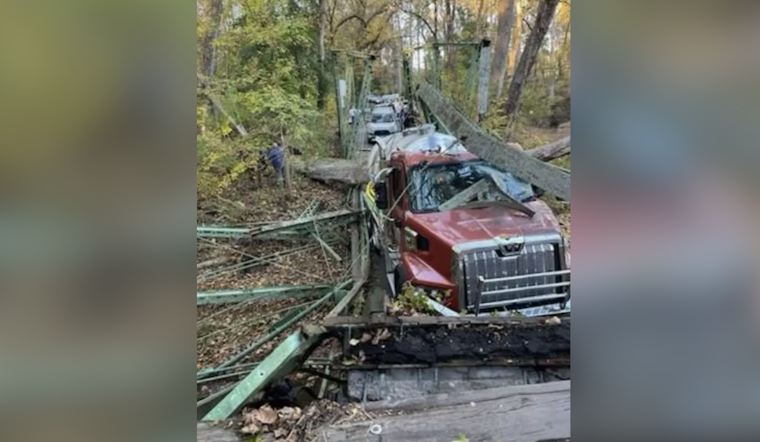
Ten months after the Carroll Road Bridge crumbled into Carroll Branch under the weight of a septic truck, residents of Phoenix, Maryland, are still driving miles out of their way, and they are running out of patience with the county's timeline to fix it. Baltimore County officials say a permanent replacement could take up to four years to design and build. Some neighbors fear it could stretch to six.
Peter Bell, a local resident frustrated by the estimated rebuild timeline, wants the county to consider a stopgap measure rather than make the community wait out the full process. He has floated the idea of installing a modular bridge that could carry traffic for five or six years while the permanent, two-lane span is designed and constructed, according to WMAR 2 News. Bell noted the original 90-to-100-foot single-lane structure's replacement could realistically take as long as six years, not the four the county has projected.
The bridge, a 145-year-old pin-connected metal Pratt through-truss span built in 1879 by Gilbert & Nelson of Chambersburg, Pennsylvania, was one of Maryland's few remaining 19th-century iron truss bridges before it went down, according to HistoricBridges.org. It carried an average of more than 2,500 vehicles and 120 heavy trucks daily before the collapse, more than triple its traffic volume from two decades earlier, as regional growth around Phoenix piled pressure onto the aging single-lane crossing, per CBS News.
What Actually Brought the Bridge Down
The bridge collapsed under a septic truck in October 2025, and Baltimore County Police determined the driver committed no traffic violations, having operated well under the span's posted 51,000-pound weight limit. County public works officials later determined that a large, leaning tree fell across the metal truss structure immediately before or during the truck's crossing, significantly weakening it before it gave way, with fire officials retracting an earlier account that blamed the truck alone, WBAL Baltimore News reports.
Public records already showed cause for concern. In December 2023, inspectors downgraded the bridge's condition rating from satisfactory to fair, documenting decaying timber and loose bolts, though county officials at the time said the defects did not require emergency repairs, per the same WBAL account. Baltimore County maintains roughly 717 bridge structures in its road system, 85 of which are at least a century old, and federal mandates require full safety inspections every two years for public bridges longer than 20 feet.
County Says Federal Rules Dictate the Pace
Ron Snyder, a Baltimore County Department of Public Works spokesperson, acknowledged that the extended and unexpected closure is inconvenient and asked the community for patience during the replacement process. The department has said the work is intended to be completed expeditiously and safely, and estimates the design-and-construction timeline at four years, funded in part by the federal government.
In an August public notice, the Baltimore County Department of Public Works and Transportation said the 48-month timeline stems from mandatory environmental permitting, design work, and regulatory review that federally funded bridge replacements must satisfy. The project remains in the design phase, and the eventual replacement is planned as a two-lane bridge, an upgrade from the single-lane span that failed.
Town Hall Set to Confront the Delay
Councilman Nino Mangione, who represents the affected area, is scheduling a town hall for 6 p.m. on September 2 at Roseda Farms, saying it will bring county officials, agencies, and affected residents together to get answers. The Manor Conservancy co-announced the gathering to address growing community concerns over emergency vehicle access and prolonged detour delays.
Local business managers and farm owners say the long closure has already cut into customer traffic at the Roseda Black Angus Farm store and forced nearby equestrian farms into extended detours, according to WBAL. Northern Baltimore County neighbors remain impatient, with the looming town hall shaping up as a direct confrontation between residents demanding faster action and a county bound by federal process. Hoodline first reported on the collapse last October.





