

























































Pinellas County health officials confirmed two locally acquired cases of dengue fever this week, adding the county to a growing list of Tampa Bay communities grappling with mosquito-borne illness after a summer of heavy rain. The cases mark a new front in a season that has already stretched vector control teams across the region, with fogging trucks, aerial larviciding, and ground inspections underway to knock down mosquito populations before more people get sick.
The confirmation, first reported by the Tampa Free Press, comes just days after neighboring Hillsborough County confirmed its own second locally acquired dengue case of the summer on August 5, following an initial case in late July, according to the Tampa Bay Times. That report noted the surge is tied to a dramatic jump in mosquito populations, with trap collections in Hillsborough County rocketing from 142 mosquitoes in a single trap in June to roughly 18,000 mosquitoes in mid-July following summer rainstorms. Hillsborough officials responded with multiple rounds of aerial and truck insecticide treatments, the newspaper reported.
The Florida Department of Health in Pinellas County said it is coordinating dengue surveillance and prevention measures with Pinellas County Mosquito Control, which participates in the broader effort to track and contain the virus locally. In response to the new cases, vector control teams increased truck fogging, conducted aerial larviciding, and carried out targeted ground inspections to find and eliminate potential mosquito breeding sites.
Warning Signs Came Before the Diagnoses
Pinellas County Mosquito Control had already flagged rising risk days earlier. On August 7, the agency issued a public advisory warning that mosquito-borne virus transmission had increased locally following heavy summer rains, per Pinellas County Government. That warning arrived before the two human dengue cases were confirmed, underscoring how vector control officials detected the elevated threat ahead of the diagnoses.
The timing fits a pattern playing out statewide. Before Pinellas County's cases were confirmed, Florida health officials had already recorded at least three locally acquired dengue cases this summer in Hillsborough, Palm Beach, and Miami-Dade counties, according to WUSF. South Florida county health departments issued their own mosquito-borne illness alerts in early August, a trend Hoodline covered in its report on dengue alerts rattling Palm Beach and Miami-Dade.
Why Rain Triggers a Mosquito Boom
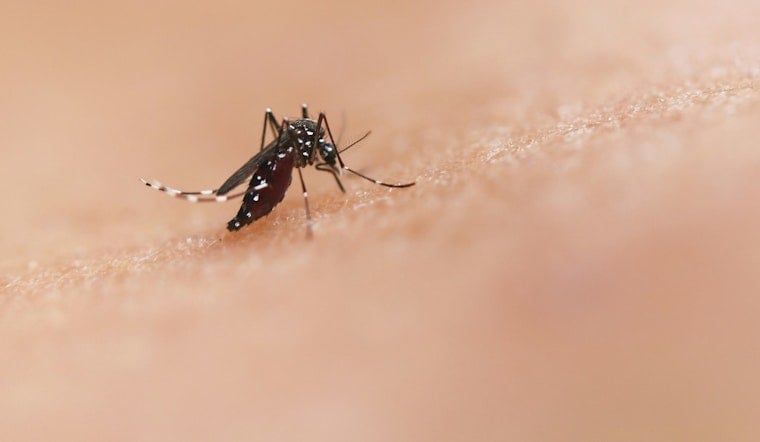
The biology behind the sudden spike traces back to the mosquitoes themselves. Female Aedes aegypti mosquitoes, the primary vector for dengue, lay eggs that can remain dormant in dry soil or containers for up to eight months until rain triggers hatching, WUSF reported, citing expert research on the species. That means a single heavy rain event can awaken a season's worth of dormant eggs almost simultaneously, feeding the kind of population explosion seen in Hillsborough's trap counts.
Infected Aedes aegypti mosquitoes transmit dengue through their bites, and unlike many native mosquito species that feed mostly at dusk or overnight, Aedes aegypti and Aedes albopictus mosquitoes bite during daylight hours. That daytime activity means routine outdoor chores and errands carry real exposure risk, not just evening hours in the yard.
Florida's Recurring Dengue Problem
Pinellas County's cases land within a state that has repeatedly led the continental United States in dengue activity. Florida recorded 91 locally acquired cases across 10 counties in 2024, along with more than 1,000 travel-associated infections, with Miami-Dade County leading the state that year at 50 local cases, according to Outbreak News Today. In 2025, the state recorded 62 locally acquired cases, but the geography shifted: Brevard County accounted for more than half of them with 35 cases, while Miami-Dade recorded 25, marking the first time a Central Florida county led the state in local transmission.
Pinellas County Mosquito Control monitors disease risk across all 24 local municipalities using 58 designated mosquito trap sites and eight sentinel chicken coops, which are tested weekly by state health labs, according to Pinellas County Government. The sentinel chickens serve as an early warning system, flagging when viruses begin circulating in wild bird populations before they spread more widely. That surveillance network sits alongside newer technology already deployed next door — in 2025, Hillsborough County Mosquito Management partnered with the University of South Florida to deploy AI-enabled smart traps and drone mapping aimed at identifying breeding hot spots like discarded tires, a program Hoodline detailed last year.
What Dengue Looks Like and How to Avoid It
Dengue is a viral illness, and symptoms typically develop within 15 days of an infected mosquito bite. Health authorities note the illness generally does not cause respiratory symptoms, but it can bring high fever, severe muscle and joint pain, and sometimes a rash. Dengue does not spread directly from person to person — it requires an infected mosquito to bite and transmit the virus.
Health authorities are urging residents to eliminate standing water around their homes, including in buckets, flowerpots, pool covers, and trash cans, since these are common breeding sites for Aedes aegypti. Officials also recommend fixing broken screens on doors and windows, wearing loose long-sleeved clothing outdoors, and applying EPA-registered insect repellents to skin and clothing. Residents who suspect dengue symptoms are advised to contact a healthcare provider.
DOH-Pinellas maintains ongoing surveillance for vector-borne pathogens across Florida, which also includes tracking for West Nile virus, chikungunya, malaria, St. Louis encephalitis, and Eastern equine encephalitis. It remains unclear which specific neighborhoods within Pinellas County the two dengue cases originated from, whether the two patients are connected in any way, or which serotype of the dengue virus was identified — questions that remain open as investigators continue their work.




