

























































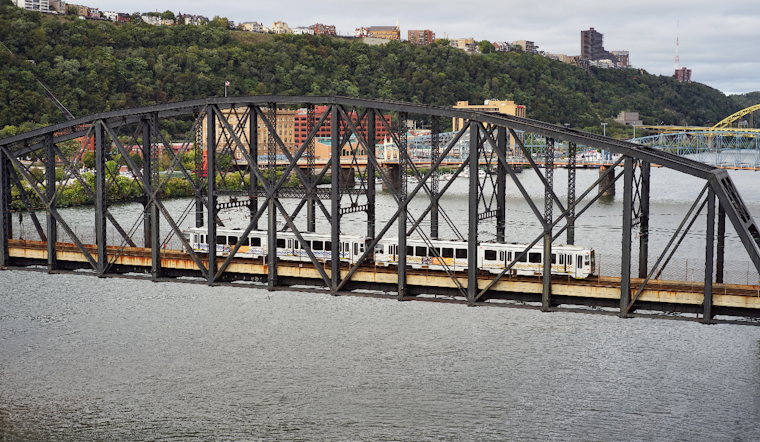
Crews have started wrapping the Panhandle Bridge in protective containment, the first visible step in a $58 million rehabilitation of the 124-year-old span that carries South Hills light rail trains across the Monongahela River into Downtown Pittsburgh. The bridge, built in 1902 and converted from heavy rail to light rail in 1984, is the sole transit connection linking South Hills Junction to the First Avenue and Station Square stations, meaning there will be no alternative light rail route for commuters once major construction begins.
According to WPXI, the containment being installed now will support painting, electrical work, and concrete substructure repairs before the bulk of construction begins. Transit officials told the station that this preparatory phase will not disrupt current light rail service. However, riders should expect the picture to change considerably once major work starts in spring 2027. At that point, rail service will be single-tracked between South Hills Junction and First Avenue, and the bridge will see weekend closures, with bus and rail detours expected throughout construction.
Why Pittsburgh Regional Transit Chose Rehab Over Replacement
The Panhandle Bridge has carried a “fair condition” inspection rating — one notch above poor — since 2004, and it hasn't had a major overhaul since its conversion for transit use more than four decades ago, according to the Pittsburgh Union Progress. That aging rating is a key reason transit officials opted for rehabilitation instead of a full replacement, which they feared could exceed $100 million. The project scope, as outlined by Pittsburgh Regional Transit, spans steel and concrete repairs, stone masonry pier rehabilitation, replacement of overhead catenary power lines, new bridge bearings and deck joints, and new dynamic decorative lighting, alongside the painting work WPXI reported.
The bridge's history stretches back well before its transit era. The Port Authority of Allegheny County, the predecessor to Pittsburgh Regional Transit, purchased the span and its adjacent Downtown tunnel from Conrail in 1980 for $8.15 million, converting what had originally been a heavy freight and passenger rail crossing into a corridor for the region's light rail network, per the Pittsburgh Union Progress.
A Logistically Complex Crossing
Because the Panhandle Bridge spans not just the Monongahela River but also two active commercial freight lines, city streets, Parkway East (I-376), and the Great Allegheny Passage Trail, construction requires coordination across a wide range of agencies. Per Pittsburgh Regional Transit's project materials, that oversight includes PennDOT, the U.S. Coast Guard, the U.S. Army Corps of Engineers, CSX and Norfolk Southern — a logistical web that goes well beyond a typical bridge repair.
Engineering design for the rehabilitation was completed by GAI Consultants' Pennsylvania Structures team, the same group that handles routine and emergency bridge inspections across the transit agency's rail network, according to GAI Consultants. Pittsburgh Regional Transit's board authorized awarding the construction contract to Pittsburgh-based Mosites Construction Company in March, after receiving three public bids and determining Mosites was the lowest responsive bidder.
Construction Timeline and Rider Impact
The rehabilitation work is expected to take 32 months to complete once it begins in spring 2027, according to WPXI. Major construction will unfold in two main phases, with Phase 1 running from January through December 2027 focused on the outbound trackway and bridge structure while single-track light rail operations continue, per Pittsburgh Regional Transit. Officials aim for the finished project to extend the bridge's useful life while maintaining light rail service into Downtown Pittsburgh.
The Panhandle Bridge project is part of a larger $150 million, five-year system-wide track and infrastructure rehabilitation program running across the light rail network from 2024 through 2028, the Pittsburgh Union Progress reported in 2024. That broader effort has already included other South Hills line closures, underscoring that this bridge project is one piece of a sustained maintenance push rather than an isolated fix.
Fiscal Pressures Shape Capital Priorities
The bridge work is also unfolding against a backdrop of financial strain at the transit agency. To help cover operating expenses, Pittsburgh Regional Transit shifted $106.7 million in capital funds toward its operating budget across two years, according to the Pittsburgh Post-Gazette. The agency retained roughly $85 million for service-critical capital work, a category that includes the Panhandle Bridge rehabilitation, illustrating how officials are trying to protect essential infrastructure projects even as budgets tighten elsewhere.
For now, the visible work remains limited to containment installation around the bridge, setting the stage for the heavier construction to come. Exactly how weekend closures and detours will be scheduled once major work begins next year has not yet been detailed, leaving South Hills commuters to watch for further updates from the transit agency as the project timeline advances.





