

























































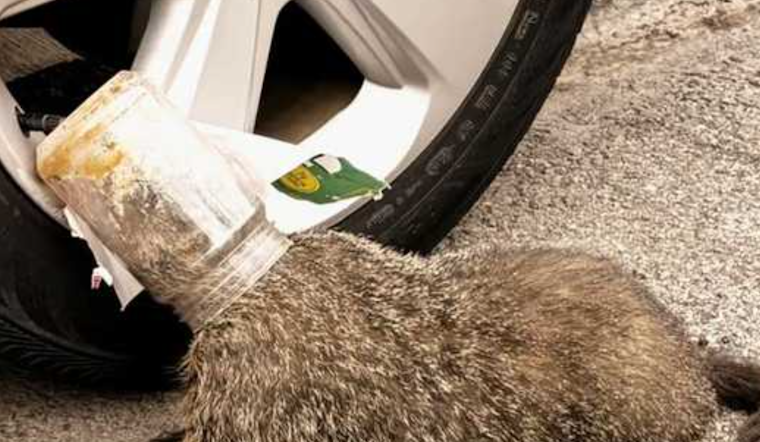
A groundhog wandering around Pittsburgh with a plastic jar stuck on its head got an unexpected rescue Tuesday, after two Animal Care & Control officers spotted the critter in what officials described as a bit of a tight spot. The officers freed the animal, which then went on its merry way.
Pittsburgh Public Safety officials said Animal Care & Control officers Ray Kranak and Charles Simpson came across the groundhog with the object stuck on its head, according to a Facebook post cited by WTAE. Officials praised the officers for keeping local wildlife safe, and the station reported that the rescue on scene was completed seamlessly.
A Familiar Job for City Officers
This wasn't the first time Pittsburgh officials have had to free a critter from a plastic container. In July 2022, homicide detectives Bobby Shaw and Eddie Fallert used tools from police headquarters to free a raccoon that had gotten its head stuck inside a plastic jar on the city's North Side, according to a Pittsburgh Bureau of Police video.
Pittsburgh's Animal Care and Control officers, which operate under the Department of Public Safety following a 2010 municipal code amendment, regularly handle unusual wildlife calls beyond typical stray-animal duties. The agency's officers have used ropes and ladders to retrieve a stranded dog from a Wabash Tunnel cliffside and hand-captured a 3-foot alligator at South Side Riverfront Park, according to CBS Pittsburgh.
Why Officers, Not Bystanders, Had to Step In
Groundhogs are classified by the Pennsylvania Game Commission as a rabies vector species alongside raccoons, skunks, foxes, bats, and coyotes, meaning they carry an elevated risk of rabies transmission and require specialized handling during rescue calls, according to the Pennsylvania Game Commission. Under state health guidelines, if an untrained person is bitten or scratched while attempting to handle a rabies vector species like a groundhog, the animal must be euthanized and tested for rabies, according to Wildlife In Need Emergency Response of Pennsylvania.
That risk is part of why trained officers, rather than curious bystanders, are the ones expected to intervene when a wild animal turns up in obvious distress. Discarded plastic food containers, especially peanut butter and mayonnaise jars, act as common traps for foraging groundhogs because the animals force their heads inside to reach food scraps but cannot back out due to their backward-pointing fur and wide cheek structures, according to the West Shore Wildlife Center.
Where Rescued Wildlife Goes Next
Similar entrapments have turned up elsewhere in Pennsylvania. In August 2024, the state Game Commission worked with vending technicians to unlock a claw machine at a Duncansville mini-golf course to free a live groundhog trapped inside, a rescue Hoodline previously covered.
For animals that need further care after a rescue, the Humane Animal Rescue of Pittsburgh operates Pennsylvania's second-largest wildlife rehabilitation hospital out of Penn Hills, treating more than 4,200 injured, orphaned, or displaced wild animals across 130 native species each year, according to TribLIVE. While the organization's Wildlife Rehabilitation Center temporarily paused summer intakes of high-risk vector species like raccoons, foxes, and skunks due to high patient volume, groundhogs have remained among the accepted species for ongoing intake and treatment.
City residents dealing with groundhog burrows or other pest problems on private property can request help through the Pittsburgh Public Safety Department's free Rodent Baiting Program, available up to twice a year per residential address through the city's 311 service line.


