

























































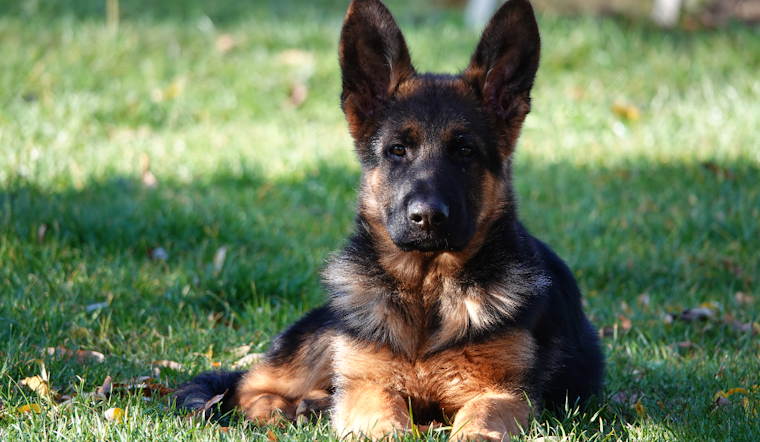
Debbie Ritchey spent more than 20 years largely confined to her home, unable to hold down a job as she struggled with post-traumatic stress disorder from her service in the Gulf War. Then came Buddy, a German shepherd trained to sense her anxiety before it spirals and to stay within six feet of her at all times. Ritchey now calls him her hero.
A Veteran's Two Decades of Isolation
Ritchey, a U.S. Army veteran, told CBS Pittsburgh that her PTSD kept her isolated for over 20 years and prevented her from working during that time. Buddy is trained to detect when she feels anxious, and he wakes her during nightmares — tasks designed to interrupt the kind of episodes that once kept her homebound. Ritchey said Buddy is her hero as a veteran living with PTSD, according to the station's report.
Buddy came to her through Life Changing Service Dogs for Veterans, a Pittsburgh nonprofit that raises money to buy service dogs for military veterans and pairs them with recipients across the region. Per the same account, the organization has funded more than 55 veterans with 55 dogs to date. William “Bill” Jeffcoat, a military veteran who serves as the nonprofit's president, has his own story: he has said his dog Fraulein gave him a reason to live.
Why Service Dogs Matter for Invisible Wounds
Service dogs like Buddy are trained to mitigate both visible and invisible disabilities facing veterans, assisting with conditions ranging from PTSD and traumatic brain injury to mobility issues and seizure disorders. The stakes behind that mission are steep — a veterans association report found that 22 veterans died by suicide every day, a 2012 figure that has long driven advocacy for expanded mental health support among former service members.
Clinical research has since given that advocacy scientific backing. Purdue University research cited in reporting from K9s for Warriors found that veterans paired with trained service dogs experienced statistically significant reductions in PTSD symptom severity, along with lower cortisol levels and decreased suicidal ideation. Those findings helped shift federal policy, which for years had largely limited Department of Veterans Affairs support to physical disabilities like vision or mobility impairments rather than mental health conditions.
A $25 Million Campus Taking Shape Nearby
Life Changing Service Dogs for Veterans was founded in 2015 by Vietnam War veterans Anthony “Tony” Accamando and George D'Angelo, according to the organization's own account, after the pair was moved by veteran suicide statistics highlighted in the documentary Project 22. They launched a campaign to pair 22 veterans with service dogs in 22 months, raising more than $1.3 million in that initial push. The nonprofit says it has since raised over $1.9 million as an all-volunteer 501(c)(3), ensuring that 100% of funds raised for service dogs or campus facilities go directly to those causes rather than executive salaries.
That fundraising is feeding a much larger infrastructure project just west of the city. In November 2023, Guardian Angels Medical Service Dogs broke ground on a $25 million, 102-acre training campus in Robinson Township, Washington County, according to the Observer-Reporter. The 12-building facility, built in partnership with Life Changing Service Dogs for Veterans, is designed to serve as a regional headquarters for the northeastern United States and will include recipient housing, training centers, and a veterinary hospital.
The Cost of Training a Single Dog
Raising and task-training a single medical service dog takes 18 to 24 months and costs approximately $25,000, according to reporting from Highmark Health, even though the dogs themselves are provided to veteran recipients at no cost. Nationally, that price tag can climb even higher — Hoodline has reported that specialized medical service dogs can require up to two years of training and cost as much as $40,000 across different nonprofits, a bottleneck that regional campuses like the one in Washington County aim to ease.
Covering that gap falls largely to community fundraising. TribLIVE reported in February 2025 that local institutions across Southwestern Pennsylvania, including Divine Mercy Academy in Monroeville, run grassroots “Dollars for Dogs” campaigns — car cruises, school drives, and similar events — to help sponsor individual pairings and offset the $25,000 per-dog cost. Life Changing Service Dogs for Veterans continues to seek both volunteers and donations to keep pace with demand.
A Track Record Regional Leaders Point To
Local advocates frequently cite one striking statistic when making the case for continued support: among the more than 400 service dogs Guardian Angels Medical Service Dogs has placed nationwide since 2010, zero veteran recipients have died by suicide, according to WPXI. That figure stands in sharp contrast to the daily veteran suicide toll that first motivated the nonprofit's founders a decade earlier.
Congress Weighs In on Wait Times
The gap between demand and available dogs has also drawn federal attention. The 2021 PAWS for Veterans Therapy Act required the VA to launch a five-year pilot program offering service dog training therapy to veterans diagnosed with PTSD, expanding eligibility beyond the physical disabilities the agency had traditionally covered. In April 2025, Senators Thom Tillis and Richard Blumenthal introduced the bipartisan SAVES Act, which Hoodline previously reported would expand federal grants and streamline access for nonprofit service dog providers, building on the PAWS Act to help shrink long waiting lists for accredited dogs.
For Ritchey, the policy debates are secondary to what Buddy has already done for her daily life. After two decades of isolation, she now has a companion trained to notice the anxiety she cannot always name herself — and to be there, within six feet, when it hits.


.jpg)