

























































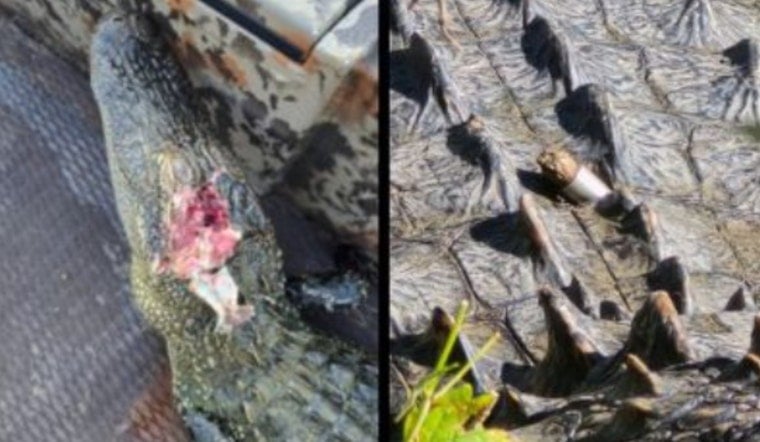
Someone shot three alligators with what appears to be a crossbow at the Fort Worth Nature Center & Refuge sometime between May and July, killing two of the reptiles and leaving a third wounded. The carcasses of the two dead alligators were abandoned and left to waste on the Lake Worth preserve, according to the Texas Parks & Wildlife Department, which announced a reward for information on Friday.
The department says at least one of the animals was shot with a crossbow bolt, a detail investigators believe points to intentional targeting rather than an accident, as reported by CBS Texas. Operation Game Thief, the state's anti-poaching tip program, is offering up to $1,000 for information leading to a conviction in the case. The nonprofit was established by the Texas Legislature in 1981 and operates alongside TPWD game wardens, and it has distributed more than $110,000 in rewards and $300,000 in equipment grants over the past decade, according to Operation Game Thief.
Authorities are now asking the public for help identifying who illegally shot the three alligators. Anyone with information can call 1-800-792-GAME, text TXOGT to 847411, or submit a tip online through TPWD's Warden Connect system.
A Protected, Native Population on the Metroplex's Edge
The shootings struck at a wetland refuge that researchers consider ecologically significant. As of August 2025, researchers at the Fort Worth Nature Center & Refuge estimated that roughly 70 to 100 American alligators live on the property, supported by at least eight active nesting sites spread across 1,000 acres of wetlands. That population sits within a much larger preserve: the refuge was designated a wildlife sanctuary in 1964 on land surrounding Upper Lake Worth that the city first acquired in 1914 for watershed protection, and it now spans 3,621 acres, making it one of the largest city-owned nature preserves in the country, according to the Friends of the Fort Worth Nature Center.
Despite persistent local rumors that the Dallas-Fort Worth area's alligators are dumped pets, historical records maintained by nature center naturalists confirm the animals are native to the West Fork Trinity River watershed, with documented sightings in the area dating back to 1849, per KERA News. A 2026 collaborative research study between the nature center and the University of North Texas found that these alligators represent the westernmost fringe of the species' entire geographic range, persisting despite urban expansion, heavy human proximity, and severe winter freezes.
Why Shooting a Gator Here Is a Clear-Cut Crime
Tarrant County's regulatory status makes the legal violation unambiguous. Under Texas Parks & Wildlife Department rules, the county is classified as a non-core alligator county, meaning hunting alligators on public land or in public waters is prohibited year-round, while legal hunting on private property is restricted to a narrow window from April 1 through June 30. Because the nature center is city-owned public land, none of the killings could have been legal regardless of when they happened.
Under Chapter 65 of the Texas Parks and Wildlife Code, taking or attempting to take an alligator without a valid permit or tag is a Class C misdemeanor for a first offense, while a separate provision in Chapter 62 makes the intentional waste of game, including failing to retrieve wounded wildlife, its own punishable violation. Leaving the two carcasses behind, as investigators say happened here, could expose whoever is responsible to charges under both statutes.
Part of a Wider Pattern of Illegal Gator Encounters
The shootings add to a string of recent run-ins between humans and Tarrant County's alligator population. In April, Hoodline reported that TPWD game wardens cited an angler on nearby Lake Arlington after he hooked a live alligator that March, hauled it onto his boat, and fed it during a two-hour social media livestream. The same report noted that state wildlife officials had to remove and relocate a 10.7-foot alligator from Eagle Mountain Lake in August 2025 after it raised public safety concerns near recreational boating areas.
State guidelines separately prohibit intentionally feeding, taunting, or harassing wild alligators in public waters, a Class C misdemeanor punishable by fines up to $500, and instruct visitors to stay at least 30 feet away from basking reptiles. Investigators now face the task of identifying a suspect across the refuge's 3,621 acres, a search that depends heavily on tips from the public rather than physical evidence at the scene.





