

























































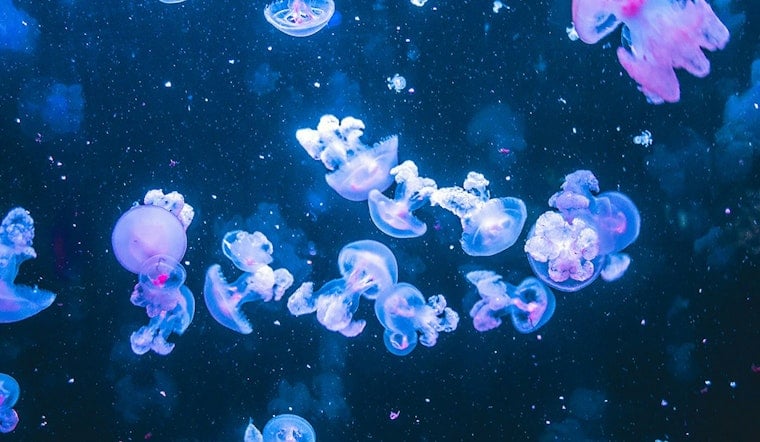
A vacant bank branch across from the Pompano Beach Pier has become something Broward County has never seen before: a museum devoted entirely to jellyfish. The Jellyfish Museum, which opened in spring 2026 inside a former Wells Fargo building at 199 N. Ocean Boulevard, is believed to be the first private museum in the United States dedicated solely to the drifting, stinging creatures, according to seed facts drawn from reporting by David Fischer.
The nearly 10,000-square-foot space — about 900 square meters spread across two stories with 20-foot ceilings — was built out for an estimated $1.4 million, according to MySA. The Pompano Beach Community Redevelopment Agency chipped in $100,547 through its Strategic Investment Program, a matching-grant tool designed to spur commercial renovation inside the city's designated East CRA District, according to the City of Pompano Beach. The 1980-built branch had sat empty since Wells Fargo shuttered it in 2024 as part of a round of South Florida branch consolidations, per Coldwell Banker property records.
From War-Torn Ukraine to a Florida Oceanfront
The museum was created by Alex and Yana Yanovsky, who fled Ukraine after the 2022 Russian invasion and later moved to Florida, per the seed facts. Before the war, the couple had built a career designing major aquatic attractions across Ukraine, including their first jellyfish museum in Kyiv and Ukraine's highest aquarium inside a Lviv restaurant called 36Po, according to background compiled by TURY.club. The Pompano Beach museum is the Yanovskys' first aquatic attraction since immigrating to the United States, and they have said they plan to expand it further.
Yana Yanovsky has said jellyfish are among Earth's most resilient creatures, and she conceived of the museum after watching how popular jellyfish displays became at the couple's other aquariums. General manager Iryna Pelypkanych has said the goal is for visitors to leave knowing more about jellyfish populations, with museum guides teaching both the animals' role in marine ecosystems and the importance of protecting them.
Twenty Species, Twenty-One Tanks
Inside, roughly 20 unique jellyfish species rotate through 21 specialized tanks, including moon jellyfish, Japanese sea nettles, spotted jellies and Florida's own upside-down jellyfish. The animals are acquired through licensed aquaculture partners rather than taken from the wild. Keeping soft-bodied jellyfish alive on display requires circular tanks called kreisels, first invented in the late 1960s to generate the gentle, continuous water flow needed to keep fragile invertebrates suspended without being drawn into filter intakes or pinned in corners, according to Quality Marine.
That engineering challenge is why jellyfish exhibits took decades to catch on. The Monterey Bay Aquarium began displaying jellyfish in temporary exhibits in 1985 and later opened a permanent jellies gallery in 1996 inside its $57 million Open Sea wing, part of a broader trajectory documented in the aquarium's own historical materials. Jellyfish themselves have a simple nerve net rather than a heart or brain, are made up primarily of water, and belong to a family of roughly 4,000 species that predate both dinosaurs and trees, having survived more than 500 million years and five mass extinction events, according to background from the World Economic Forum.
A Native Species With a Local Twist
Among the exhibit's residents is Florida's native upside-down jellyfish, Cassiopea xamachana, which is found in the state's mangrove swamps. Rather than swimming freely, the species lies inverted on shallow mangrove seafloors to expose the photosynthetic algae living in its tentacles to sunlight, receiving carbohydrates in return, according to the Key West Aquarium. Researchers at Tohoku University discovered in 2020 that these jellyfish also release microscopic floating structures called cassiosomes that fire stinging cells remotely, a finding that helped explain the long-reported phenomenon of Florida Keys swimmers feeling stings without ever touching a jellyfish, as reported by Popular Science at the time.
Monty Graham, director of the Smithsonian Environmental Research Center, is cited among outside experts weighing in on the species featured at the museum. Scientists have also pointed to a broader ecological shift underway in the world's oceans: as marine heatwaves and nutrient runoff disrupt habitats favored by fish, jellyfish are proving unusually resilient in warm, low-oxygen water, a pattern tied to a global rise in jellyfish bloom frequency, per the World Economic Forum's earlier reporting.
Practical Details for Visitors
Regular adult admission runs $23, with a discounted $21 rate for Florida residents and free entry for children under three, according to coverage from The Broward Scene around the museum's official March 27 grand opening. The museum sits within Pompano Beach's East CRA District, a redevelopment corridor where the city has used tax-increment financing to draw new commercial investment to the beach corridor near the pier, according to the City of Pompano Beach.





