

























































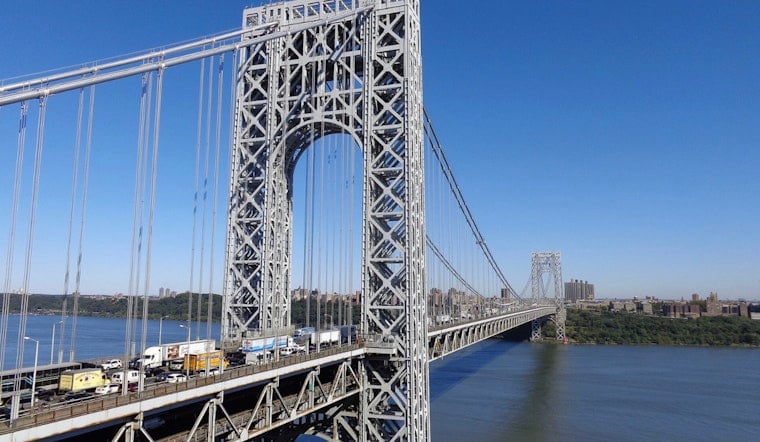
A 24-inch steel truck leaf spring came crashing through Joseph Rosario's windshield as he drove west across the George Washington Bridge's upper level on March 2, 2020, fracturing his skull and leaving him comatose for weeks. More than six years later, the Port Authority of New York and New Jersey has agreed to pay him $10.5 million to settle the case, closing it just three days before it was set to go to trial.
Rosario, then 28 years old, was struck at approximately 10:42 a.m. as he headed toward New Jersey, according to Law Commentary. The leaf spring, a steel component from a truck's suspension system, pierced the windshield of his 2015 Chrysler 200 and landed in the rear passenger seat after fracturing his skull, according to Sing Tao Daily. He was rushed to Hackensack Meridian Health Hackensack University Medical Center for emergency brain surgery and spent weeks in a coma before surviving with permanent brain injuries; he now requires full-time care from his parents and uses a wheelchair.
A Settlement Reached Days Before Trial
The $10.5 million settlement was formally executed on May 8, 2026, exactly three days before a jury trial was scheduled to begin in New Jersey Superior Court, according to Infobae. Two construction companies working on the bridge at the time of the crash, Skanska Koch Inc. and El Sol Contracting, each settled separately for undisclosed amounts, the report notes. Rosario's lawsuit claimed the traumatic brain injury caused lasting cognitive and physical disabilities, disfigurement and loss of bodily function.
Rosario's attorney, Edward Capozzi, built the civil case around the legal concept of constructive notice, which under New Jersey civil negligence law depends on how long a hazard was present and whether similar problems had occurred before. Capozzi said available footage showed the object had been sitting on the roadway for at least 10 minutes and 49 seconds before the crash, and investigation video appeared to show an object consistent with the leaf spring already lying in the roadway beforehand. Civil negligence does not require proof that anyone intended to cause harm or committed a crime — only that a dangerous condition existed and that the agency knew or should have known about it.
Records Showed the Bridge Went Unswept for Five Days
Plaintiff's counsel revealed during litigation that despite Port Authority maintenance protocols mandating daily roadway sweeping, bridge records showed the crossing had gone unswept for five consecutive days prior to the crash. No regular daytime sweep was conducted around the time Rosario was injured, and the upper level of the bridge, where he was struck, experienced more debris than the lower level even though it was supposed to be swept at the same frequency. Bridge logs did show that crews typically swept the roadway several times a week, and the Port Authority has said its cleaning trucks remove debris, clear clogged basins, conduct regular roadway surveys, and sweep the bridge in both directions, with crews removing enough material to fill multiple dump trucks.
Capozzi claimed that Port Authority workers repeatedly entered only broad descriptions into the agency's software when logging collected debris, failing to record each object and exactly where it was found. That incomplete record-keeping, his team argued, limited the agency's own ability to identify areas with recurring debris problems. The Port Authority has not detailed whether its sweeping or record-keeping practices changed after Rosario was injured, leaving that question unresolved.
A Dozen Prior Debris Strikes Cited as Evidence
Court filings submitted by Rosario's legal team documented at least 12 prior instances of vehicles being struck by roadway debris on the George Washington Bridge, which attorneys used to argue the hazard was a recurring problem rather than an isolated anomaly, per Sing Tao Daily. Rosario's lawyers argued that video evidence, earlier debris crashes and maintenance records together gave the Port Authority enough warning to find and remove the leaf spring before it caused harm. Capozzi noted on The Domino Lawyer Podcast that during the exact week in May 2026 when Rosario's trial was originally set to begin, two additional roadway debris incidents occurred on the same bridge.
Before the personal injury case was resolved, Rosario had already fought — and won — a separate legal battle just to obtain the Port Authority's internal crash and maintenance records. He sued the agency in New Jersey Superior Court under the Open Public Records Act in 2020, and an appellate panel affirmed the order compelling disclosure in July 2021, awarding him $11,164.70 in legal fees. Police investigators reviewed surveillance footage, interviewed witnesses and inspected several trucks traveling near Rosario at the time, but found no evidence linking the leaf spring to the vehicles examined; the criminal investigation was ultimately closed without determining where the debris came from, and police concluded the incident appeared accidental.
Debris Concerns Persist on the World's Busiest Bridge
The case unfolded against a backdrop of continued scrutiny over debris and structural hazards on the George Washington Bridge corridor. In May 2026, a concrete slab detached and crashed onto a car on the Trans-Manhattan Expressway approach, an incident Hoodline previously reported prompted emergency Port Authority structural inspections. The bridge is recognized as the world's busiest vehicular crossing, carrying over 100 million vehicles annually between New York and New Jersey, a volume that generates constant roadway wear and elevates the risk of loose commercial truck parts breaking free, according to CRH.
The Port Authority is currently in the midst of a 10-year, $2 billion capital overhaul program called Restoring the George, which includes 11 major construction projects such as replacing all 592 steel suspender ropes and rehabilitating main span structural steel, the agency has said. Whether that broader rehabilitation effort has translated into more frequent sweeping or improved digital record-keeping for roadway debris remains an open question, one the agency has not addressed publicly since the settlement.





