

























































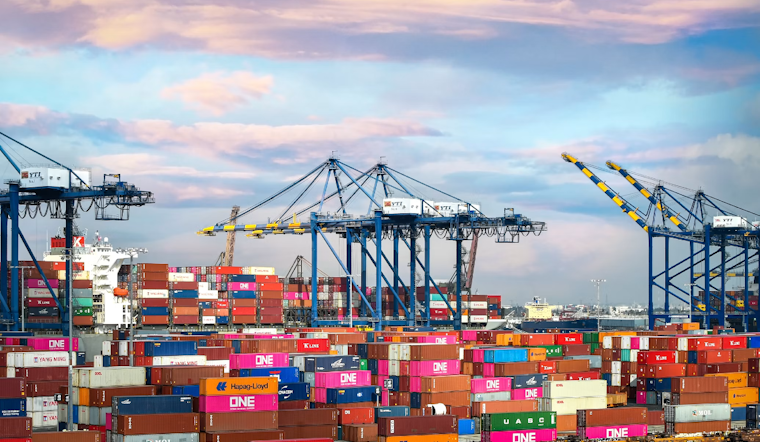
The Los Angeles Board of Harbor Commissioners has approved a 30-year lease with Yusen Terminals, keeping one of the port's longest-tenured operators anchored on Terminal Island through 2056. As part of the deal, Yusen Terminals will invest $200 million in zero-emission cargo-handling equipment, replacing an operating permit that had been set to expire at the end of September.
The 232-acre terminal at Berths 212-224, located north of the Vincent Thomas Bridge along the port's East Basin Channel, has been run by Yusen Terminals since 1991, according to MyNewsLA.com. The company will mark its 35th anniversary at the port later this year, and the new lease replaces Permit No. 692, an agreement originally executed in October 1990 that was scheduled to expire on September 30, 2026. The terminal's footprint has grown considerably since those early agreements, expanding from 185 acres to its current 232 acres.
Port of Los Angeles Executive Director Gene Seroka said the port greatly values its longstanding partnership with Yusen Terminals, per the same MyNewsLA.com report. Yusen Terminals President and CEO Alan McCorkle said the agreement provides long-term certainty for continued investment in the terminal, people and technology, adding that the company will continue building its partnership with the port for decades to come.
A $200 Million Bet on Zero-Emission Cargo Handling
Under the newly approved lease, Yusen Terminals will invest an additional $200 million in zero-emission equipment over the coming years, building on gear that already includes electric top handlers, forklifts and yard tractors. The operator already runs zero-emission and hydrogen fuel-cell equipment on-site and has, according to the report, immediately stepped up to test and incorporate zero-emission machinery as it becomes available.
That spending lines up with a mandatory regional deadline rather than a voluntary gesture. Under the San Pedro Bay Ports Clean Air Action Plan, the Port of Los Angeles and the Port of Long Beach require all marine terminal operators to convert 100% of their cargo-handling equipment to zero emissions by 2030, with drayage trucks facing the same requirement by 2035. Yusen's commitment also builds on public dollars already flowing into the port: the U.S. Environmental Protection Agency awarded the Port of Los Angeles a $412 million Clean Ports grant in October 2024, paired with $234 million in private matching funds from terminal operators including Yusen, according to Port Technology International. That grant is meant to fund nearly 425 pieces of battery-electric cargo equipment and 300 charging stations across the port complex, and Yusen was one of six marine terminal operators named as joint partners in the port's application.
Corporate Ownership and a Decade of Co-Investment
Yusen Terminals is owned by Ocean Network Express, one of the world's largest container shipping companies, which completed its acquisition of a 51% controlling stake in the terminal operator in November 2023. ONE bought the majority interest from Japanese shipping line Nippon Yusen Kabushiki Kaisha, according to Ocean Network Express, which itself was formed in 2017 through the merger of Japan's three primary container shipping lines, NYK, MOL and K Line.
The new lease is also the latest chapter in a longer history of joint infrastructure spending at the terminal. In 2015, the port and Yusen Terminals launched a $135 million upgrade that deepened berths to 53 feet and expanded on-dock rail capacity, allowing the facility to simultaneously service three mega-containerships carrying up to 13,000 TEUs, per FreightWaves. That project also installed four alternative maritime power connections so ships could plug into shore power while docked.
Operational Track Record and Broader Clean-Air Push
Yusen Terminals provides stevedoring, terminal operations and specialized cargo-handling services at the port and participates in multiple port clean air initiatives, alongside what the port describes as strong community partnerships across the harbor area. In November 2025, the operator coordinated with local emergency responders and harbor authorities during a fire aboard the containership Ocean Network Express Henry Hudson, helping contain emissions and restore full terminal operations within 24 hours, according to the Port of Los Angeles. Seroka formally commended Yusen Terminals for that response during his 2026 State of the Port address.
The lease extension arrives as the port keeps racking up record-scale cargo volumes and tightening clean-air rules across the harbor. The Port of Los Angeles handled 10.2 million TEUs of cargo in 2025, its third-busiest year on record, maintaining its rank as North America's busiest container port for 26 consecutive years, according to gCaptain. The San Pedro Bay complex handles roughly 40% of all containerized import cargo entering the United States. Just weeks ago, Ports Face New Clean-Air Deadlines under an updated framework between the South Coast Air Quality Management District and the twin ports, which includes a $40 million regional fund for zero-emission charging and fueling infrastructure and phased completion deadlines for container terminals by December 2027.
Those pollution-reduction efforts have already produced measurable results. Port-related diesel particulate matter emissions fell 90% and sulfur oxides fell 98% between 2005 and 2025 across the San Pedro Bay port complex, according to the Port of Los Angeles, which reports achieving the lowest emissions footprint per container move of any major port worldwide. The port has also launched a $75 million zero-emission drayage truck incentive program, aimed at helping trucking fleets meet the 2035 zero-tailpipe-emission deadline that applies to drayage operations serving the harbor.





