

























































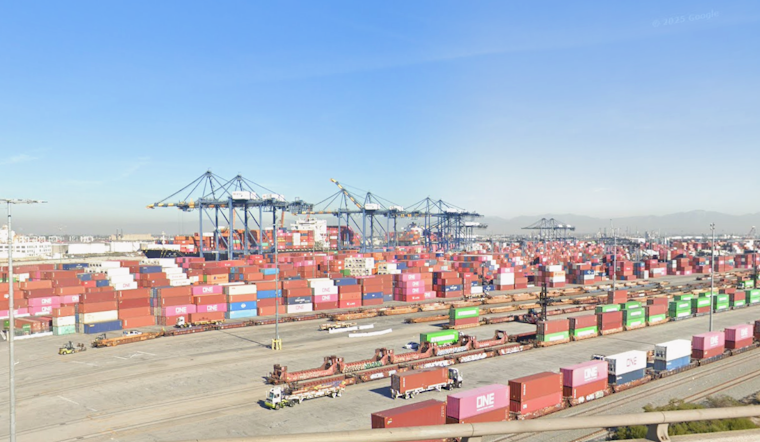
The South Coast Air Quality Management District's Governing Board voted unanimously to approve an addendum expanding its cooperation agreement with the Ports of Long Beach and Los Angeles, adding enforceable deadlines, financial penalties for missed milestones, and $40 million in new funding for regional charging and fueling infrastructure. The vote strengthens a framework that regulators and port officials had built as an alternative to a mandatory rule that once loomed over marine terminal operations across the region.
That original framework traces back to August 2025, when the AQMD's Governing Board voted to pause rulemaking on Proposed Rule 2304, a mandatory Indirect Source Rule that would have directly regulated marine ports, in favor of negotiating a voluntary agreement instead, according to CalMatters. Environmental advocates initially pushed back on that pivot, worried that a voluntary arrangement might lack teeth compared to a binding rule. The AQMD and the ports of Long Beach and Los Angeles ultimately signed the original cooperation agreement in 2025, establishing a framework for advancing zero-emission infrastructure at the twin ports, per MyNewsLA.com.
What the Original Deal Already Covered
That original agreement already committed the ports to zero-emission technologies across trucks, trains, harbor craft, ships, and cargo handling equipment, according to the same report. Under its terms, the ports agreed to complete zero-emission infrastructure plans in three phases: container terminals and drayage trucks by December 2027, non-container equipment and harbor craft by December 2028, and ocean-going vessels by December 2029, per the South Coast AQMD. That phased structure was designed to line up infrastructure buildout with when zero-emission technology actually becomes commercially available.
The newly approved addendum builds directly on that roadmap. It outlines enforceable deadlines and financial consequences for missed milestones, and it requires annual reporting to track progress, along with public meetings and public review of any new programs, MyNewsLA reports. The addendum also creates a zero-emission truck utilization incentive program offering new incentives tied to zero-emission truck visits or activity at the ports, and it establishes an enhanced clean ship incentive program that provides increased rewards for companies operating environmentally friendly vessels.
$40 Million Split Between the Twin Ports
To back those new incentive programs, the addendum includes a $40 million investment in regional charging infrastructure, with the Port of Long Beach and the Port of Los Angeles each contributing $20 million, according to MyNewsLA. The AQMD will manage project selection, funding, and implementation of that charging and fueling infrastructure program. The addendum still requires approval from the boards of harbor commissioners for both ports, which are expected to sign off over the next several weeks, according to the AQMD.
Governing Board member Michael A. Cacciotti framed the vote as a necessary next step rather than a finish line, saying meaningful action is required for a cleaner goods movement future. Port of Long Beach CEO Noel Hacegaba said the addendum will strengthen the port's commitment to cleaner air across the South Coast Air Basin. Officials describe the new commitments as designed to advance clean solutions for the largest port complex in the Western Hemisphere while improving air quality for surrounding communities.
A Track Record the Ports Point To
Port officials have leaned on their pollution-reduction record to make the case that voluntary, incentive-driven partnerships can work. The Port of Los Angeles says it has achieved the lowest pollution footprint per container move since measurements began more than two decades ago. Between 2005 and 2025, voluntary measures under the San Pedro Bay Ports Clean Air Action Plan cut port-related diesel particulate matter by 90%, nitrogen oxides by 68%, and sulfur oxides by 98%, according to the Port of Los Angeles.
Still, the stakes behind the push remain high. Mobile sources tied to port operations and freight logistics represent the single largest regional source of nitrogen oxides and diesel soot in Southern California, creating health risks for nearby communities including Wilmington, San Pedro, and West Long Beach, CalMatters reports. The region also remains under federal pressure: in August 2024, the U.S. Environmental Protection Agency proposed finding that the South Coast Air Basin failed to meet the federal 1997 8-hour ozone standard by its statutory June 2024 deadline, keeping the area's designation as an extreme nonattainment zone, according to the Federal Register.
Bigger Ships, Bigger Cargo Volumes Ahead
The San Pedro Bay ports move approximately 30% of all containerized waterborne freight in the United States and project combined cargo volume to reach 20 million twenty-foot equivalent units annually by 2050, according to the Port of Long Beach. To tackle emissions from ocean-going vessels, historically the largest single contributor to port pollution, Long Beach and Los Angeles established zero-emission green shipping corridors with major Asian trade hubs including Shanghai and Singapore in late 2025.
The addendum's next phase will focus on infrastructure and incentives meant to accelerate zero-emission goods movement more broadly, according to MyNewsLA. That approach builds on other recent state investment in the region: California's Port and Freight Infrastructure Program awarded $383.3 million to the Port of Long Beach in July for its System-Wide Investment in Freight Transport project, Hoodline reported at the time, funding that included an on-dock rail support facility and zero-emission terminal equipment and chargers.





