

























































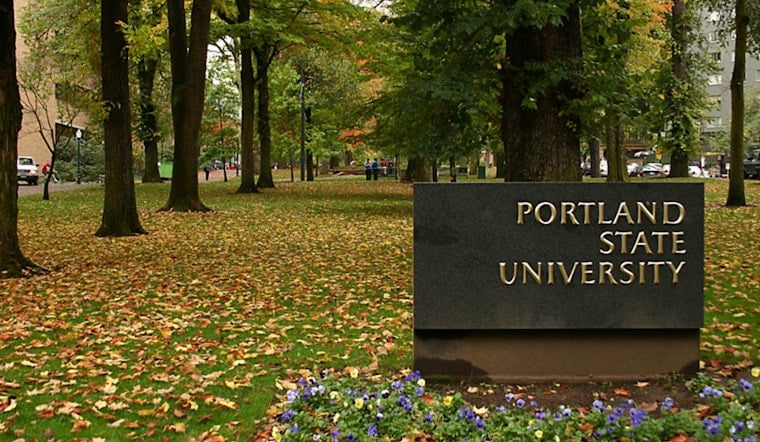
A federal appeals court has revived a lawsuit from a former Portland State University student who says he was suspended and later expelled not for the vulgar language in his anti-vaccine email, but for the political views behind it. Cal Jamison McCollough, now 44 and living in Eugene, sent an email in October 2021 objecting to PSU's COVID-19 vaccine mandate and requesting a waiver, and the university's response to that message has now spent years working through the federal court system.
What the Email Said
According to court filings cited by OregonLive, McCollough told university administrators to “suck his dick” and described the COVID-19 vaccine as the “mark of the beast,” while also claiming his objection to the mandate was rooted in a sincerely held moral and religious belief. The email, sent October 7, 2021, arrived as Portland State was requiring students to receive COVID-19 vaccinations that year. PSU responded by claiming McCollough's profane language and insults disrupted employees' work at the student health and counseling center on October 11, 2021, and the university notified him to appear at a disciplinary proceeding over Zoom that same day.
McCollough submitted a written statement rather than attending the hearing, and during the process he objected to the hearing officer's pronouns. On October 19, 2021, Portland State ordered him to write an essay of at least two pages on making good choices and blocked him from registering for classes. He refused to write the assigned essay, and the case escalated from there — the standoff over the hearing process and the refused assignment ultimately led to his suspension and, later, expulsion.
The Ninth Circuit's Ruling
The 9th U.S. Circuit Court of Appeals found that McCollough plausibly claimed Portland State retaliated against him for constitutionally protected First Amendment speech, and the panel ruled that the university and Provost Susan Jeffords are not entitled to immunity from his allegation. The three-judge panel — Circuit Judges Jacqueline Nguyen, John B. Owens and Kenneth Kiyul Lee — reversed U.S. District Judge Michael H. Simon's dismissal of the case and sent it back to district court for further proceedings. Nguyen and Owens were appointed by former President Barack Obama, while Lee was appointed by President Trump.
The appeals panel ruled that crass and disrespectful political speech may merit First Amendment protection, and it concluded that disciplining McCollough for his anti-vaccine opinions would not be viewpoint-neutral. While universities may regulate speech in nonpublic forums within school settings, any such regulations must be reasonable and viewpoint neutral. The court also rejected the university's contention that McCollough's email disrupted employees' work, and it found that he adequately showed his speech could have been a substantial or motivating factor in the discipline he faced.
A Mixed Ruling for Both Sides
The panel did not side with McCollough on every point. It affirmed the dismissal of his Fourteenth Amendment due process claim, rejecting his argument that the university needed to use a higher evidentiary standard during his disciplinary hearing. Earlier in the case, U.S. Magistrate Judge Jeff Armistead had found that McCollough's First Amendment claim did not reasonably show the school acted with a retaliatory motive, and had concluded that Portland State and its provost were entitled to immunity even if retaliation had occurred — a conclusion the appeals panel has now overturned.
Before the case reached the Ninth Circuit, McCollough — representing himself as a pro se litigant — filed motions in early January 2025 seeking to disqualify both Magistrate Judge Armistead and Judge Simon over alleged bias, challenging Armistead in part over his prior employment with the Oregon Court of Appeals. Judge Simon denied those recusal requests on January 8 and January 13, 2025.
Both Sides React
Attorney Erin M. Burris, representing the university, argued there was no clearly established right to use vulgar language toward a PSU administrator. Portland State officials declined to comment on the pending litigation, but university spokesperson Katy Swordfisk said vigorous debate is valued and protected at Portland State, adding that the school will continue to be a welcoming home for free speech.
McCollough, who is not currently employed and is not enrolled in any school, said he should not have had to go through the process at all. He told reporters his food stamps recently ran out, and he plans to continue pursuing his case against Portland State University in court.
A University Under Financial Strain
The lawsuit's revival lands at a difficult moment for Portland State, which has been grappling with a steep enrollment decline and budget crisis. State higher education data shows the university's headcount dropped 24% from roughly 26,020 students in fall 2019 to 19,697 in fall 2025, contributing to a $35 million budget shortfall. That crunch led administrators in March to put 19 academic departments under review for major cuts or elimination under the school's “Bridge to the Future 2.0” restructuring initiative.
What Happens Next
On remand, the district court must now evaluate whether Portland State qualifies for sovereign immunity as an arm of the state under the Ninth Circuit's Kohn v. State Bar of California framework, which weighs factors including state control and treasury impact. That question places McCollough's case within a broader regional reassessment of how Pacific Northwest public universities can invoke Eleventh Amendment immunity in pandemic-mandate lawsuits, an issue the Ninth Circuit also confronted in an August ruling involving the University of Washington. For now, McCollough's lawsuit heads back to federal district court, where the central dispute — whether his suspension was punishment for vulgarity or retaliation for his political views — remains unresolved.





.jpg)