

























































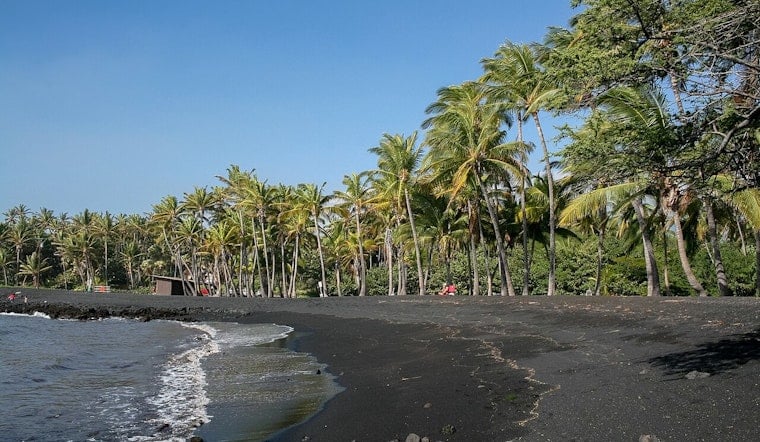
The bathrooms, pavilions, parking lot and campgrounds at Punalu'u Black Sand Beach Park are no longer Hawaii County's to manage. The county's lease on the 6.8-acre site, held with successive private landowners since at least 1954, expired on June 30, 2026, and county-run park services have now ceased, handing daily upkeep of the grounds back to the property's owner.
The shift comes as reported by the Honolulu Star-Advertiser, whose reporting forms the backbone of what's known about the breakdown. Hawaii County had proposed a new 10-year lease with annual payments starting at $159,300 and built-in 3% annual increases, according to the paper's account, but landowner Black Sand Beach LLC declined the offer and chose to end the existing lease instead, the county says. The black sand beach and coastline remain accessible to the public via a road at the beach's northern end, since the sand itself is state property regardless of who controls the upland park.
Two Sides, Two Very Different Stories
Mayor Kimo Alameda said the county made multiple good-faith offers aimed at protecting public interest in Punalu'u, framing the lease's end as a landowner decision the county tried to avoid. The county also says it rejected a further 30-day extension offered by Black Sand Beach LLC once talks stalled, according to the same reporting.
Colin Sakumoto, the Oahu-based attorney representing Black Sand Beach LLC, disputes that framing entirely. He has accused Hawaii County of mischaracterizing the events leading to the lease's termination and said his client did not terminate the existing lease. Sakumoto also says he drafted a conservation easement over the park for submission to the county and points to an April 4 letter he sent to Assistant Corporation Counsel J. Yoshimoto as part of the record the county is allegedly leaving out. The dossier does not resolve which account is accurate, only that both versions have been put forward by the parties directly involved.
A Buyout Offer That Never Closed
Underneath the dispute over who ended the lease sits a bigger sticking point: money. Hawaii County's Public Access, Open Space, and Natural Resources Preservation program, known as PONC, appraised the leased property at $1.46 million, but the county says it legally cannot offer more than that appraised maximum, and PONC purchases require a willing seller. The landowner rejected the county's PONC purchase offer, according to the Star-Advertiser's reporting, leaving the appraisal gap unresolved.
Black Sand Beach LLC purchased the surrounding 434 acres in Punalu'u in 2020, inheriting the existing lease with six years remaining on it. The company approached the county in 2024 seeking changes to the lease's rent and duration, setting the stage for the negotiations that ultimately collapsed this year. Black Sand Beach LLC has said it remains committed to ensuring public access to Punalu'u Beach Park going forward, even as county-managed services end.
Storm Damage Complicates the Handoff
The lease expired without electricity or county water at the site, conditions left behind after Hurricane Lala tore through the Ka'ū District with 80 mph winds and flooding earlier in August, according to Big Island Now. The Punalu'u community is still recovering from that storm, and the park also has long-running dysfunctional private wastewater facilities, compounding the transition at a moment when basic infrastructure was already strained. Hawaii County had signed a lease extension with the landowner in June 2026 to keep the park open through late August while negotiations continued, per county records, but that stopgap has now run out.
What the Law Still Guarantees
Regardless of who runs the parking lot or pavilions, the shoreline itself remains public. Under Hawaii's public trust doctrine and statutes governing shoreline access, all lands seaward of the natural shoreline are state property, guaranteeing public transit along the beach no matter who owns the land above it, according to the Hawaii Department of Land and Natural Resources. Hawaii law also makes it a criminal misdemeanor to intentionally block those shoreline access corridors, a protection enforced by the DLNR's Office of Conservation and Coastal Lands.
Environmental and cultural stakes run high at the site. Punalu'u Beach is one of the few remaining nesting areas in the main Hawaiian Islands for endangered hawksbill turtles, and it also provides habitat for green sea turtles. Maxx Phillips has said changes in ownership and management could affect beach access, the turtles, and the area's cultural and environmental resources.
A Community and an Industry Feeling the Loss
Just under 100 residents call Punalu'u home, and the beach functions as an economic engine for businesses throughout Ka'ū, supporters say. State Rep. Jeanne Kapela represents the district. For Aloha Aina Tours, the lease termination carries a significant impact: the black sand beach is one of the highlights of the company's south-side itinerary, and Vice President of Operations Steve Wan says there is no direct replacement for it. The company is now looking at other locations, including Pohoiki, though Wan has made clear that Punalu'u is considered part of the identity of Ka'ū and Hawaii Island itself.
The property's recent financial history has added to the uncertainty. Black Sand Beach LLC, whose principal is Eva Liu, defaulted on a $3.4 million mortgage tied to a 147-acre parcel of the larger property, and a Hawaii circuit court granted a foreclosure order in May 2025 before entering a stipulation for dismissal the following month, according to Honolulu Civil Beat. That financial turbulence briefly stalled the company's plans for a proposed 225-unit resort development known as Punalu'u Village, a project that has also faced organized opposition: the Center for Biological Diversity and Native Hawaiian advocacy group 'Iewe Hānau o ka 'Āina petitioned in March 2024 for a contested case hearing against the company's Special Management Area permit application, pausing county approval of the resort.
Precedent for Public Purchase Elsewhere in Ka'ū
Hawaii County has pulled off similar preservation deals before. The county has previously used PONC funds alongside state and federal grants to acquire more than 1,000 acres of coastal land between Punalu'u and Honu'apo, as well as 3,128 acres at Kahuku makai, protecting the Ka'ū coastline from industrial development in past years. Under the PONC charter mandate, any land the county does acquire must be held in perpetuity, with resale prohibited outright.
Hawaii County says it remains committed to preserving Punalu'u for current and future generations, even with the lease now over. What that commitment looks like in practice is still unclear, since the original 1998 lease between SM Investments and the county — executed for just $1 — has given way to a landscape of competing legal claims, storm damage and an unresolved appraisal gap that neither side has closed.





