

























































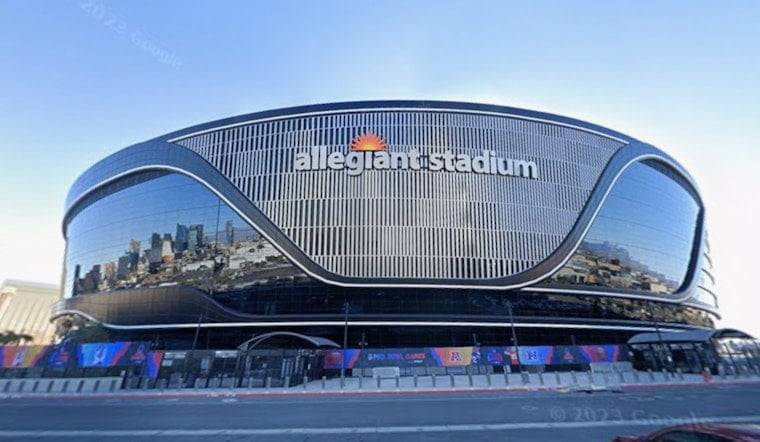
The Las Vegas Raiders are asking Clark County's Stadium Authority for up to $75 million in public money to help fund a $158 million elevated plaza platform at Allegiant Stadium, a project designed to ease the crush of pedestrians and rideshare vehicles that clog the area around the venue after games and concerts. The proposal goes before the Stadium Authority board at its Thursday meeting, though board chairman Steve Hill has said the panel will only hear the request that day, not vote on it.
According to the Las Vegas Review-Journal, the Raiders plan to build a north plaza platform extending from the Hacienda Avenue bridge out over the stadium's Lot C parking area. The structure would create a second story off Hacienda, serving as a gathering point for fans while a covered area beneath it would be dedicated to ride-hailing pickups and drop-offs. A special Stadium Authority meeting tentatively planned for September 2 is when the board could actually take up approval of the funding request, though no timeframe has been announced for when construction itself might begin.
Why Hacienda Avenue Became a Bottleneck
The site sits at the center of one of the busiest pedestrian corridors in Southern Nevada on event nights. Hill has said the Hacienda corridor is used by more than 20,000 people traveling to and from the Las Vegas Strip for Raiders games and other large Allegiant Stadium events. For major games and concerts, transportation authorities close the 0.3-mile Hacienda Avenue bridge over Interstate 15 to vehicle traffic entirely, letting between 22,000 and 30,000 attendees walk directly between Strip resorts and the stadium, according to the Las Vegas Sun.
That foot traffic has long coexisted with brutal post-event rideshare delays. Hoodline previously reported that wait times have stretched 45 to 90 minutes after big events, with surge pricing multipliers running between 3.5x and 5.5x standard rates. The plaza's lower-level ride-hailing zone appears aimed squarely at that friction point, and it would also connect to a future Boring Company Vegas Loop station planned for the north plaza area.
How Room Tax Dollars Would Cover the Bill
The Raiders' funding request would draw from the Stadium Authority's waterfall residual account, which collects excess revenue from the 0.88 percent room tax originally used to cover the public's contribution to Allegiant Stadium's construction. That fund only receives money after bond debt payments, Stadium Authority operating expenses and other requirements are met, and it can be used for capital improvements to the stadium or for paying down debt early. Public records reviewed by the Clark County government showed the waterfall fund held an ending balance of roughly $56.3 million as of February 2026 — well short of the $75 million the team is seeking, a gap that raises questions about whether any award would be phased over multiple fiscal years as future room tax revenue accrues.
The public originally contributed $750 million toward Allegiant Stadium's construction under a cap set by Nevada's 2016 Senate Bill 1, but that figure understates the full long-term cost to Southern Nevada taxpayers. Once interest and bond repayment terms across a 30-year window are factored in, the region carries more than $1 billion in total public debt obligations tied to the stadium, according to the Nevada Independent. The 2018 lease agreement between the Raiders and the Stadium Authority requires the team to submit annual capital improvement lists to keep Allegiant Stadium a premier, modern NFL venue, a contractual obligation that underlies the team's periodic funding requests.
Other Claims on the Same Pot of Money
The Raiders' ask isn't the only item competing for waterfall dollars. Clark County is separately requesting just over $2 million from the fund for three minor stadium additions, including a wider sidewalk on Hacienda, new gantry signs over Polaris Avenue north of Russell Road, and gantry signs on Dean Martin Drive south of Oquendo Road. The waterfall account also guarantees up to $3.5 million annually to UNLV football to offset stadium transition revenues; in February 2026, UNLV received a $3.6 million payment from the authority following a 17 percent attendance drop during its 2025 season, per the Review-Journal.
Thursday's meeting will also bring the board an update on the Athletics' $2 billion ballpark project and a separate update on the northwest plaza situation, which was initially expected to be built by Bally's Corp. That adjacent 35-acre site, the former home of the Tropicana, is slated to host the A's new $1.5 billion MLB ballpark under a Bally's master plan that includes two hotel towers with 3,000 rooms, a 56,000-square-foot casino and a 2,500-space parking garage, according to Ballpark Digest. Hill sits at the intersection of both mega-projects, serving simultaneously as Stadium Authority board chairman and CEO of the Las Vegas Convention and Visitors Authority, putting him atop public oversight of both Allegiant Stadium and the incoming ballpark.
A Stadium Already Straining Under Its Own Success
Allegiant Stadium's 65,000 seats have hosted more than 700 events and welcomed over 6 million total visitors between its 2020 opening and early 2026, boosting hotel demand on Sunday nights, according to a filing reviewed via SEC.gov. That volume of foot traffic is part of why the venue's approach corridors are under such pressure — and why Hoodline recently covered the Raiders' Waymo robotaxi partnership aimed at easing the same ground transportation crunch the new plaza is meant to address.





