

























































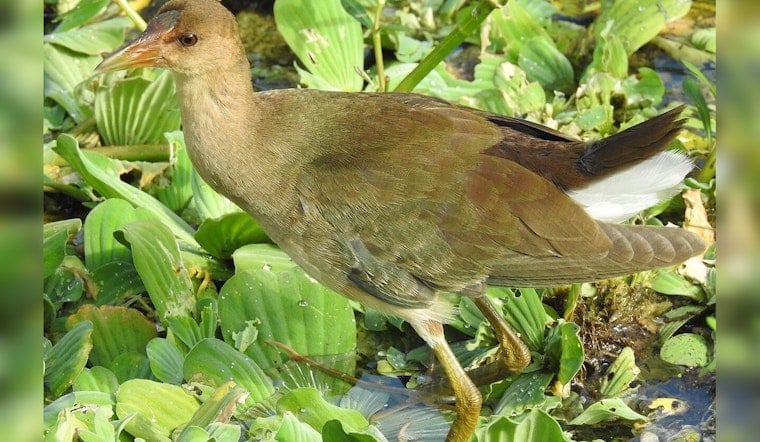
A juvenile purple gallinule has been wading through Pond C at Irvine's San Joaquin Marsh and Wildlife Sanctuary since mid-August, and the tropical bird's unlikely visit has turned a quiet stretch of wetland near Campus Drive into a magnet for binocular-toting crowds. The bird, identified as Porphyrio martinica, is not supposed to be anywhere near Southern California, which is exactly why so many people have shown up to see it.
Local birders first reported the gallinule on August 14 in Pond C, according to The Birding Lists Digest, which noted that regional rare bird alerts quickly pegged the spot as the animal's primary foraging area. Word spread fast in birding circles, and as NBC Los Angeles reported, crowds began converging on the marsh to catch a glimpse of the visitor before it potentially moves on.
A First for Orange County, an Eighth for California
The sighting marks the first documented observation of a purple gallinule in Orange County history and only the eighth recorded in California since 1961, according to the Los Angeles Times. Rare bird observations in California are reviewed and formally evaluated for state records by the California Bird Records Committee, underscoring just how unusual this appearance is. The paper's reporting places this bird among a very short list of vagrants ever confirmed in the state.
The Irvine Ranch Water District, which manages the sanctuary, confirmed the bird is a juvenile, distinguishable by its light brown plumage with hints of green-bronze rather than the vibrant purple-blue feathers adults display. The district's report also detailed the bird's physical toolkit: unusually long yellow toes and strong legs that let it walk across lily pads and floating marsh vegetation by spreading its weight over a broad surface. Adults typically grow to about 12 inches long and feed on seeds, plants, insects, frogs, and fish.
A Tropical Bird Thousands of Miles From Home
Purple gallinules are native to tropical and subtropical wetlands, living year-round in Central and South America and breeding in Florida, the Caribbean, and coastal Mexico, according to the Cornell Lab of Ornithology. In the United States, breeding populations concentrate almost entirely in the extreme southeast, making Irvine an especially odd stopover. The species is nonetheless known for extreme vagrancy, with wandering individuals documented as far afield as Iceland, South Georgia Island, and South Africa, per the lab's research.
Researchers note that severe droughts in the birds' core breeding habitats can trigger autumn dispersal and long-distance wandering, offering a possible scientific explanation for how a bird built for Florida marshes ended up in an Orange County treatment pond. It remains unclear how long this particular juvenile will linger in Pond C before moving on or dispersing further.
A Wetland Built to Clean Water, Now a Birding Hot Spot
San Joaquin Marsh was never designed as a birding destination first. Built in the 1990s by the Irvine Ranch Water District, the 300-acre wetland naturally treats more than 1 billion gallons of dry-weather urban runoff each year from San Diego Creek before it reaches Upper Newport Bay. A series of constructed ponds relies on natural biological processes and sunlight to strip excess nutrients from the water and curb algae blooms downstream.
That engineering has produced an ecological bonus. In 2019, the international Society of Wetland Scientists named San Joaquin Marsh California's only Wetland of Distinction, one of just 32 such designated wetlands nationwide, with criteria that include water quality performance, biological diversity, and public accessibility. Sitting along the Pacific Flyway, the marsh now hosts more than 300 bird species and serves as an educational hub, with walks and programs run by the Sea and Sage Audubon Society out of the district's Learning Center on the marsh campus.
Rules for the Crowds Flocking In
With more visitors converging on the sanctuary to search for the gallinule, the water district is reminding the public of long-standing site rules. Bicycles and domestic pets are strictly prohibited anywhere within the sanctuary's more than 10 miles of trails, a measure meant to protect resident wildlife and sensitive plant habitat. The preserve remains open to pedestrian visitors daily from dawn to dusk, giving hopeful birders a wide window to try their luck at spotting Orange County's newest, and most unlikely, resident.





