

























































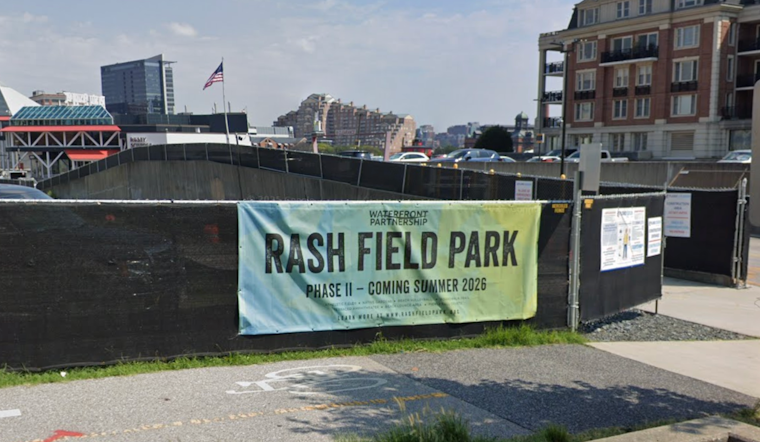
After more than a year behind construction fencing, Rash Field Park is on the verge of reopening along Baltimore's Inner Harbor, the centerpiece of a $35 million overhaul meant to turn a once-underused stretch of waterfront into a year-round destination. Most of the construction work is done, according to Waterfront Partnership of Baltimore president Dan Taylor, and the organization plans to hold a grand opening event early next month.
The transformation, first reported by The Baltimore Banner, traces back to a 2013 survey in which Baltimore residents asked for more green space, shade, trees and parks along the waterfront. The 8.3-acre park is owned by the city, while the Waterfront Partnership of Baltimore secured funding for the project and handles its programming and upkeep. Taylor told the Banner the park needed to prove it offered “a fun, active reason” to visit the waterfront; Phase 2 is designed to clear with amenities aimed squarely at adults rather than just families.
From High School Stadium to Harbor Hotspot
The site's history stretches back decades before anyone imagined pickleball courts or a Ninja Warrior course. Joseph H. Rash Memorial Field opened in 1976, named for Joseph H. Rash, a former food company executive and Baltimore park board president, according to the Banner. The field initially served as a recreational space for local sports teams before later becoming a staging area for large events and a home for beach volleyball leagues, including a league where 11th District city council member Zac Blanchard once played.
Landscape architecture firm Mahan Rykiel Associates designed both phases of the park, while local contractor Plano-Coudon Construction managed general contracting for the Phase 2 build, according to SouthBMore.com. Rash Field originally opened as an athletic stadium for Southern High School but became underutilized once the school built its own facilities, leaving the area subject to unfulfilled city proposals over the years like a Ferris wheel and a zip line, SouthBMore.com reported.
What Phase 1 Already Delivered
Rash Field Park's first phase, completed in November 2021, included a BGE-sponsored pavilion, play areas and a skatepark, per the Banner's reporting. That skatepark, known as Jake's Skate Park, was dedicated in memory of 5-year-old South Baltimore resident Jake Owen, who was killed by a distracted driver in 2011, according to Baltimore Fishbowl. Owen's family helped found the Change for Jake Foundation and successfully advocated for state legislation against distracted driving, Fishbowl noted.
That first phase already proved popular: cellphone data showed it drawing roughly 22,000 people per month, the Banner reported. Baltimore's Board of Estimates also approved local minority-owned vendor OneDo Coffee Roasters in August 2024 to operate a 1,200-square-foot café within the BGE Pavilion, according to the Baltimore Development Corporation, with indoor service alongside outdoor patio seating facing the harbor promenade.
Fitness Zones, a Beach and a Restored Memorial
Phase 2, which began in April 2025, expands the park's offerings well beyond its original youth-focused footprint. The new phase includes a fitness zone, volleyball courts, pickleball courts, a beach, an outdoor concert plaza, a nature walk and an open field, the Banner reported, along with seating and 230 trees. The fitness zone's signature feature is an 11-station outdoor Ninja Warrior-style obstacle course designed for users ranging from elementary-aged kids to adults, according to SouthBMore.com.
Among the park's historic elements, the Pride of Baltimore Memorial — featuring a raked clipper ship mast and pink granite honoring four crew members lost when the original schooner sank in 1986 — was restored and re-erected at its original park location in July, according to footage shared by Waterfront Partnership of Baltimore. Project planners had originally considered relocating the monument before deciding to keep it restored in place.
Funding, Delays and a Council Member's Hopes
The $35 million project drew funding from multiple layers of government and philanthropy. The State of Maryland contributed $18 million, the city of Baltimore added $15 million, and private donors — including BGE, Brown Advisory, T. Rowe Price and the Abell Foundation — gave a combined $2 million, per the Banner's reporting.
The project has faced weather and funding delays throughout construction. Phase 2 lost 33 workdays to weather overall, including 21 workdays lost during a 2026 winter storm, the Banner reported. The construction team worked Saturdays to recover lost time, and contractors coordinated with the Maryland Department of the Environment throughout the build. Adam Boarman, chief of capital development for Baltimore's Recreation and Parks Department, has noted that design, development, permitting and regulatory reviews for projects like this can take two years, with construction typically taking another few years on top of that.
Blanchard, the city council member, said he believes the south side of the Inner Harbor will become attractive once the park reopens and that people will want to use it. That optimism comes as the park sits directly across the harbor from Harborplace, which the Banner described as nearly empty and awaiting redevelopment — MCB Real Estate is expected to begin demolishing the Harborplace pavilions next month.
Filling the Gap While Construction Wrapped Up
While Phase 2 construction dragged on, the Waterfront Partnership found ways to keep the community engaged. In July, the organization launched a six-week pop-up Inner Harbor Pickleball Courts experience sponsored by PNC Bank, according to the Waterfront Partnership, giving racquet-sports fans a taste of what was coming before the permanent courts opened. The park has also become part of a broader municipal push around water access — Hoodline previously reported that automated self-service kayak rental kiosks operated by Rent.Fun were installed at Rash Field this year as part of the city's Baltimore Blueway network, offering app-based access to life vests and paddles for casual harbor paddling.
Leadership at the Waterfront Partnership has also changed hands during the project's later stages. Dan Taylor officially became president on July 1, 2025, succeeding founding president Laurie Schwartz following her retirement after 20 years leading the organization, according to CBS News. Taylor previously served as vice president at the Baltimore Development Corporation before stepping into the role.
Safety Concerns Along the Surrounding Corridor
The park's revival has unfolded alongside separate public safety concerns along the Key Highway corridor bordering Federal Hill. A pre-dawn fatal shooting near Rash Field Park in April prompted city officials and neighborhood organizations to introduce updated safety measures and curfews across the surrounding area, as Hoodline reported at the time. Those measures, including curfews, ID checks and road closures, were formalized by local leaders in the weeks that followed.
None of those safety measures are tied directly to the park's construction or design, but they form part of the broader neighborhood backdrop as thousands of visitors are expected to return once Rash Field Park fully reopens. For now, city officials and the Waterfront Partnership are focused on the finish line: a park that has sat closed for more than a year is set to welcome the public back with a grand opening event planned for early September.



