

























































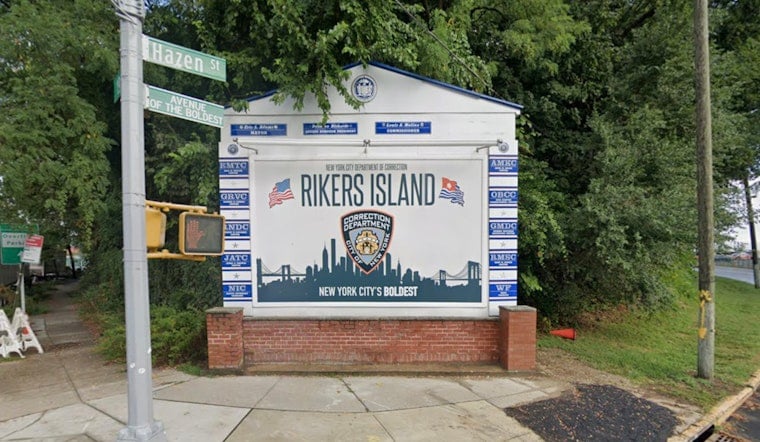
A woman detained at Rikers Island says correction officers shackled her repeatedly throughout her pregnancy — during court appearances, doctor visits, and psychiatric transports — despite a New York law that bans restraining pregnant detainees except under narrow, documented circumstances. Luz Burke, who was held at the jail complex between August 2023 and March 2024, has filed a lawsuit alleging the city violated both state and federal law in how it treated her while she was expecting.
According to Gothamist, Burke's suit alleges that Department of Correction staff shackled her during scheduled court appearances, doctor visits, and transports for psychiatric examinations. The lawsuit says officers used full-body shackles on Burke even after the department confirmed her pregnancy with a positive pregnancy test, and that staff kept her shackled while she was in a hospital. Officers reportedly stopped using leg shackles about two months into her detention, then switched to handcuffs before halting that practice roughly a month later, per the same account.
Burke also alleges the city subjected her to unsafe housing conditions, claiming she was kept in a mental health observation dormitory where she was exposed to pepper spray directed at other detainees. She further alleges the Department of Correction failed to provide her necessary care and treatment during her pregnancy. New York state law requires medical care and comfortable accommodations for pregnant detainees, according to the same report.
A Law on the Books Since 2015
New York expanded Correction Law § 611 in December 2015 to prohibit the use of restraints “of any kind” on incarcerated pregnant individuals during all stages of pregnancy, medical transport, labor, and for eight weeks postpartum, unless written “extraordinary circumstances” are documented, according to the New York State Assembly. That update expanded a 2009 statute that had previously only covered active labor and delivery. Burke's lawsuit alleges Rikers staff violated that state standard, along with federal law, through their use of restraints.
The city Law Department told Gothamist that the agency had not been served with or reviewed the lawsuit. Lawmakers introduced legislation in 2026 that would require enhanced NYPD training on the rules surrounding restraints for pregnant detainees, the outlet reported.
A Costly Pattern for the City
New York City has faced this kind of allegation — and paid for it — before. In April 2021, the city agreed to pay $750,000 to settle a federal lawsuit brought by a 22-year-old pregnant woman who was handcuffed and shackled by NYPD officers during active labor and postpartum recovery at Kings County Hospital in 2018, according to the Legal Aid Society. As part of that settlement, the NYPD agreed to conduct roll-call training for officers on restraint rules.
Two years earlier, in July 2019, the city paid $610,000 to settle a federal civil rights lawsuit filed by a 40-week pregnant Bronx woman who was kept in foot and wrist shackles for 30 hours, including during active labor at Montefiore Medical Center in 2018, as reported by the New York Daily News. Hospital doctors in that case repeatedly protested the use of restraints, while officers said they were following standard manual procedures. The city promised to revise patrol guide rules and officer training following that litigation.
The issue has surfaced again as recently as May, when 33-year-old Samantha Randazzo gave birth on a courtroom bench inside Brooklyn Criminal Court while awaiting arraignment, after spending more than 24 hours in police custody on low-level charges. Randazzo had been discharged from a hospital hours before being brought to court, where her water broke in open court, according to the Queens Daily Eagle. Public defense organizations condemned the incident as a systemic failure and alleged she was kept in handcuffs during labor.
Conditions Inside the Women's Jail
Burke's allegations about hazardous conditions and pepper-spray exposure echo other oversight concerns at Rikers. During an April inspection of the Rose M. Singer Center, City Council members found 12 pregnant detainees housed in general population rather than in dedicated areas like the facility's nursery unit, and requested that the Department of Correction transfer them, per the Queens Daily Eagle. City leaders have projected reducing the daily female jail population to 200 as part of broader plans to close Rikers Island.
Separately, the Bronx District Attorney indicted two Rikers Island correction officers in April after surveillance video contradicted their reports and showed unjustified pepper-spray deployment against detainees, as Hoodline previously reported. Misuse of chemical agents and false reporting remain ongoing targets of oversight at the jail complex.
Rikers has also faced scrutiny this year over its custody death toll. Five people died in New York City Department of Correction custody during the first eight months of 2026, including a 41-year-old detainee who suffered a medical emergency in August at the Robert N. Davoren Center, Hoodline has reported in its coverage of a fifth 2026 custody death. In 2025 and 2026, Rikers detainees also filed federal class-action lawsuits challenging jail practices that subjected people to prolonged isolation of 23 to 24 hours a day and extended shackling during transport and court appearances, according to a report cited by 1010 WINS.
A landmark 2020 study led by Johns Hopkins Medicine researchers estimated that roughly 55,000 pregnant individuals are admitted to U.S. jails annually, accounting for about 3% of female jail admissions — a reminder that Burke's case reflects a recurring situation for correctional systems nationwide rather than an isolated one. Some states have moved to tighten protections further: Pennsylvania expanded its Healthy Birth for Incarcerated Women Act under Act 45 to extend anti-shackling protections to pregnant juveniles and mandate a post-birth bonding period for incarcerated mothers, Hoodline has reported in a Pennsylvania case involving similar shackling allegations.



