

























































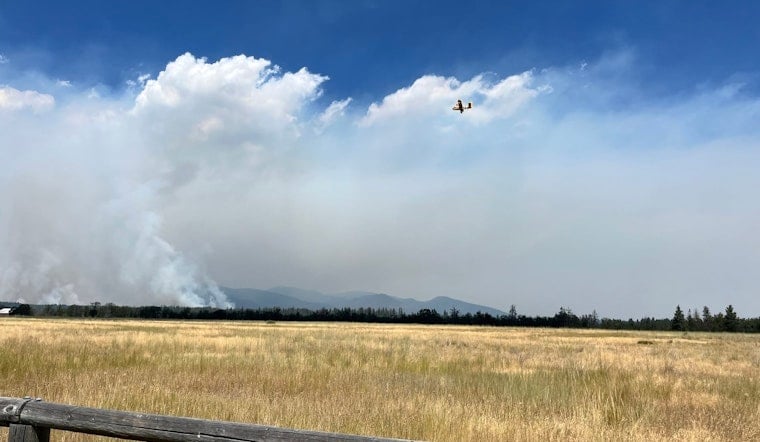
Unauthorized drones buzzing near Oregon's Grasshopper Fire have repeatedly forced firefighting aircraft out of the sky this month, officials say, slowing water drops and retardant runs at a moment when the state is enduring its most destructive wildfire season on record. Fire managers say even a single hobbyist drone spotted over the fire zone can trigger a full suspension of aerial operations, grounding tankers and helicopters until the device is located or leaves the airspace.
Kenji Sugahara, the Oregon Department of Aviation director, said drones near the Grasshopper Fire have delayed firefighting operations, according to KOIN. “If there's a wildfire, don't fly,” Sugahara said, warning that an unauthorized drone can force firefighting aircraft out of the area entirely, posing a serious collision risk to pilots dropping retardant or water. The Grasshopper Fire, a lightning-caused blaze that ignited in Wasco County on July 23, has burned 93,365 acres and threatened communities near Mount Hood National Forest, prompting Level 3 “Go Now” evacuation orders in Wasco and Hood River counties before crews reached more than 75% containment in mid-August, per KGW.
Why Grounded Aircraft Matter So Much Right Now
Oregon has recorded more than 2 million acres burned this season, and statewide totals have already surpassed 2,498,677 acres as of Friday, making 2026 the most severe wildfire season in the state's recorded history, KGW reports, with the new mark eclipsing the previous statewide record of 1.93 million acres set in 2024. Against that backdrop, any delay to aerial firefighting carries outsized stakes: fire crews coordinate air assets and authorized unmanned aircraft systems to direct ground crews, locate lingering heat, and track fire activity, but that entire system depends on airspace that stays clear of unauthorized traffic.
When an unauthorized drone is detected, firefighting aircraft may suspend operations altogether, and crews say the resulting delay can allow a wildfire to spread farther while increasing risk to firefighters, nearby communities, structures, and critical infrastructure. Andrew Jahier, the Oregon Office of Emergency Management's director of response and recovery, has warned drone operators not to fly over wildfires, a message echoed by the Oregon Department of Emergency Management, which has separately cautioned operators to stay out of active fire zones.
A National Problem, Not Just an Oregon One
Oregon's experience mirrors a fast-growing national trend. The U.S. Forest Service recorded 218 drone sightings over active wildfires nationwide in 2025, more than the cumulative total of 125 incursions logged over the previous seven years combined, with 184 of those 2025 incidents occurring during the Eaton and Palisades fires in Los Angeles alone. Hoodline has previously reported on the same dynamic playing out closer to home, when unauthorized civilian drone flights forced a suspension of aerial firefighting support during a major brush fire that injured four people in May.
Active wildfire areas are treated as strict no-drone zones around the clock, including nights and weekends, and fire crews must deconflict aircraft to prevent collisions even before an unauthorized drone appears. Drone-detection equipment can sometimes locate an unauthorized aircraft or even trace it back to its ground station, but until an operator is found, an entire aerial fleet can remain grounded. Officials are asking anyone who spots an unauthorized drone near a fire to report it to local law enforcement or 911, and are urging operators to check for temporary flight restrictions before ever launching near a fire zone.
Steep Fines and Possible Prison Time
The penalties for flying into an active fire zone have grown sharper. Personal drone flights near wildfires can result in civil fines of up to $75,000, permanent revocation of pilot certificates, confiscation of drone equipment, and federal prison sentences of up to 12 months, according to KOIN's reporting. The Federal Aviation Administration updated its enforcement policy in February to make formal legal action the default response for drone flights that violate restricted airspace or endanger emergency operations, a shift instituted after repeated unauthorized flights near disaster areas and public events across the country.
The agency has already shown it will use that authority. In 2023, the FAA imposed a $36,770 civil penalty on a drone operator for flying near emergency response aircraft during an active wildfire, one of 18 major drone enforcement actions the agency highlighted when it announced its stricter prosecution rules. Federal law also allows for criminal prosecution of knowing or willful violations of temporary flight restrictions over disaster zones, carrying up to a year in federal prison and fines as high as $100,000 under federal statute, according to Rupprecht Law. Those restrictions become legally binding the moment the FAA publishes them and apply automatically to any uncrewed aircraft, regardless of the operator's intent.
Oregon has its own state-level tools as well. Under Oregon Revised Statute 837.374, knowingly or intentionally operating a drone to interfere with wildfire suppression is a Class A misdemeanor punishable by up to one year in prison and fines up to $6,250, according to Oregon law. Interference that causes serious injury or death can escalate the charge to a Class A felony. State lawmakers tried to go further last year: the Oregon House unanimously passed a bill to elevate intentional drone interference with emergency response to a Class C felony, drafted after a 2024 unauthorized drone flight near the Upper Applegate Fire grounded all responding aircraft as that fire expanded past 500 acres, but the measure ultimately stalled in the state Senate.
When Drones Collide With Firefighting Planes
The risk isn't hypothetical. A California drone operator was sentenced last September to two weeks in federal prison, a $9,500 fine, and $147,000 in restitution after his drone collided mid-air with a Canadian Super Scooper firefighting plane during the January 2025 Palisades Fire in Los Angeles, according to Courthouse News Service. The collision tore a fist-sized hole in the plane's wing and grounded the aircraft for four days during peak firefighting efforts.
The stakes are especially pointed in Oregon given the state's recent investment in authorized aerial technology. Ahead of this fire season, the Oregon Department of Forestry purchased a $13 million multi-mission aircraft equipped with thermal infrared sensors and AI software designed to stream live mapping to commanders, a tool Hoodline previously reported was meant to improve situational awareness in remote parts of the state. That plane, like every other authorized aircraft assigned to the Grasshopper Fire, becomes useless the moment an unauthorized drone forces a shutdown of the airspace it needs to fly in.





