

























































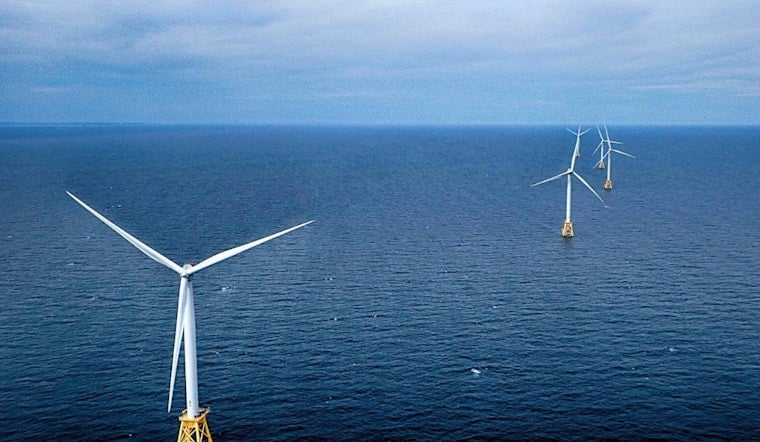
RWE U.S. Offshore has struck a $1.22 billion deal with the Trump administration to relinquish offshore wind leases off New York, California and Louisiana, marking the fifth such federal buyback this year. The company says it determined there was no foreseeable path forward to permit the projects, and it plans to redirect the reimbursed funds into fossil fuel and gas infrastructure, including a major liquefied natural gas project in Louisiana.
Of that $1.22 billion, roughly $900 million is earmarked for a 16% stake in a Louisiana LNG export project currently being developed by Woodside Energy Group, according to Reuters. RWE is also spending $300 million on natural gas turbines and is developing 15 natural gas peaking projects across the United States, part of a broader company pivot away from offshore wind. Interior Secretary Doug Burgum welcomed the agreement, framing it as a voluntary investment that strengthens the nation's energy security and provides dependable baseload power, according to the Baltimore Sun.
“Americans deserve an energy system built on common sense, not one dependent on costly subsidies or technologies unable to meet current demand,” Burgum said, per the same report. The administration has made no secret of its aim to discourage offshore wind expansion in favor of fossil fuels, even as offshore wind produces electricity without the carbon pollution that comes from burning oil, coal and natural gas. President Trump has said his goal is not to let any windmills be built.
A Strategy Born From Courtroom Losses
The lease-buyback approach didn't emerge from nowhere. As The Guardian has reported, the administration pivoted to negotiated buyouts only after federal courts repeatedly struck down its executive orders and stop-work directives attempting to halt fully permitted wind construction, ruling those earlier moves arbitrary and unlawful. Since then, the Baltimore Sun notes, offshore wind lease agreements have cost the federal government roughly $3.9 billion in total across five separate deals.
Those deals have piled up fast. TotalEnergies took nearly $1 billion under the first agreement announced in March, a buyout redirecting $920 million to Texas gas. Golden State Wind and Bluepoint Wind followed in April, ending their leases for reimbursements totaling nearly $900 million and agreeing to invest an equivalent amount in fossil fuels. Invenergy struck its own deal in June, ending four offshore wind leases in exchange for $765 million in reimbursed lease fees, according to offshoreWIND.biz, which reported the canceled projects included Leading Light Wind off New Jersey, Even Keel Wind off California, and two lease areas in the Gulf of Maine.
States Push Back in Court
Not everyone is on board. Sheldon Whitehouse said the lease buybacks effectively bribe companies to leave clean energy and will raise costs for consumers, adding that consumers are already paying billions of dollars in extra costs, per the Baltimore Sun's reporting. States losing offshore wind capacity are suing over the buybacks, and California intends to file its own legal challenge.
California's Attorney General's Office filed a formal Notice of Intent to Sue the Department of the Interior in July, arguing the federal buyouts of Golden State Wind and Invenergy violate the Outer Continental Shelf Lands Act by bypassing required state consultation, according to the Office of the California Attorney General. State officials argue the buyouts threaten more than $100 million in state public investments in port and grid infrastructure. The California Energy Commission has also issued administrative investigative subpoenas to Golden State Wind and Invenergy, examining the secretive federal agreements and their impact on local clean energy targets, according to KALW.
A seven-state coalition has gone further, filing a federal lawsuit in D.C. to strike down the Interior Department's $795 million buyout agreement with TotalEnergies. The Office of the New York Attorney General alleges the administration lacked authority under federal law to cancel the Attentive Energy lease off New York. That office estimated the canceled project would have generated 1,342 megawatts of electricity, saved New York consumers $10 billion in energy costs, and created over 1,700 jobs.
Congress Scrutinizes the Money Trail
Separately, a group of U.S. House lawmakers launched a congressional investigation in May into the administration's use of the Department of Justice's Judgment Fund to execute the buyouts, alleging the fund — a permanent appropriation meant to pay court judgments or legal settlements — was improperly used to bypass congressional appropriations for what amounts to an executive policy shift. The scrutiny adds another layer of legal uncertainty to a buyback strategy that has already drawn multiple lawsuits.
The cumulative toll on planned offshore capacity is steep. Earlier buybacks for Bluepoint Wind and Golden State Wind alone eliminated up to 4.4 gigawatts of planned offshore wind capacity across the Atlantic and Pacific coasts, and a broader energy market report from EnkiAI found that federal policy reversals and lease buyouts have contributed to $34.8 billion in U.S. clean energy project cancellations and the loss of 38,000 planned jobs between 2025 and 2026. Whether the pending multi-state lawsuits can unwind any of these already-executed deals remains an open question, as does how affected states will adjust their clean-energy targets to the lost capacity.





