

























































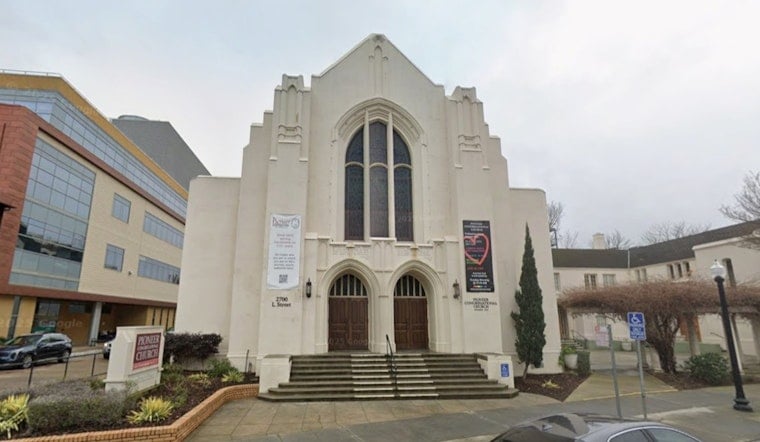
Sacramento's oldest congregation is facing a stark new chapter: a development application filed with the city proposes turning the century-old Pioneer Congregational Church building at 2700 L Street into a 12-room boutique hotel with an event space. The 1926 structure, directly across from Sutter's Fort in Midtown, has stood as a designated historic landmark for decades, but more than $23,000 in pending city fees tied to the application must be paid by August 24, 2026, or the submission will be voided.
As reported by Abridged by PBS KVIE, the church, whose congregation traces back to 1849, hosted its final Sunday service at the end of May 2026 and has since suspended future services altogether. The building was listed for sale earlier this year, with Turton Commercial Real Estate pricing it at $3.2 million. According to the article, the property was reportedly in escrow, though available records show the sale has not yet closed.
A Landmark Weighing Its Future
The church's leaders have pointed to declining membership and the cost of maintaining such a large building as reasons for the sale, a familiar story for mainline Protestant denominations nationwide. Rev. David Bocock told Abridged that the congregation is hopeful an investor might allow it to remain in the building in some form, and said members might also share space with another congregation elsewhere as they continue discerning where they will worship next.
Pioneer Church is part of the United Church of Christ, a denomination that has experienced membership decline for decades since its peak in the 1960s. Nationwide UCC membership has fallen roughly 70% from a 1960 peak of 2.25 million to 683,936 members across 4,485 congregations, a loss of about 15,000 members a year, according to data published by Religion Watch. The same data shows two out of three UCC congregations nationwide averaged 50 or fewer worshippers per week in 2023, underscoring the financial pressure now facing buildings like the one at 2700 L Street.
What Would Be Lost, and What Might Be Kept
Inside the 19,400-square-foot building, a two-story layout wraps around a central courtyard, housing a sanctuary, commercial kitchen, auditorium, meeting space, medical clinic, and offices, according to a video posted by Brian Jang Real Estate on Facebook. The sanctuary itself still contains stained-glass windows and a pipe organ, irreplaceable features that any hotel conversion would need to address. The building also houses a 1926 bell tower whose bell was originally cast in Troy, New York, and shipped around Cape Horn aboard a windjammer before it was hung in 1854 at the congregation's original 6th Street site, where it served as Sacramento's sole alarm bell for volunteer fire brigades, according to a Facebook post referencing the church's history.
When the current building's cornerstone was laid in 1926, builders encased inside it the cornerstones from the congregation's 1854 church along with a 50-pound Indigenous rock bowl uncovered during site excavations, per a local history post shared on Facebook. The property was officially designated a Sacramento historic landmark under City Ordinance No. 82-046 on June 15, 1982, placing it on the Sacramento Register of Historic & Cultural Resources.
Clara's House and the Clinic's Uncertain Future
The second floor of the church building is home to Clara's House, a free community medical clinic operating in the section of the building behind the courtyard. The clinic remained open and was still actively recruiting Spanish-speaking volunteer staff as of August, according to its own site. Its future, along with that of any other tenants, would hinge on how a hotel conversion proceeds and whether the clinic can remain in the redeveloped space.
The Regulatory Clock and a Statewide Precedent
Because the building carries historic landmark status, any site plan and design review submission must clear evaluation by city staff and public hearings before the Sacramento Preservation Commission before a building permit can even be applied for. That review process is what makes the looming fee deadline so consequential: if the more than $23,000 in pending fees tied to the application are not paid by August 24, the submission will be voided outright, forcing the applicant to start over.
Sacramento has seen this kind of conversion before. On the opposite side of Sutter's Fort from Pioneer Church, the historic Eastern Star Hall, also a city landmark, was previously converted into a boutique hotel without demolishing its historic exterior, according to a local business account on Facebook. Preservationists note that adaptive reuse projects in Sacramento can tap incentives such as federal historic tax credits and property tax reductions under California's Mills Act, tools that could factor into whether Pioneer Church's landmark features survive a conversion.
A more recent example comes from Santa Barbara, where developers completed Casa Iglesia in June, a 37-unit boutique hotel built through the adaptive reuse of a 100-year-old historic church that kept its exterior and central courtyard intact, as reported by Noozhawk. Developers on that project noted a hotel conversion preserved open interior volumes better than a multi-family residential apartment build would have, a consideration that could weigh on how Pioneer Church's sanctuary and auditorium are eventually reused.
For now, the congregation that has called Midtown Sacramento home since 1849 is left waiting to see whether its building becomes a hotel, stays partly intact for community tenants like Clara's House, or finds some other path entirely. Bocock's comments to Abridged suggest the church itself has not given up hope of staying connected to the space, even as it continues discerning where its members will worship next.



