

























































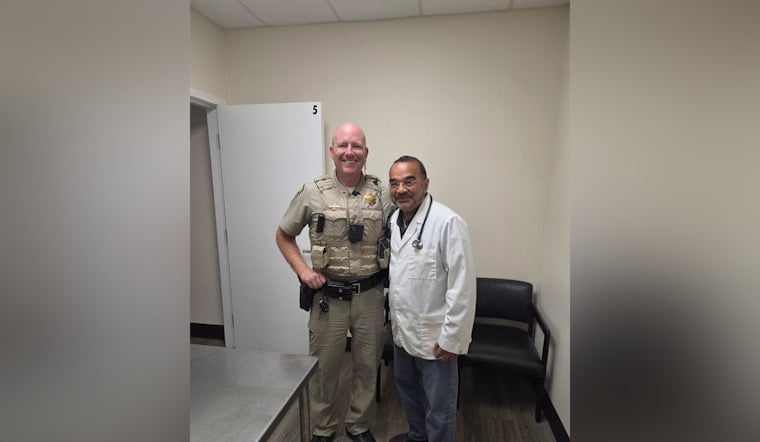
Dr. Singh, a longtime veterinarian at Sisk Veterinary Hospital in Salida, was driving near Sisk Road and the State Route 99 off-ramp on January 16, 2024, when his heart stopped. He collapsed after what officials describe as a minor traffic collision, and strangers on the roadside began performing CPR before a California Highway Patrol officer arrived and took over compressions himself.
The California Highway Patrol's Modesto office publicly detailed the rescue this week, more than two and a half years after it happened, revealing for the first time that the motorist saved that day was Dr. Singh. According to the California Highway Patrol, Officer Fowles was patrolling near the off-ramp when he encountered the collision and found Good Samaritans already performing CPR on a man lying on the ground. Fowles took over chest compressions, and the man regained consciousness before firefighters and paramedics transported him to a local hospital.
A Veterinarian Known Throughout Salida
Dr. Singh works as a veterinarian at Sisk Veterinary Hospital, a daytime practice at 4566 Salida Boulevard that serves pet owners across Stanislaus County and the surrounding Central Valley, per the clinic's own description of its services. The hospital sits close to where the emergency unfolded, since Salida Boulevard runs parallel to Sisk Road near State Route 99, according to background compiled from local roadway history. Following the roadside intervention, Dr. Singh underwent triple bypass surgery and made a full recovery, the CHP said, and he was later reunited with Officer Fowles.
Salida itself is an unincorporated community in northern Stanislaus County, with a 2020 census population of 13,886, sitting directly north of Modesto along State Route 99, according to Stanislaus County. The community was originally established as a railroad siding in 1870 and takes its name from the Spanish word for exit, the county notes. Local fire protection and first-responder medical services in the area are handled by the Salida Fire Protection District, working alongside Stanislaus County emergency medical services, which is consistent with the fire crews and paramedics who took over Dr. Singh's care from Officer Fowles that day.
Why Minutes of CPR Matter So Much
The stretch of roadway where the collision happened is no quiet backstreet. State Route 99 through Stanislaus County functions as the primary north-south freeway linking Modesto, Salida, Ceres, and Turlock, carrying heavy commuter and freight traffic through the Central Valley, according to the California Department of Transportation. CHP officers patrol its off-ramps and connecting arterials, like Sisk Road, as part of routine coverage, which put Officer Fowles close enough to respond within minutes.
That speed can be the difference between life and death. Clinical research published by the American Heart Association in November 2024 found that people who receive bystander CPR within two minutes of an out-of-hospital cardiac arrest have 81% higher odds of surviving to hospital discharge than those who do not, with survival chances dropping by roughly 10% for every minute CPR is delayed. Nationally, 42.5% of out-of-hospital cardiac arrest victims received bystander CPR in 2025, the highest rate recorded since 2016, according to Cardiac Arrest Registry to Enhance Survival data reported by the Sudden Cardiac Arrest Foundation — even as overall survival across more than 350,000 annual cases remains around 10.5%.
Training and Legal Protections Behind the Rescue
Officer Fowles was able to step in and take over compressions because California peace officers are required to do so. California POST regulations and Title 22 of the California Code of Regulations mandate that officers, including CHP personnel, complete at least 21 hours of initial public safety first aid and CPR/AED training, with refresher training required every two years, according to the California Commission on Peace Officer Standards and Training. That requirement reflects the reality that law enforcement is often the first trained responder to reach a highway medical emergency, ahead of fire crews or paramedics.
The bystanders who started CPR before Fowles arrived were also acting within a legal framework designed to encourage exactly that kind of intervention. Under California Health and Safety Code Section 1799.102, people who render emergency medical or non-medical care in good faith at the scene of an emergency are shielded from civil liability for their acts or omissions, provided the aid is voluntary and free of gross negligence. It remains unclear whether those Good Samaritans were ever formally identified or recognized alongside Officer Fowles.
A High-Survival Surgery After a Roadside Save
Once stabilized, Dr. Singh underwent triple bypass surgery, a procedure that reroutes blood flow around three blocked coronary arteries to restore circulation to the heart muscle. Coronary artery bypass graft surgery, including the triple bypass variant, is a standard treatment for severe multi-vessel coronary artery disease and carries short-term 30-day survival rates between 95% and 98%, according to the Cleveland Clinic. Dr. Singh's full recovery and eventual reunion with Officer Fowles closed out a case that CHP Modesto describes simply as proof of why officers do the job they do.





