

























































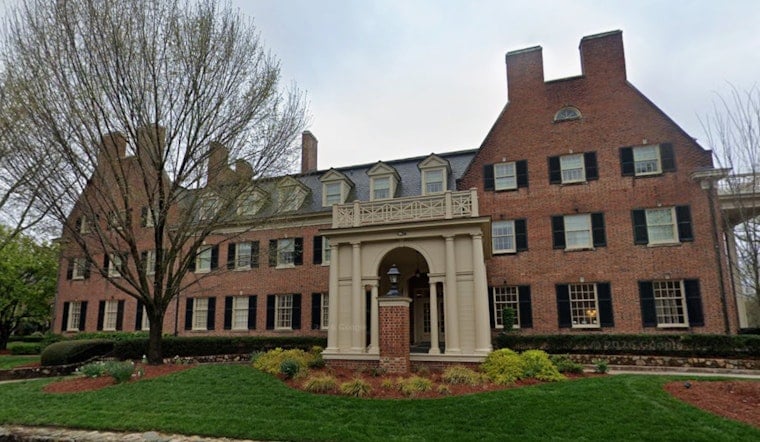
Chapel Hill is about to host some of the biggest names in global tech and trade policy. OpenAI CEO Sam Altman and Nvidia CEO Jensen Huang will join U.S. Commerce Secretary Howard Lutnick at the Carolina Inn on September 1 and 2 for the G20 Innovation Ministerial, a gathering aimed at fostering global cooperation on artificial intelligence and other emerging technologies.
The two-day event, first reported by Axios, will bring technology and digital ministers together on day one, followed by trade and commerce ministers on day two. Ministers from Japan, South Korea, Mexico, Poland, India and Saudi Arabia are among those expected to attend, according to the outlet. Lutnick is set to host Altman and Huang, with Altman expected to preview coming AI advances and discuss the technology's global economic implications.
Altman is also expected to highlight OpenAI's work with North Carolina Governor Josh Stein, per the same report, pointing to the company's partnerships with the state on hurricane recovery and cyberdefense. That local tie-in gives the ministerial an unusually hometown flavor for a summit built around trillion-dollar trade questions.
A Historic Campus Hotel Steps Into the Global Spotlight
The venue itself carries its own story. The Carolina Inn is a AAA Four Diamond, Colonial Revival hotel built in 1924 by UNC alumnus John Sprunt Hill, who donated it to the University of North Carolina at Chapel Hill in 1935, according to The Carolina Inn. The university still owns the property today, and its net profits help support Wilson Library's North Carolina Collection.
The ministerial is co-hosted by the U.S. Department of Commerce and the White House Office of Science and Technology Policy, whose director, Michael Kratsios, was confirmed in March 2025 and previously served as U.S. Chief Technology Officer during the first Trump administration, according to FASEB. Kratsios issued a 123-page strategy report in July 2026 titled “Science: A New Golden Age” urging a federal research realignment around emerging technologies like AI, the report notes.
Trillions in Foreign Investment on the Agenda
The gathering sits inside a much larger diplomatic frame. It falls under the broader 2026 U.S. G20 presidency, which the country assumed in December 2025 and which will culminate in the 21st G20 Leaders' Summit scheduled for December 14-15 at Trump National Doral Miami, according to Wikipedia. A U.S. Department of Commerce media advisory notes that the G20 forum as a whole represents roughly 85% of global gross domestic product and two-thirds of the world's population, with press registration for the Chapel Hill event running through Thursday.
Money commitments loom large over the talks. Japan has pledged $550 billion in U.S. investment, and South Korea has committed $350 billion, per Axios. Hoodline previously reported on a $33 billion Ohio gas plant, a 9.2-gigawatt facility operated by SoftBank-linked SB Energy, that emerged as one of the first concrete projects tied to Japan's pledge.
Chip Equity Rules Loom Over Lutnick's Agenda
Lutnick arrives at the summit fresh off an aggressive push to reshape how Washington funds semiconductor manufacturing. Under his direction, the Commerce Department has required federal equity stakes in private semiconductor and quantum computing firms receiving CHIPS Act research funds, approving 19 company awards totaling $3.8 billion through mid-2026. Hoodline detailed that shift, which marks a departure from earlier non-dilutive grant procedures, in an August report on Commerce's equity stakes in seven chip firms, including a $300 million stake in GlobalFoundries.
North Carolina's Own AI Push Sets the Local Backdrop
The choice of Chapel Hill is no accident. Governor Stein created North Carolina's AI Leadership Council through Executive Order 24 in September 2025, co-chaired by State IT Secretary Teena Piccione and Commerce Secretary Lee Lilley, to establish statewide AI governance and workforce guidelines, according to the Carolina Journal. The order also set up an AI Accelerator inside the state's IT department.
That effort built on an earlier state pilot: North Carolina's Department of State Treasurer ran a 12-week program with OpenAI in mid-2025 in which staff reported saving 30 to 60 minutes per day on routine administrative tasks using ChatGPT, according to the N.C. Department of Information Technology. UNC Chapel Hill later hosted its inaugural “AI for Public Good Conference” in April 2026, bringing state officials together with OpenAI Chief Economist Ronnie Chatterji, with Governor Stein appearing via video message, per the university.
Not everything about the state's AI boom has gone smoothly. In July, Stein called on Duke Energy to formalize binding utility rate structures for large AI data centers after tech companies including OpenAI signed a national Ratepayer Protection Pledge, according to the North Carolina Governor's Office, which said the pledge is meant to keep data centers on separate utility tariffs so household energy rates stay protected.
Whether that state-level model of public-private AI cooperation becomes a talking point on day two of the ministerial, alongside the trade and semiconductor equity questions facing Lutnick's international counterparts, remains to be seen once the sessions get underway next week at the Carolina Inn.




