

























































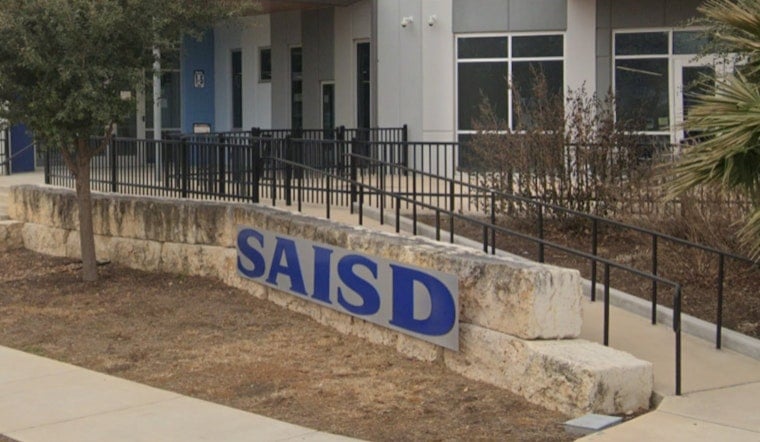
San Antonio Independent School District voters will decide on Nov. 3 whether to approve a $600 million bond package and a 3.17-cent property tax rate increase designed to shore up aging campuses and boost teacher pay. The SAISD Board of Trustees voted to place the voter-approval tax rate election, known as a VATRE, along with three bond propositions on the ballot, according to a district release.
As reported by Fox San Antonio, the bond is split into three propositions. Proposition A carries the biggest price tag at $492 million, covering school modernization, capital system replacements, and safety and security upgrades. That includes replacement of chillers, boilers, plumbing, utilities, roofing and windows, along with security fencing and vestibules, strategic site lighting for after-hours campus safety, fire alarm systems and emergency indicators, ADA access enhancements, and renovations to learning environments. Proposition A would also fund a police fleet supporting campus safety and district patrol, plus a new bus fleet equipped with three-point seat belts.
Bus Belts Tied to a 2029 State Deadline
The seat belt provision isn't optional window dressing. Under Texas Senate Bill 546, passed during the 2025 legislative session, all Texas public school buses must be equipped with three-point seat belts by September 1, 2029, according to CBS News. The law is an unfunded state mandate — Texas requires districts to report retrofit costs but provides no money to cover them, leaving SAISD to lean on Proposition A to comply.
Proposition B would direct $102 million toward information technology improvements, including network infrastructure and teaching and learning devices, per the district. Proposition C is the smallest of the three, setting aside $6 million for improvements to Alamo Stadium and the Convocation Center.
Why the Bond Shrank From Earlier Estimates
The $600 million figure represents a scaled-back version of what district planners once envisioned. In May, SAISD's Blue Ribbon Task Force pared its recommended bond package down to $600 million after flat property valuations and higher interest rates cut the district's non-tax-increase bonding capacity from $450 million to $300 million, according to Texas Public Radio. Flat property appraisal growth across Bexar County lowered revenue projections tied to the district's existing debt tax rate, forcing the smaller ask.
The bond arrives against the backdrop of some of the oldest school buildings in the city. The average age of SAISD facilities is 63 years old — 13 years past a school building's standard 50-year operational lifespan — with some campus structures dating back to the 1880s, according to the San Antonio Express-News. As San Antonio's founding school district, SAISD operates the city's oldest school buildings, a fact the paper's reporting frames as the physical necessity behind Proposition A's infrastructure focus.
Separate Tax Vote Targets Teacher Pay
Distinct from the bond, the VATRE would let SAISD raise its maintenance and operations tax rate to generate additional day-to-day operating revenue — money that, unlike bond funds, can pay for salaries and programs rather than construction. School bonds are legally restricted to educational infrastructure, facility improvements and modernization and cannot be used for daily operating expenses. SAISD estimates the 3.17-cent increase would generate $5.5 million in additional tax revenue, according to the district.
That revenue would help fund compensation initiatives, including a one-time supplement, as well as teacher pipeline initiatives such as an Associate of Arts in Teaching pathway for high school students and apprenticeship and community pathways for aspiring educators. It would also support college and career-readiness efforts, including career and technical education programs, industry-based certifications, dual credit, early college opportunities, work-based learning, skilled trades pathways, middle school career exploration, and literacy and math initiatives.
For homeowners, the district estimates the combined tax rate increase would add $1.99 a month in 2026 if voters approve all four proposals, rising to an additional $1.26 a month in 2027 for a total of $3.25 a month, and climbing incrementally to $5.76 a month by 2030. Senior citizens' SAISD property taxes would not be affected by any of the three proposals if they have filed the required homestead and over-65 exemptions with the Bexar County Appraisal District and owned the home as of Jan. 1, 2026.
A District Under Financial Strain
The ballot measures come as SAISD grapples with a structural budget shortfall. In March, the district identified $19.3 million in budget reductions to help close a projected structural deficit of roughly $45.9 million, a process that included trimming about 220 central office and campus positions, as Hoodline previously reported. Enrollment pressure underlies much of that strain: SAISD's total student enrollment fell to 42,548 in 2026, a 19.8% decline since 2016 driven by falling birth rates, charter school competition, and suburban population shifts, according to the Texas Tribune.
SAISD isn't alone in turning to voters this fall. The district is part of a broader wave of Bexar County school systems seeking tax measures on the November ballot, with Northside ISD proposing an $886 million bond and tax rate increase and South San ISD pursuing a tax rate reallocation, the Express-News reports. Area school systems across the region face similar cost increases, flat property values, and stagnant state basic allotments.
Leadership Transition and Recent Wins
The bond vote also lands during a leadership handoff at SAISD. Trustees voted 5-2 in July to hire Adrian Bustillos, previously chief transformation officer in Aldine ISD, as the district's new superintendent, replacing Jaime Aquino, who moves into an emeritus role through January 2027.
District leaders can point to at least one recent success story as they campaign for the bond. Earlier this month, SAISD reopened Kate Schenck Elementary School following a two-year, $33.9 million bond renovation, establishing the district's largest elementary campus with 764 students and its first dedicated community room inside a secure entry vestibule, as Hoodline reported this month. Schenck students had been temporarily relocated to Foster Elementary during construction.
Still, the district's bond history carries some baggage that could shape voter sentiment. An early 2024 investigation found SAISD had spent over $9 million in 2020 bond funds on architectural designs and preliminary work for campuses that were later slated for closure under the district's Rightsizing plan, which shuttered 15 schools that year amid declining enrollment. That scrutiny followed SAISD's 2020 bond election, when voters approved a $1.3 billion package — $1.21 billion for campus renovations and $90 million for technology — with more than 68% approval across both propositions, according to Ballotpedia. SAISD says it will hold community information sessions ahead of the November election.





