

























































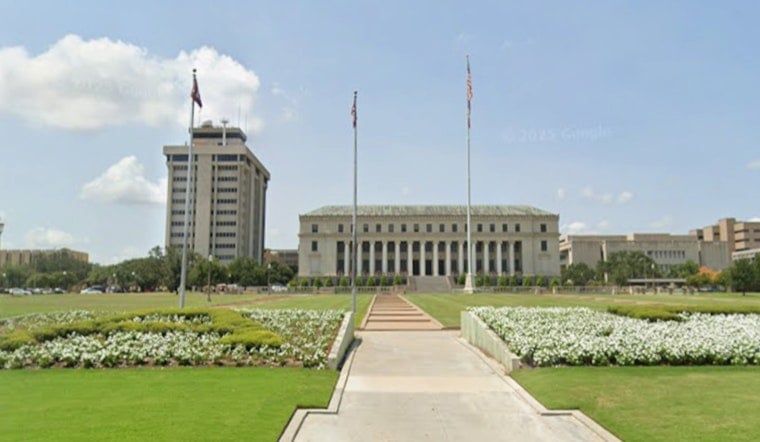
An 18-year-old San Antonio student who was adopted from China at age six just won first place in the Varsity division of an international academic competition for blind and visually impaired students, beating out a field of more than 2,000 competitors worldwide. EmmaGrace Olech, who has competed in the contest since third grade, will head to Texas A&M University in College Station this fall to study biomedical science with hopes of becoming a medicinal chemist.
Olech's win came at the 2026 Braille Challenge Finals, held at the University of Southern California in Los Angeles, where 50 finalists were selected from the international entrant pool, according to the San Antonio Report. It marked a step up from 2025, when she placed second in the Varsity division, and a long way from July 2022, when she was the sole student representing Texas in the global final round as a high school freshman, according to an earlier account from the same outlet.
The Braille Challenge tests reading comprehension, spelling, speed and accuracy, proofreading, and tactile charts and graphs, per the San Antonio Report's coverage of the event. The speed and accuracy portion requires students to transcribe an audio passage into Braille using a Brailler, while the charts and graphs section requires them to analyze tactile graphics to answer questions. The competition also includes French spelling and transcription of excerpts from Charles Dickens and Mark Twain, the outlet reports.
A Global Contest Rooted In Local Preparation
Regional qualifying rounds for the Braille Challenge were held at the Texas School for the Blind and Visually Impaired in Austin, the report's article notes. That same school partnered with Baylor University's chemistry department to give Olech hands-on biochemistry lab experience in Waco, where she worked with 3D molecular models, tactile graphic plates, and electron microscopes as part of TSBVI's In Your Element: Access to Chemistry initiative. Olech also researched in a biochemistry lab at Baylor University, according to the same account, building the kind of tactile scientific literacy she now hopes to carry into a career developing and improving medicines. She is particularly interested in the nervous and immune systems, the outlet's reporting adds.
Olech has blue cone monochromacy, a rare genetic condition affecting color and fine-detail vision, which the National Institutes of Health describes as an X-linked congenital retinal disorder affecting roughly 1 in 100,000 people, caused by mutations in red and green opsin genes that leave visual perception dependent on blue cones and rod photoreceptors. Despite the condition, she supplemented her homeschool curriculum with college classes during high school, per the San Antonio Report's profile.
“Braille provides access to higher math, tactile graphics, difficult texts, and foreign languages,” Olech told the San Antonio Report, and she has said Braille skills provide students with keys to success despite obstacles. Her mother, Jean Olech, described her as determined, inquisitive, motivated, and persistent, and recalled that EmmaGrace ran up and down the stairs on her first day home, according to the outlet's reporting.
Why Braille Fluency Still Matters For Employment
Dimitri Kales, quoted in the San Antonio Report's coverage, said knowing Braille gives those who are visually impaired a gateway to independence, and recognized the importance of Braille reading and writing more broadly. That framing lines up with national data: the National Federation of the Blind has reported that approximately 90 percent of employed adults who are blind are Braille literate, and the organization has said Braille literacy has a strong connection with employment.
Yet fewer than 10 percent of the estimated 1.3 million legally blind individuals in the United States actually read Braille, and only 10 percent of blind children are actively learning it in school, according to a separate National Federation of the Blind report. A study cited by Accessibility.com, drawing on research published in the Journal of Blindness Innovation and Research, found an $11,000 annual wage gap and a 12 percentage point higher employment rate among blind adults who read Braille compared to those who do not. Separately, data from the American Foundation for the Blind showed visually impaired working-age adults in the U.S. had an employment rate of just 44.2 percent in 2017.
Advocates emphasize that audio tools alone cannot substitute for tactile literacy in technical fields, since chemistry equations and graphs still require Braille comprehension to fully access, per TSBVI's chemistry initiative materials. That distinction underscores why competitions like the Braille Challenge, which places high school students in grades 10 through 12 into its top Varsity division, put such heavy emphasis on tactile charts and graphs alongside straightforward text transcription.
National Recognition Beyond The Trophy
Olech's success extends beyond the competition stage. In May, the American Council of the Blind and the American Foundation for the Blind jointly awarded her two national scholarships — the Dr. Bradley Burson Scholarship and the Paul and Ellen Ruckes Scholarship — to support her post-secondary studies, according to the American Council of the Blind. The 2026 Braille Challenge itself has grown substantially, expanding to 70 regional competitions across four continents and adding Kenya as its first African regional host, reaching more than 24,000 youth competitors over the program's 25-plus year history, per the Braille Institute.
Olech's path from a homeschool student in San Antonio to a national scholarship recipient headed for Texas A&M's biomedical science program reflects a broader story about tactile literacy opening doors in STEM fields that have historically been difficult for blind and visually impaired students to enter. As she prepares for College Station this fall, her trajectory offers a local counterpoint to the national statistics showing how rare — and how valuable — sustained Braille fluency remains.





