

























































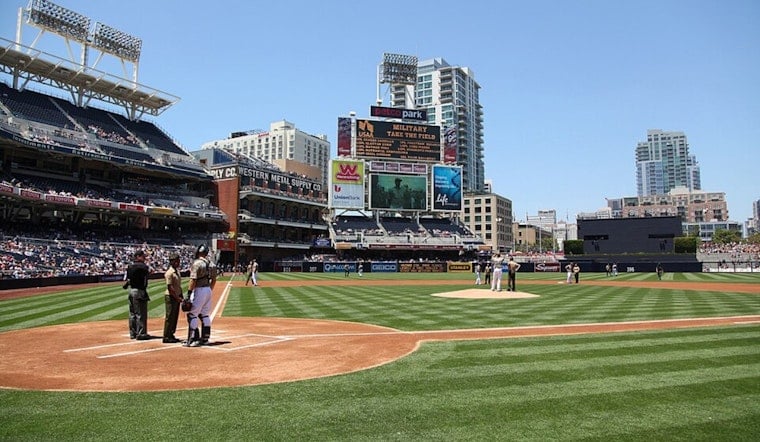
The San Diego Padres are quietly testing whether fans would tolerate the team wading into local politics, commissioning a poll that asks whether the club should back a minimum-wage increase, oppose it, or even endorse candidates in city races. The survey lands as the team stews over two policy fights it says it learned about with little to no advance warning: a spike in parking-meter rates around Petco Park and a push to raise wages for tourism workers across the city.
A Poll That Tests the Padres' Political Future
According to a KPBS report authored by Scott Lewis, the polling firm Competitive Edge Research and Communication sent a survey to at least one reader asking whether professional sports teams should take stands on local political issues affecting their business operations. The poll also asked whether respondents support or oppose the city's proposed minimum-wage increase, whether the Padres should actively support that increase, and — notably — whether the team endorsing a local candidate that a respondent opposed would worsen that person's opinion of the club. Competitive Edge has a history with the organization, having previously worked with the Padres on multi-year market research projects, including fan feedback that shaped the team's brown and gold uniform redesign.
The polling comes as insiders tell KPBS that the Padres and other organizations are discussing whether to support an easier or phased version of the wage increase, and that the team and area hotels may even push the issue to a public referendum. The station's report frames the survey as evidence the ballclub is becoming a more overt political actor in San Diego public affairs, with political spending potentially reshaping how directly the Padres involve themselves in civic conversations going forward.
Parking Rates Around Petco Park Jumped Fourfold
Part of the friction traces back to parking. The city of San Diego raised meter rates around Petco Park during major events from $2.50 per hour to $10 per hour and also ended free parking-meter time after 6 p.m. during those events, per the same KPBS account. The Padres sent a statement saying the decision was made without meaningful input from key stakeholders, including the organization itself, and the team says it still has not received information about how the new parking revenue will be reinvested locally — even though state and local rules, as detailed by Inside San Diego, require meter revenue to be reinvested in parking and mobility infrastructure within the zone where it was collected.
Inside San Diego's announcement of the Special Event Parking Zone shows the $10-per-hour rate applies within a half-mile radius of the ballpark, kicking in two hours before major events. The policy has drawn pushback well beyond the Padres: Times of San Diego reported that Councilmember Raul Campillo and downtown business leaders held a January press conference proposing targeted amendments to reduce the event-parking rates after complaints from local workers and merchants. Hoodline previously noted the $10 meter jump in coverage of a downtown concert announcement.
Wage Ordinance Adds to the Team's Grievances
The parking dispute is only one flashpoint. San Diego's Hospitality Minimum Wage Ordinance, championed by Councilmember Sean Elo-Rivera, took effect July 1, raising minimum pay for event-center workers at Petco Park, Pechanga Arena, the Civic Theatre, and the San Diego Convention Center to $21.06 per hour, according to KPBS's earlier coverage of the ordinance. That rate is scheduled to climb annually until it reaches $25 per hour by July 1, 2030. A separate schedule covers hotels with at least 150 rooms and city-leased amusement parks larger than 75 acres, which moved to a $19.00-per-hour minimum this year before following the same path to $25 by 2030.
Padres CEO Erik Greupner wrote that the city gave the organization no prior notice before publicly announcing the minimum-wage proposal, which the article notes would apply broadly to workers at hotels, convention centers, event centers, stadiums, arenas, amusement parks, and zoos. The proposal under consideration by the San Diego City Council would raise the tourism-worker minimum from $17.25 per hour to $25 per hour. Greupner has said the team already pays stadium workers above minimum wage and meets the mandated living wage required of tenants operating in a city facility, with Padres stadium workers currently earning more than $21 per hour. That baseline sits above the city's general minimum wage, which rose to $17.75 per hour on January 1 for employers not covered by the hospitality ordinance, according to a policy analysis from Constangy, Brooks, Smith & Prophete LLP.
Why the Padres Feel They Have Leverage
The team's frustration is rooted partly in its economic weight. Petco Park and Gallagher Square generated $913 million in new economic impact and $1.48 billion in total countywide economic sales across 183 events in 2024, according to a March economic impact study from the San Diego Regional Economic Development Corporation, as Hoodline previously reported. The same analysis estimated that each Padres home game generates roughly $9.3 million in local economic sales, while contributing more than $16.4 million annually to the city's general fund and $10.5 million to $12.4 million in hotel tax revenue.
Despite the standoff, the Padres declined to discuss their political aims or position when asked by KPBS, and the team says it looks forward to better understanding the city's plan on these issues going forward. The club said it feels it has been left out of too many conversations, even as it continues setting attendance records and, per baseball people widely cited in the KPBS report, is expected to compete for a National League championship and a World Series appearance this season. Whether that on-field success translates into political capital off the field may hinge on what the Padres' polling ultimately tells them.




