

























































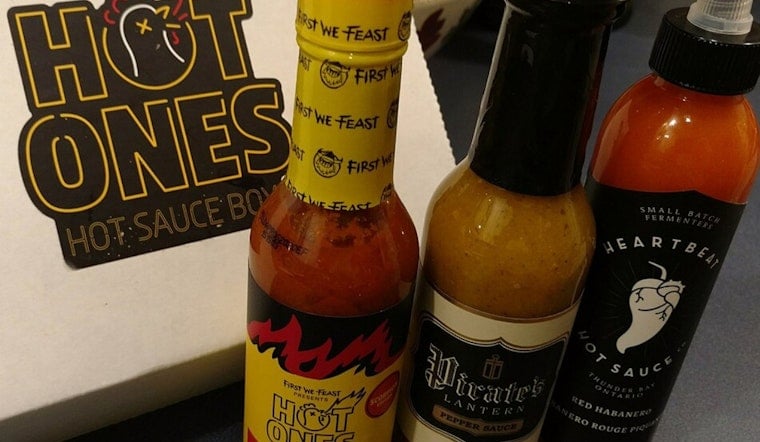
A hot sauce brewed in San Diego's Midway District is now the very first bottle contestants reach for on the newest season of Hot Ones, the YouTube show where celebrities answer questions while eating progressively spicier chicken wings. Down to Ferment's “That's What Shishito Said” landed the No. 1 spot in the show's 10-sauce lineup for Season 30, marking a major leap for a company that started with a folding table at neighborhood farmers' markets.
According to FOX 5 San Diego & KUSI News, a Hot Ones team member first discovered the sauce while shopping at San Diego International Airport, where Down to Ferment sells its products. That team member later contacted the company about featuring the sauce in the show's lineup, and the Hot Ones team ultimately asked Down to Ferment to be the first sauce of the season — an offer the company accepted. Hot Ones was created by Sean Evans and Chris Schonberger, and each episode features guests sampling all 10 sauces while fielding interview questions.
Down to Ferment co-founder Sean Kirkpatrick told the outlet he had one particular reaction in mind when he heard the news: he wanted to hear Sean Evans say “That's What Shishito Said” on camera. The sauce carries a mild 2/10 heat rating and leans into an Asian-inspired umami profile built from fire-roasted shishitos, jalapeños, yerba mate kombucha culture, white miso, black garlic, shiitake mushrooms, ginger, yuzu, mirin, tamari, and shiso leaf, according to Heatonist, the retailer that curates and distributes the show's official sauce packs.
A Kombucha Base Instead of Vinegar
What sets Down to Ferment apart from most hot sauce makers, per the FOX 5 San Diego & KUSI News report, is that the company skips traditional vinegar entirely. Instead, it uses house-made kombucha as the base ingredient across its lineup, all produced in-house at its facility. Kirkpatrick said the kombucha lets the ingredients meld together and creates a more pleasant palate experience than a straight vinegar base typically allows.
That fermentation-first approach takes time. Producing a single bottle requires more than a month from start to finish, the result of a full lactic acid pepper fermentation process paired with in-house kombucha brewing, according to Down to Ferment. Most commercial shelf-stable hot sauces rely on quick-cooked distilled white vinegar rather than a raw, brewed base, making the company's process notably slower and more hands-on than typical mass production.
From Farmers' Markets to a Global Audience
Down to Ferment was co-founded by Kirkpatrick and Ryan Minor, a Marine Corps veteran and craft mixologist. Kirkpatrick started the business after working as an executive chef and culinary director, seeking more creative freedom than that role allowed, per Down to Ferment's own account of its founding. The company built its early customer base the old-fashioned way, selling at weekly farmers' markets in Hillcrest, La Jolla, and Poway before expanding into its current Midway District facility.
The brand had already picked up national recognition before its television debut. “That's What Shishito Said” won 1st Place for Best Asian Style Sauce at the NYC Hot Sauce Expo's Screaming Mimi Awards, while another Down to Ferment product, Harissa Vibe, took 1st Place in the World Beat category at the 2026 Scovie Awards. Down to Ferment says it hopes the Hot Ones exposure will introduce more people to its growing lineup of unique, flavor-forward hot sauces.
How the Hot Ones Lineup Gets Chosen
Landing a spot on the show is no small feat. Each season's 10-sauce lineup is chosen through a multi-round curation process in which Heatonist founder Noah Chaimberg and show co-creator Chris Schonberger taste-test 20 to 30 candidate sauces across multiple sessions, according to Mashed. Heatonist has served as the show's official hot sauce curator since 2015.
Small-batch producers that make the cut often see what the industry calls the “Hot Ones Effect,” a phenomenon in which featured brands experience immediate global e-commerce order spikes and accelerated retail distribution, per SIAL Paris. Featured sauce makers frequently use the spotlight to expand into major national grocery chains soon after their episodes air.
A Bigger Moment for California's Hot Sauce Scene
Down to Ferment's rise arrives as investor attention on Southern California condiment brands has been building. Dallas private equity firm Highlander Partners acquired Vernon-based Tapatío Hot Sauce in April, while committing to keep the company's factory operations local, as Hoodline previously reported. The global hot sauce market itself was valued at $5.85 billion in 2025 and is projected to reach $10.9 billion by 2034, driven largely by demand for flavor-first, low-sodium, and fermented specialty condiments, according to Straits Research.
For now, Down to Ferment's focus remains on its Midway District kitchen, where the same month-long fermentation process that built its local following continues to produce every bottle bound for San Diego International Airport shelves and, soon, a much wider national audience tuning in to watch celebrities sweat through its sauce.





