

























































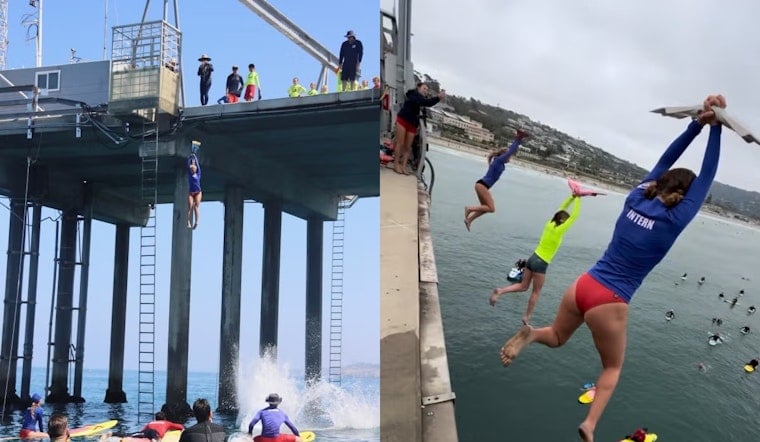
Finn Renard spent his final day as a San Diego junior lifeguard intern the same way he'd spent the rest of his summer — training in the water he loved. Instead, the 17-year-old broke his neck after diving into the ocean off Mission Bay, and 19 days later he remains on life support in intensive care.
A Routine Relay Turns Catastrophic
According to a GoFundMe campaign organized on behalf of the Renard family, Finn was taking part in a routine training relay on July 31 — the last day of his summer internship — when he struck his head on the ocean floor. He was briefly knocked unconscious before fellow junior lifeguards administered emergency care and coordinated his transport for treatment, per the campaign. As reported by 10News, Finn broke his neck after diving into the ocean and has now been on life support in the ICU for 19 days.
Surgeons at Scripps Memorial Hospital in La Jolla performed emergency spinal surgery to replace Finn's C5 vertebra and install titanium instrumentation from C2 through C6, according to the GoFundMe page. He regained some partial arm movement after the surgery but still has no movement in his hands or legs, and the family says he is expected to eventually transfer to Craig Hospital in Colorado, a facility that specializes exclusively in spinal cord and brain injury rehabilitation, for long-term neuro-rehabilitation.
A Program He Loved, A Family Far From Home
Finn traveled to San Diego each summer for the program, which 10News reports was his favorite part of the year. His family moved to Texas five years ago, but he kept coming back for the internship — a detail that has resonated with the local community rallying around him. His mother, Courtney Renard, told the outlet that San Diego is a small community, and that the response since his injury has been overwhelming.
San Diego Lifeguard Chief James Gartland visited Finn in the ICU, the station's report notes. Amid his treatment, Finn has reportedly told medical staff he wanted to thank them for trying to keep him alive. A GoFundMe campaign set up to help with his recovery has received 360 donations and nearly reached its $60,000 goal, and Courtney Renard said the community has provided substantial support during an unimaginably difficult stretch.
Inside San Diego's Junior Lifeguard Pipeline
Finn wasn't simply a teenager at the beach. He was a paid intern in the City of San Diego Junior Lifeguard Intern Program, a competitive summer initiative run through the San Diego Fire-Rescue Department's Lifeguard Services division for teens aged 15.5 to 17. Applicants must clear physical prerequisites including a 1-mile run in under 8 minutes 30 seconds and a 500-yard swim in under 10 minutes before they're accepted.
Interns in the program assist professional lifeguards in mentoring and instructing younger participants aged 7 to 17 in water safety, CPR, and ocean rescue skills, with support from the Prevent Drowning Foundation of San Diego. The program has long served as a recruitment pipeline for the city's future seasonal and full-time ocean lifeguards, and younger participants often look up to interns like Finn as role models, according to city materials.
Why Shallow Water Turns So Dangerous So Fast
Finn's injury fits into a grim national pattern. Diving is the fifth leading cause of paralyzing spinal cord injuries in the United States, according to the Shepherd Center, with young males accounting for roughly 80% to 85% of victims — and more than 60% of these injuries happen during summer months. National registry data show that over 60% of diving-related cervical spinal cord injuries result in quadriplegia, with most shallow-water diving injuries occurring in water under four feet deep.
The Centers for Disease Control and Prevention reports that diving and head-first water entry cause between 700 and 1,000 cervical spinal cord injuries nationwide each year, the vast majority resulting in permanent paralysis, and notes that shifting sandbars and ocean beds create hazards that aren't visible from the surface. A study published in BMC Public Health on beach-related cervical spine injuries found that these accidents happen most often during outgoing tides and low-to-moderate wave conditions, when hidden sandbars conceal sudden changes in depth without any warning on the water's surface.
San Diego's own municipal ordinances prohibit jumping or diving into the Pacific Ocean or Mission Bay from heights greater than five feet above the water, a rule Hoodline previously reported is meant to prevent exactly this kind of coastal and shallow-water trauma. City lifeguards perform dozens of rescues and water safety interventions along local shorelines every year, underscoring how unpredictable San Diego's surf zones can be even for trained swimmers.
For now, Finn remains on life support in the ICU as his family and the broader San Diego lifeguard community wait and hope. His mother's words to 10News — that the community's support has been overwhelming — reflect a city rallying around a teenager who spent his summers teaching other kids to be safe in the same waters that badly injured him.





