

























































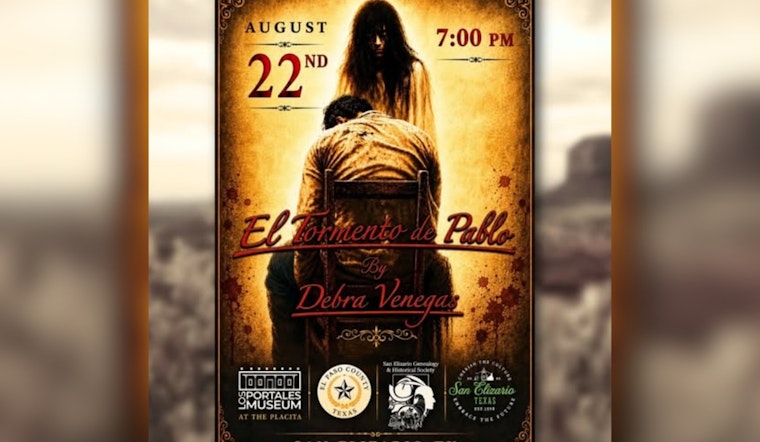
A new play is about to turn one of the Southwest's most famous ghost stories on its head, and it's happening right in the plaza of one of Texas's oldest towns. On Saturday, August 22, San Elizario will host the debut of “El Tormento de Pablo,” an original work by Debra Venegas that reimagines the legend of La Llorona not through the eyes of the weeping woman herself, but through those of her grieving husband, Pablo.
The evening kicks off with a mercado at 5:30 p.m. at the Los Portales Museum, followed by the play itself at 7 p.m. at Los Portales Museum at the Placita, according to a City of Socorro, Texas government post announcing the special evening. The museum sits at 1521 San Elizario Rd. in San Elizario, and the city says it is joining Los Portales Museum and Venegas to bring the production to the community. The mercado will feature local artists, vendors, food, refreshments, and live entertainment, per the same post.
That live entertainment lineup is packed for a single night: Danza Azteca Omecoactl, an Aztec blessing ceremony, live music, dancing Catrinas, and ballet folklórico are all part of the bill, according to the announcement. The production itself flips the traditional folklore by focusing on Pablo's choices and grief rather than solely on the weeping woman myth, according to Visit El Paso, which also notes the play incorporates Aztec blessing ceremonies, live music, and dance performances alongside Venegas's script.
A Museum Built on Ranger and County History
Los Portales Museum, the site hosting both the mercado and the performance, is associated with the San Elizario Genealogy & Historical Society, per the seed announcement. The building itself dates back further than most of the legends performed inside it: it was constructed in the early 1850s as a Territorial-style private home for Captain Gregorio Nacianceno Garcia, a Texas Ranger captain and El Paso County judge, according to Texas Time Travel. Garcia later donated the property in the 1880s to serve as El Paso County's first public school, and the structure operated as a school until 1936 before its conversion into a museum and visitor center.
The San Elizario Genealogy & Historical Society, which co-organizes events at the property, was founded in 1991 following a family reunion and incorporated as a Texas non-profit in 1997. The volunteer-led group partners with El Paso County to operate both Los Portales Museum and the Old County Jail Museum, according to its own account on the San Elizario Genealogy and Historical Society website.
A Plaza With a Deep Borderland Past
The town hosting this year's production carries a history that stretches back centuries before its current role in West Texas cultural tourism. San Elizario grew around a Spanish presidio established in 1789 and remained Mexican territory until the 1840s, when an 1829 Rio Grande flood shifted the river's channel south and ultimately placed the town within Texas boundaries, Texas Time Travel reports. Long before that, Texas historical markers and local accounts record that Spanish colonizer Don Juan de Oñate held a day of thanksgiving mass and feast with local Indigenous people near present-day San Elizario on April 30, 1598 — 23 years before the Pilgrims' Plymouth celebration, according to the Texas Almanac.
The town's 27-acre historic district earned a spot on the National Register of Historic Places on February 27, 1997, and was later designated a Texas State Cultural District in 2013, per the National Park Service. The district encompasses 18 self-guided historic sites centered around the plaza and sits along El Camino Real de Tierra Adentro National Historic Trail, a 404-mile U.S. route designated by Congress in October 2000 that originally spanned 1,600 miles from Mexico City to New Mexico, according to the National Park Service's account of the corridor's preservation.
From County Seat to Outlaw Lore
San Elizario's plaza has seen more than colonial ceremony and county governance over the centuries. The town actually served as the original county seat of El Paso County when the county was first established in 1850, holding the title twice before losing it to Ysleta and eventually to the city of El Paso in 1883, according to Beyond Nevada Expeditions. Losing the county seat, combined with being bypassed by the transcontinental railroad in 1881, contributed to a severe population decline in the late 19th century.
Just across the plaza from Los Portales stands the Old El Paso County Jail Museum, marking the original 1850s jail building where outlaw Billy the Kid famously broke out his associate Melquiades Segura in 1876 without firing a shot, according to Texas Highways. That jailbreak remains one of the town's most famous 19th-century episodes. San Elizario also anchors the El Paso Mission Trail alongside the historic Ysleta and Socorro mission churches, even though its primary chapel originated as a military presidio church rather than a mission — a detail Texas Highways notes complicates its inclusion on the three-site trail.
For anyone planning to attend the mercado and performance on August 22, the setting alone offers a walk through four centuries of borderland history before the first note of live music even plays.


