

























































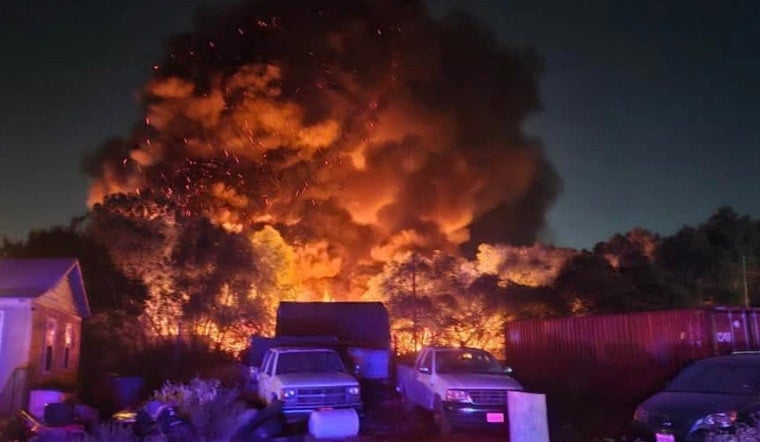
A brush fire tore through the unincorporated Dallas County settlement of Sandbranch last night, burning for about three hours before crews contained it around 11:30 p.m. after hauling water from hydrants two miles away because the community has no water infrastructure of its own. At least 13 volunteer and municipal fire departments responded to or hauled water into the roughly 80-person community, which lacks running water, sewer service, and even a local hydrant to draw from.
The fire ignited in an area with piles of mulch, tree stumps, and abandoned trailer structures, centered behind a section of Sandbranch that residents call “the bottom,” according to The Dallas Morning News. Resident Julie Ghant said she called 911 before 9 p.m. after seeing the beginnings of the flames, then evacuated with her dog Jasper as sheriff's deputies moved residents to nearby streets. Fellow resident Chris Ford said he was told to evacuate by a Dallas County Sheriff's deputy around 9 p.m. and noted there was no water in the area to fight the flames.
Dallas County Fire Marshal Assistant Chief Michael Barber said there were no injuries or fatalities, but that limited water resources increased the threat and prolonged extinguishing the fire. Crews ultimately hauled water from hydrants near the Southside Wastewater Treatment Plant, roughly two miles from the fire scene. Saturday's blaze marked at least the second fire Sandbranch has experienced in about a month; a resident's trailer caught fire on July 25.
A Settlement Founded by Freed Slaves, Still Waiting on Water
Sandbranch has never been annexed into Dallas or Seagoville and has never had running water or sewer infrastructure, leaving the county unable to provide municipal utilities to the unincorporated area. The settlement was established in 1878 by 12 formerly enslaved African Americans from Louisiana who bought land roughly 14 miles southeast of downtown Dallas and built an agricultural community, according to the Texas A&M Law Review. County officials confirmed well contamination in the community's wells in the mid-1980s, and while Sandbranch lots still have wells, residents largely rely on bottled water donations for cooking and drinking.
The isolation is made starker by geography: Sandbranch sits directly adjacent to the roughly 3,000-acre Dallas Southside Wastewater Treatment Plant, built in 1964, which has active municipal water lines running to it while the neighboring homes remain unconnected, as reported by The Guardian. A 2016 Texas A&M University study found the community's groundwater heavily contaminated with toxic runoff, rendering private well water unsafe for drinking, cooking or bathing. The community also lacks municipal trash collection, streetlights and dedicated fire protection, forcing residents to burn household trash on their own lots — a practice that creates the kind of dry-brush fire risk that fueled Saturday's blaze.
Decades of Blocked Fixes and a Distrust of Buyouts
The barriers to bringing Sandbranch water aren't just financial. In 1985, Dallas County adopted FEMA National Flood Insurance Program regulations designating Sandbranch part of a 1% Trinity River floodplain, which restricts new construction and major structural improvements to existing homes, per the Texas A&M Law Review. In 1991, the City of Dallas formally declined to annex the community after estimating it would cost $6.8 million for flood protection and $4.2 million for water and sewer infrastructure, according to the Dallas Weekly.
A 2005 Dallas County buyout program offers a cautionary tale for residents wary of relocation offers. Thirty-six Sandbranch families agreed to move under that program, but after property demolition fees were deducted, participating residents received as little as $350 each, leaving many struggling to secure housing elsewhere in the county. Texas counties, meanwhile, lack broad ordinance-making authority and cannot directly operate municipal water utilities in unincorporated areas without forming special districts, under Article V, Section 18 of the Texas Constitution and Chapter 232 of the Local Government Code.
Interim Fixes and a Renewed Push for Pipes
In the absence of pipes, nonprofits and clean-water advocates began installing solar-powered hydropanels in 2021 and 2022, costing about $8,000 per pair, to pull drinking water directly from air moisture for individual households. The panels produce small daily amounts of drinking water but cannot support fire suppression or household plumbing. Frank Alexander, pastor of Wayside Baptist Church on Beltline Road, said bringing water into the community can take too long, and he and volunteers distribute donated bottled water door-to-door every Saturday in Sandbranch.
Ghant said she wants running water inside residents' homes, not stopgap deliveries. In April 2023, Dallas County Judge Clay Jenkins and U.S. Rep. Jasmine Crockett announced joint efforts to secure federal USDA grants and state revolving funds to connect Sandbranch to Dallas Water Utilities, an effort tracked by the Water for Sand Branch Coalition. Previous grant applications had stalled over floodplain compliance issues, and as Saturday's fire showed, the community is still waiting for a fix that would let firefighters turn on a hydrant instead of hauling water two miles down the road.





