

























































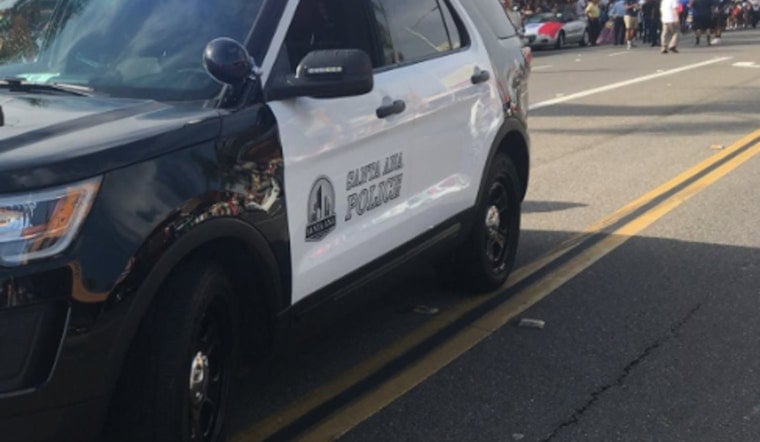
A bicycle theft from a Santa Ana front porch turned into a felony robbery arrest earlier this week after the suspect threatened to stab the owner when confronted, and police say a drone helped track the suspect down after he ditched the bike and ran. Officers ultimately took the man into custody on a robbery charge, a more serious offense than the simple theft that started the encounter.
According to the Santa Ana Police Department, the suspect stole the bicycle straight off the porch of a residence earlier this week. When the owner confronted him, the suspect allegedly threatened to stab them before fleeing with the bike. The department's post, tagged with the hashtags #SantaAnaPD, #WeAreSAPD and #31Eagle, credited the drone unit known as Eagle 1 with locating the suspect after he later abandoned the bicycle and ran from the area.
That threat is what turned a routine property crime into a felony. Under California Penal Code Section 211, robbery is defined as taking personal property from another person's immediate presence against their will through force or fear, a charge that carries state prison sentences of up to five years for second-degree robbery, according to Eisner Gorin LLP. California law treats robbery as a violent felony that cannot be reduced to a misdemeanor.
How a Porch Theft Becomes a Robbery Charge
The legal mechanism at work here is known as the “Estes robbery” doctrine. Under that rule, an ordinary theft automatically escalates to felony robbery if a suspect uses force or threatens physical violence — such as threatening to stab a victim — while trying to escape, per Radford & Rome. Established in the case People v. Estes, the doctrine holds that force or fear applied during the getaway phase legally transforms theft into robbery, even when the original taking involved no violence at all.
The bicycle case is the latest example of Santa Ana's Drone as a First Responder program in action. Just three days before the bicycle arrest, on August 4, officers used the same Eagle 1 drone to track down and arrest two felony suspects after spotting a stolen commercial work truck on 1st Street with property being loaded into it, according to Officer.com. In that incident, the aerial unit kept a visual lock on the suspects and guided ground officers directly to the scene.
A Program Built Under Strict Rules — and Recent Publicity
The Santa Ana City Council formally approved the Drone as a First Responder program on February 3, 2026, authorizing a $682,900, three-year contract for five drones funded by law enforcement grants, per DroneDJ. The city's Unmanned Aerial Systems policy adopted alongside that approval limits drones to specific incidents like crimes in progress or pursuits, and explicitly bars general surveillance, facial recognition, or continuous recording.
Just days before the bicycle arrest, Santa Ana Mayor Valerie Amezcua and SAPD held a public “Coffee with the Mayor” event on August 1 featuring a live demonstration of the drone program's real-time video feed, as reported by Voice of OC. The drones have also seen broader use beyond property crime; during the Fourth of July weekend, SAPD deployed them citywide, resulting in 107 drone-issued citations and contributing to what the department called the largest illegal fireworks seizure in Orange County history.
Regulation and a Regional Debate Over Surveillance
Santa Ana's drone rollout did not happen in a vacuum. Under California Assembly Bill 481, passed in 2021, law enforcement agencies must obtain annual approval from their governing body and submit public reports before purchasing or operating military-grade equipment, including drones, according to LAist. That requirement is why the drone policy went before Santa Ana's City Council and the public in the first place.
Drone adoption is expanding well beyond Santa Ana. Neighboring Irvine Police Department logged more than 4,300 drone flights in a single year, according to disclosures released in July 2026 and reported by the same Voice of OC outlet. Multiple Orange County jurisdictions are investing in similar first-responder drone systems aimed at cutting response times.
That expansion is occurring even as statewide crime data shows a different trend. Official California crime statistics indicate that overall rates of violent crime, property crime, robbery, and vehicle theft have dropped since 2019, even as Southern California law enforcement agencies increase spending on surveillance technology, per Voice of OC's reporting. Local debates in Santa Ana often set falling crime metrics against the city's growing budget for police technology, leaving residents and privacy advocates to weigh whether tools like Eagle 1 are proportionate to the threat they're built to counter.





