

























































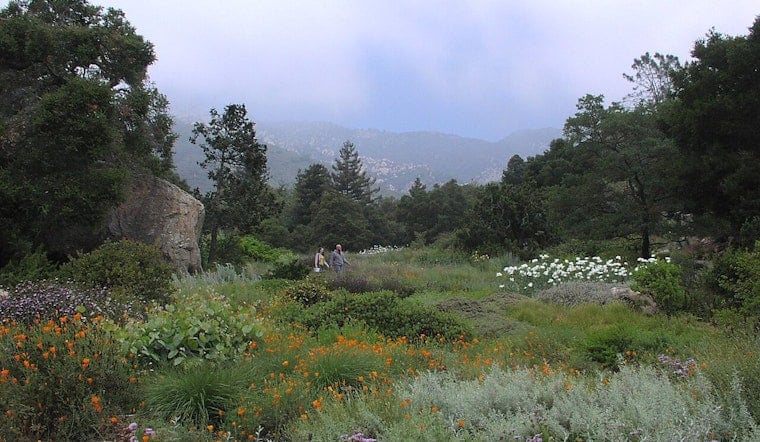
The Santa Barbara Botanic Garden is turning 100 years old this year, and it's marking the milestone by throwing open its gates for free admission every Sunday in October. The Mission Canyon institution, which has grown from a small memorial garden into a 78-acre showcase of California native plants, is pairing the free-entry offer with a season of centennial events, from a silent disco under the redwoods to a Halloween dog parade.
The garden traces its roots to 1926, when local philanthropist Anna Dorinda Blaksley Bliss purchased 13 acres in Mission Canyon as a memorial to her father, Henry Blaksley, according to the Santa Barbara News-Press. What began as the Blaksley Botanic Garden has since expanded to more than five miles of trails showcasing over 1,000 California native plant species. By 1936, the garden had narrowed its horticultural mission exclusively to species within the California Floristic Province — a region stretching from Baja California to southwestern Oregon — making it the first botanic garden in the United States dedicated solely to native plants, per the Santa Barbara Botanic Garden.
As NBC 7 San Diego reports, free admission will run every Sunday in October, but reservations are required to manage capacity even on the no-cost days. That requirement isn't just centennial red tape — the garden operates under a Santa Barbara County conditional use permit that caps annual public attendance at 110,000 visitors due to traffic and parking constraints in Mission Canyon. The News-Press reported in March that Executive Director Steve Windhager said high demand has leadership favoring a push for an increased cap of 130,000 visitors, contingent on agreement from neighboring residents.
A Century Recognized by the State
The garden's anniversary hasn't gone unnoticed in Sacramento. California Senate President pro Tempore Monique Limón officially named the Santa Barbara Botanic Garden the 2026 California Nonprofit of the Year in May, honoring its 100 years of conservation leadership and climate resilience research, according to the garden. Members of the California State Legislature select one standout nonprofit annually from their respective legislative districts, and this year that distinction landed on the Mission Canyon institution.
The recognition reflects a mission that goes well beyond scenic trails. The garden operates the Pritzlaff Conservation Center, home to a Conservation Seed Bank holding more than 850 accessions representing nearly 300 rare plant species, plus a Tissue Bank established in 2018 that now houses more than 13,500 genomic samples, per the garden. Seeds stored in cryogenic freezers there serve as a genetic backup against extinction for species found across California and the Channel Islands.
Layers of History Beneath the Trails
The grounds themselves carry history that predates the garden by more than a century. The property encompasses the Mission Dam and Aqueduct, built in 1806 using Chumash labor to supply water to Old Mission Santa Barbara by gravity flow two miles downstream. The structure was designated Santa Barbara County Historic Landmark #24 in 1983, with the designation expanded in 2003 to protect additional garden structures including the Caretaker's Cottage and Information Kiosk.
The garden's landscape design also bears the fingerprints of two prominent 20th-century landscape architects. Lockwood de Forest Jr. designed the early trails and the 1938 Information Kiosk, while Beatrix Farrand joined the garden's board in 1938 to design the oval meadow and master plan, according to the The Cultural Landscape Foundation. The two reportedly engaged in famous design debates over whether entry paths should be formal and axial or naturalistic and meandering.
The garden has also weathered disaster. In May 2009, the Jesusita Fire burned through 60 of its 78 acres and destroyed several historic structures. Staff later used areas like the Porter Trail to study and showcase native plant regeneration in the fire's aftermath, turning the recovery into a living lesson on wildfire ecology.
Centennial Events Fill Out the Fall Calendar
Beyond the free Sundays, the garden's centennial year features a self-guided Centennial Route Map tracking landmark historical points, along with an archival exhibition titled Still Growing: 100 Years of California's Native Plants, which opened in June and draws from a century of photos, blueprints, and records housed in the Blaksley Library, according to Noozhawk.
Fall programming ramps up with Silent Disco in the Redwoods on October 2, priced at $75 per ticket and including a pair of drinks from Lumen Wines and Third Window Brewing. The garden will also include music and storytime sessions among its fall offerings. Local restaurants and bars are joining in too: the Garden to Glass promotion will feature limited-time botanical cocktails at participating venues including Convivo and La Paloma, with $1 from each drink sold donated back to the garden.
Families and dog owners get their own centennial moment on October 25 with the Halloween Pooch Parade, a costumed dog event offering a garden dog membership as its grand prize. The local chapter of Therapy Dogs of America is teaming up with the garden for the event. It's a fitting complement to The Backcountry, the garden's 4.5-acre interactive outdoor play space along Mission Creek, where wooden bridges, play huts, and tree stump obstacles encourage unstructured children's play in native habitats — a feature leadership has credited as a primary driver of increased youth attendance.





