

























































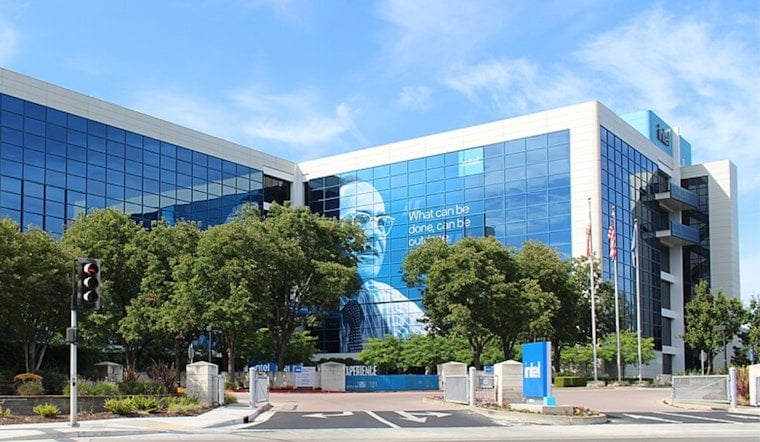
Intel is asking Wall Street for $15 billion, betting that the flood of demand for AI computing chips will keep paying off even as the Santa Clara company's stock takes a hit from the move. The chipmaker announced the common stock offering Monday, saying the money will go toward capital expenditures and working capital as it races to build out manufacturing capacity for artificial intelligence hardware.
The offering is being lead-managed by J.P. Morgan Securities, Goldman Sachs, Morgan Stanley, and Citigroup, and underwriters have a 30-day option to purchase up to an additional $2.25 billion in shares — meaning Intel could ultimately pull in as much as $17.25 billion, according to CNBC. In its announcement, Intel pointed to purpose-built silicon, advanced packaging, and physical AI as major growth opportunities driving the need for fresh capital, per the same report. The company said the proceeds are meant to support what it described as skyrocketing customer demand for AI compute.
Investors didn't exactly cheer. Intel shares fell 3% to 4% in premarket trading Monday, dropping below the $100 mark on dilution concerns, even though the stock has surged more than 170% so far in 2026 and over 400% in the trailing 12 months, according to Morningstar. That's a steep round trip for a stock that bounced from a 52-week low of $19.61 before climbing above $101 heading into Monday's announcement.
Why Intel Needs the Cash Now
The equity raise comes on the heels of Intel hiking its own spending targets. In July, the company raised its full-year 2026 capital expenditure forecast from $18 billion to more than $20 billion, and executives have projected that 2027 capex will climb significantly higher still, according to the Wall Street Journal. Intel management has tied that surge directly to customer commitments outstripping the company's current manufacturing capacity — cleanroom space and specialized equipment simply can't be built fast enough to keep pace with orders.
The numbers behind that urgency showed up in Intel's second-quarter results. The company reported $16.1 billion in revenue for the quarter, a 25% year-over-year increase that marked its fastest top-line growth in more than 15 years, alongside $7.0 billion in operating cash flow, per Silicon Republic. Intel's Data Center and AI Group alone posted $6.3 billion in revenue, up 59% year-over-year, as server CPU demand for AI inference and agentic workloads outpaced what the company's factories could actually produce, according to Quartz.
Intel's contract foundry business also grew, generating $5.8 billion in revenue during the quarter — up 31% year-over-year — as the company committed to mass production of its next-generation 14A process node by 2028, having landed Tesla as its first major 14A client in April, according to Euronext Reuters. Even so, external foundry sales — revenue from outside customers rather than Intel's own chips — remained modest at $293 million for the quarter, a gap that underscores how much scaling is still needed before the foundry business can justify the scale of new investment on its own.
A Wider Bet Playing Out Across Ireland and the Cloud
Some of that capital spending is already landing far from Santa Clara. In July, Intel committed €5 billion, or roughly $5.7 billion, to upgrade and expand its semiconductor manufacturing campus in Leixlip, Ireland through 2027, installing tools to produce Intel 3 node Xeon 6 processors for European markets, per Tom's Hardware. That single project accounts for more than a quarter of Intel's planned 2026 capital spending.
Intel has also been widening its customer base beyond its own chip lines. The company signed a multiyear agreement with Google Cloud in 2026 to co-develop custom ASIC-based IPUs and processors, and it joined Elon Musk's Terafab chip factory project, moves that reflect how cloud providers are increasingly pursuing multi-vendor foundry strategies rather than relying on a single chipmaker.
A Federal Stakeholder and a Leaner Workforce
Intel's balance sheet already carries an unusual backer. In August 2025, the U.S. government acquired a 9.9% non-voting equity stake in Intel, purchasing 433.3 million common shares at $20.47 per share for $8.9 billion by converting remaining CHIPS and Science Act grants and Secure Enclave defense funds into stock, according to Manufacturing Dive. The deal converted $5.7 billion in CHIPS Act grants and $3.2 billion in Secure Enclave funds without granting the government board seats or voting rights, making Washington Intel's largest shareholder even as it stays out of day-to-day governance.
That capital raise arrives alongside a leaner Intel workforce. Under CEO Lip-Bu Tan, who took over in 2025, the company has cut more than 35,000 jobs globally since 2024 as it reallocates capital away from legacy operations toward AI chip fabrication and advanced packaging, per Silicon Republic's reporting. Locally, that shift has hit close to home — Hoodline previously reported that Intel filed WARN notices cutting 103 Santa Clara jobs across four local facilities as part of the same data center realignment.
The equity raise also fits into a much larger industry pattern. Megacap technology companies have been ramping capital expenditures on AI demand, spending an estimated $765 billion in 2026 and a projected $1.2 trillion in 2027, according to Goldman Sachs estimates cited by CNBC. Amazon has given the highest capital expenditure guidance among that group, and has cited a memory chip supply crunch as part of its own spending rationale — a sign that the capacity crunch driving Intel's stock sale extends well beyond one Santa Clara company.





