

























































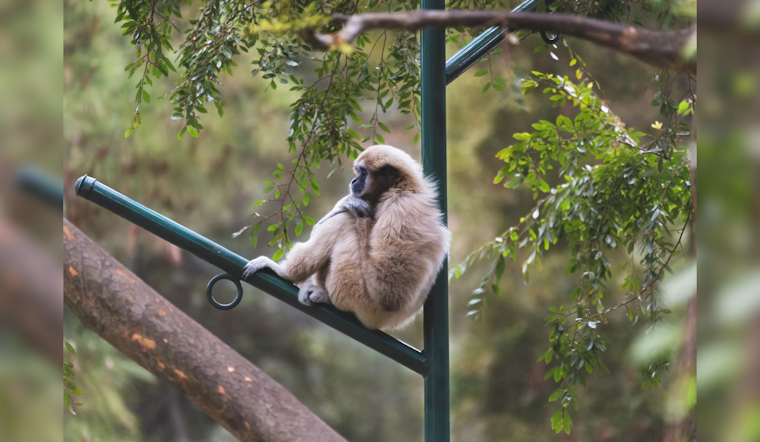
Tucked into a canyon at 1,400 feet elevation in Santa Clarita, a small nonprofit sanctuary has spent half a century keeping some of the world's rarest apes alive and, remarkably, reproducing. The Gibbon Conservation Center cares for about 50 gibbons across five species, feeding them five to six times a day in an effort to mimic the foraging patterns they would follow in the wild. Some of those species number fewer than 1,000 individuals left in the wild.
The sanctuary was founded by self-taught primatologist Alan Root, according to the Associated Press. Other historical accounts identify the center's founder as Alan Richard Mootnick, a self-taught primatologist who purchased the 10-acre property in 1980 using earnings from his home remodeling and painting business, per the Los Angeles Times. Mootnick directed the facility for 35 years, becoming an internationally recognized gibbon authority and publishing peer-reviewed papers despite lacking a formal academic degree in biology, before dying at age 60 in November 2011 following complications from heart surgery.
Today the center is led by director Gabi Skollar, who moved to the United States from Hungary in 1994 and began working at the sanctuary that year. Skollar continued the center's mission after her husband's death, stepping in to manage day-to-day operations and animal health. On-site caretaker Jodi Kleier, who hand-raised a gibbon named Rocky, said the center must continue caring for the animals — a commitment on display two weeks ago when Kleier fed a gibbon a piece of banana and Skollar fed another gibbon inside one of the center's enclosures.
A Global Distinction Bred in a California Canyon
The Santa Clarita sanctuary remains the only institution in the world to house and successfully breed species across all four extant gibbon genera — Hylobates, Hoolock, Nomascus, and Symphalangus — reproducing seven gibbon species in captivity, according to Hipcamp. The center has successfully bred Javan gibbons, an endangered species found only on the Indonesian island of Java, and is now sending a pair of northern white-cheeked gibbons — among the rarest gibbons — to the Pittsburgh Zoo. Gibbons are exceptionally sensitive to environmental stress and rarely reproduce in captive settings unless conditions meet strict physical and emotional needs.
Gibbons sing loudly in the morning, a chorus that some nearby neighbors in Santa Clarita can hear from their homes. The behavior is rooted in biology: gibbons possess enlarged hyoid neck bones that allow their complex songs and calls to travel up to two miles through forest canopy, establishing territory and reinforcing monogamous pair bonds, according to Metrolink. Each of the 20 recognized gibbon species carries its own distinct song and acoustic signature.
Extreme Weather and an Uncertain Future in the Wild
Housing tropical Asian apes in Southern California's high desert brings its own operational headaches. The sanctuary's canyon location sees summer temperatures top 100 degrees and freezing winter nights, requiring custom tarps, vinyl-wrapped Dogloo shelters, and high-pressure misting systems that evaporate quickly to add humidity without rusting the metal enclosures.
The stakes driving that daily effort are stark. Gibbons face increasing threats from habitat destruction and the wildlife trade, with young animals captured from their parents as babies and sold as pets. All 20 recognized gibbon species are threatened with extinction on the IUCN Red List due to tropical deforestation and poaching, and the Hainan gibbon stands as the world's rarest primate, with a global wild population of roughly 42 individuals as of 2025, according to the Frontiers journal. Habitat fragmentation had already reduced that population to fewer than 10 individuals in the 1970s. Native populations of species like the northern white-cheeked gibbon have plummeted nearly 80% over the past 50 years, per the Akron Zoo, which noted that the Association of Zoos and Aquariums has established a Gibbon SAFE program to coordinate conservation science, education, and anti-poaching work across accredited institutions.
A Research Hub and a Push for New Enclosures
Beyond breeding, the center studies gibbon care and identification and has published its findings in scientific journals, contributing to global gibbon research. It works with the teaching zoo at Moorpark College, which takes first-year students on an annual field trip to the sanctuary, and the center more broadly receives students from schools, universities, and senior centers alongside researchers from around the world. The sanctuary hosts as many as 3,000 veterinary, anthropology, and ethnomusicology students and researchers each year, offering non-invasive observational access that supports studies of vocalizations and skeletal anatomy tied to wild conservation.
The center's reach has even extended to film: a feature-length documentary titled The CENTER: Gibbons and Guardians, directed by Alex M. Azmi and featuring commentary from Dr. Jane Goodall, was released in September 2021 profiling the sanctuary's daily operations and the threat posed by regional brushfires, according to Film Threat.
Operating as a 501(c)(3) nonprofit that relies on donations and volunteer labor, the center opens to the public for guided tours on weekends, priced at $20 per adult, with visits strictly by reservation to avoid disturbing the resident ape families. The sanctuary now plans to raise more money to build larger gibbon enclosures and construct an education center for visitors, continuing a mission that has kept rare, endangered gibbons alive in a Santa Clarita canyon for half a century.




