

























































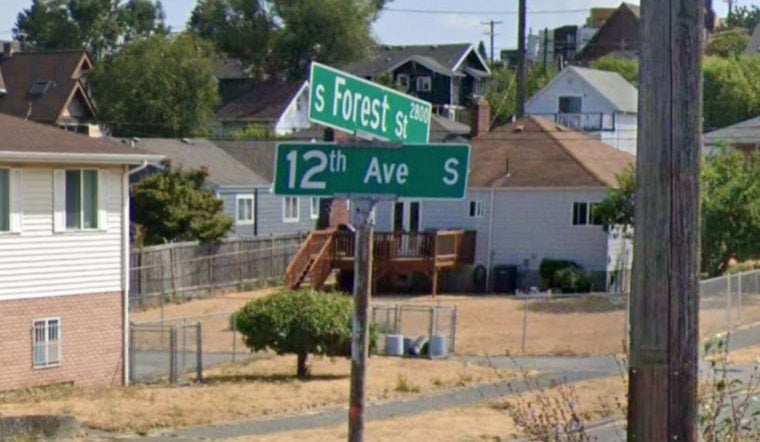
Seattle firefighters launched a rope rescue operation early Monday after a person fell down a steep ravine near 12th Avenue South and South Forest Street and couldn't climb back out. Crews located the patient approximately 30 feet down the slope, according to the department, and worked to bring them to safety using technical rescue equipment.
The Seattle Fire Dept. posted about the response on the social platform X, confirming that firefighters located the patient roughly 30 feet down the ravine near the Beacon Hill intersection. The department reported that a rope rescue response was underway for a person who had fallen and was unable to climb out on their own.
The location sits along the steep western slope of Beacon Hill, where sloped greenbelt ravines drop sharply toward Interstate 5 and Airport Way South, according to property records reviewed by Redfin. That topography has made the area a recurring site for technical rescues. A Facebook video from earlier this year documented Seattle Fire executing a rope rescue at this same intersection for a person who fell approximately 50 feet down the hillside off a nearby trail.
A Specialized Team Built for Steep Terrain
Rope rescues like this one typically fall to Seattle Fire's Technical Rescue Team, which operates out of Rescue 1 at Fire Station 14 in SoDo. Per the department, that unit handles high-angle rope rescues, structural collapses, trench rescues, and confined space extrications across the city. Station 14 also serves as part of King County Fire Zone 5 and participates in Washington Task Force 1 urban search and rescue operations, according to the Washington Military Department.
Firefighters assigned to that team complete more than 40 hours of intensive rope rescue technician training, according to Empact Northwest, covering high-directional anchors, victim packaging in Stokes baskets, and mechanical advantage haul systems. Their equipment and procedures are governed by state rules: under Washington Administrative Code 296-305-05113, fire departments performing rope rescues must follow NFPA 1670 technical rescue standards and use life safety ropes rated to NFPA 1983.
A Pattern of Ravine and High-Angle Calls
Monday's response fits a broader pattern this year of Seattle Fire deploying rope teams across steep and hard-to-reach terrain. In May, the Technical Rescue Team used high-angle rope equipment at Discovery Park to extricate a hiker who suffered a 40-foot fall, a rescue Hoodline covered in a standstill at Discovery Park. In April, firefighters set up a high-directional rope system from a 10th-floor opening to rescue two people trapped in an elevator shaft in a downtown high-rise, and in March, multiple companies including Ladder 13, Ladder 1, Engine 26, Engine 32 and Rescue Company 1 rappelled nearly 20 feet down a West Seattle bluff to retrieve two stranded therapy dogs.
Beacon Hill's greenbelt slopes, including areas around Dr. Jose Rizal Park and nearby ravine corridors, see regular foot traffic from residents, park visitors, and encampments along informal trails, according to KOMO News. Unmanaged brush and steep inclines along those unmaintained paths present ongoing safety risks for anyone navigating off-trail routes.
It remains unclear how the patient ended up 30 feet down the ravine or whether informal trail conditions played a role in the fall. The patient's condition following Monday's rescue has not been released, and there is no indication yet of whether the city plans any physical barriers or warning improvements along this stretch of Beacon Hill.





