

























































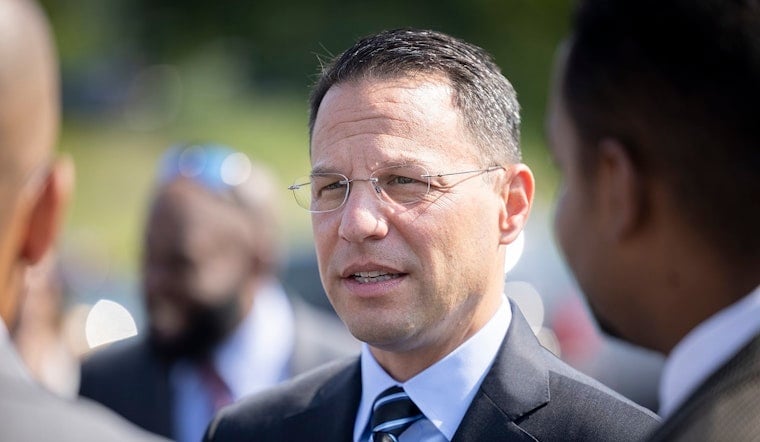
Governor Josh Shapiro has launched a new six-figure advertising blitz aimed squarely at Pennsylvania's Latino voters, rolling out a Spanish-language ad on YouTube that centers on an Allentown woman who credits one of his tax credit programs with putting more money back into her family's pocket. The early push, months before most voters typically start paying attention to a general election, signals that Shapiro's team sees Latino communities along the state's 222 corridor as pivotal to both his reelection and something further down the road.
The Pennsylvania governor's race pits Shapiro against Republican nominee and current state Treasurer Stacy Garrity, and as Axios reports, Shapiro has dominated Garrity in fundraising heading into the fall campaign. In the ad, the featured Allentown woman says plainly that “prices are out of control” and that her family feels it is impossible to get ahead — a sentiment her testimonial ties directly back to relief she says came from a Shapiro-backed tax credit.
That credit traces to December 2023 legislation that expanded Pennsylvania's Child and Dependent Care Enhancement Tax Credit from a 30% state match of the federal credit to a full 100% match, raising the maximum benefit to $2,100 per family. According to the Commonwealth of Pennsylvania, the expanded credit delivered $136.5 million in relief to nearly 219,000 working families in 2024 alone.
Why The 222 Corridor Matters
The ad buy is landing in a stretch of eastern Pennsylvania known as the 222 corridor, which includes Allentown, Hazleton, Reading and Lancaster. Pennsylvania is home to roughly 1.3 million Latinos, and a UCLA Latino Policy and Politics Institute study found the state had about 579,000 eligible Latino voters as of September 2024 — nearly 6% of the total electorate, with voters aged 18 to 24 four percentage points more likely to be Latino than the broader voting population.
City-level numbers make the stakes plain. Census data and local electoral analysis cited by the Pittsburgh Post-Gazette show Reading is more than 70% Latino, Hazleton is 62% Latino and Allentown is 54% Latino. Political observers say the corridor has seen growth in the Republican vote in recent elections, a shift that helps explain why Shapiro's campaign isn't waiting until after Labor Day, when many voters typically begin tuning in, to make its pitch.
A Divided Political History
That Republican growth hasn't been uniform. Hazleton became the only one of Pennsylvania's three major Latino-majority cities to back Donald Trump in recent elections, while Reading and Allentown supported Democratic presidential candidates even as both cities gave Trump about 35% of their vote, according to reporting from the Philadelphia Inquirer. Randall Miller, a professor emeritus of history at St. Joseph's University and political commentator, said voters in these communities want to know whether Shapiro is helping them now, not just making promises.
“Shapiro is saying he understands and empathizes with the problem and proposes to help,” Miller said, pointing to cost of living as a major concern for families and small business owners across the region. Trump administration tariffs have also contributed to higher prices on goods, adding another layer to the economic anxiety driving the messaging in Shapiro's ad.
An Eye Toward 2028
Miller also suggested the ad campaign carries implications beyond this year's ballot. He said Shapiro could be positioning himself to seek Latino voters' support for president in two years, an idea reinforced by the Democratic Party's decision to move up states with heavy Latino populations, including Nevada and New Mexico, in the presidential primary schedule. That shifting calendar could give Latino voters an earlier say in choosing the next Democratic presidential nominee.
Shapiro's campaign spokesperson, Manuel Bonder, framed the effort differently, saying per Axios that the campaign builds on Shapiro's long track record of delivering for and engaging with Pennsylvania's Latino community. Latino voters could prove key to both Shapiro's reelection and any future presidential run, though Miller noted Shapiro must first secure a dominant win over Garrity before testing a national coalition in a White House bid.
The Money And The Messaging
The financial gap between the two candidates has become one of the defining features of the race. Shapiro raised $10.5 million in the first quarter of 2026 alone, a Pennsylvania record for that reporting period, and accumulated $50 million total for his reelection campaign between January 2025 and July 2026, according to Spotlight PA. Garrity, by contrast, reported just $1.5 million on hand at the end of March 2026.
Part of Shapiro's fundraising surge came from a national book tour tied to his memoir, Where We Keep the Light, including appearances on national late-night television that expanded his donor base across all 50 states, per CBS News. That national network allowed him to direct $250,000 to the state party aimed at flipping battleground legislative seats. A Susquehanna Polling & Research survey released in March 2026 showed Shapiro with a commanding 22-point lead over Garrity among likely voters, 58% to 36%.
Garrity has turned to President Trump for a boost of her own, holding a six-figure fundraising dinner at Trump's Mar-a-Lago club in March 2026 and appearing alongside him in an August Oval Office video posted to Truth Social in which he formally endorsed her campaign. Garrity previously won election as state treasurer in 2020 with more than 3.2 million votes, the highest total recorded by any statewide candidate in Pennsylvania that year, before winning reelection in 2024 and the uncontested GOP nomination for governor this past May.
Beyond the ad buy, Shapiro has also worked pop culture into his outreach, appearing in Meek Mill's latest music video, and Hispanic adults are especially likely to encounter such messaging online — 43% regularly get news on YouTube, according to Pew Research Center. With the governor's race expected to heat up in the coming weeks, the early and heavily targeted rollout suggests Shapiro's team isn't leaving Latino outreach in eastern Pennsylvania to the fall stretch.





