

























































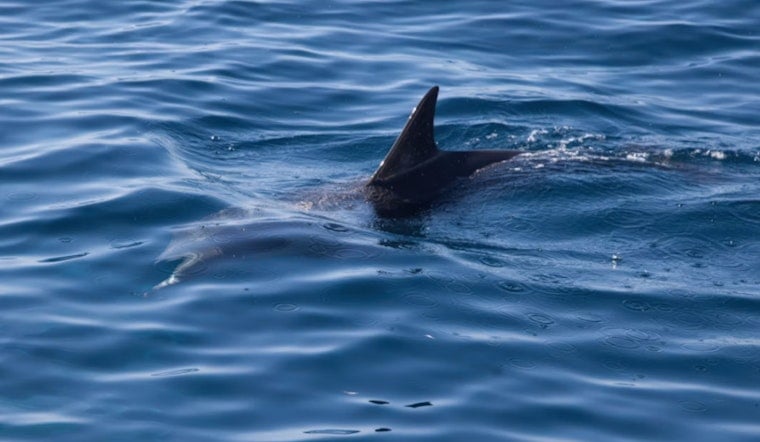
Swimming came to an abrupt halt at Cohasset's Sandy Beach on Saturday after a shark was spotted in local waters, prompting police to shut the beach down to swimmers for the rest of the day. No injuries were reported, and officials urged beachgoers to follow posted restrictions and stay out of the water until the closure lifts.
The Cohasset Police Department announced the closure after the sighting, though as Boston 25 News reported, police did not immediately specify the shark's species or the exact coordinates of the sighting. The story was still developing as of Saturday, and further details were expected to be updated as they became available.
It's not the first time this exact stretch of coastline has seen a summer swim get cut short. According to Boston 25 News, Cohasset Police suspended swimming at Sandy Beach for more than two hours in July 2025 after a local lobsterman reported seeing what was believed to be an oceanic whitetip shark offshore — a sighting that, like Saturday's, could not be independently verified by public safety crews who canvassed the water.
Who Actually Runs Sandy Beach
Sandy Beach itself sits under an unusual dual-governance setup that shapes how these closures unfold. The beach is a private barrier beach owned and managed by the non-profit Sandy Beach Association under a trust established in 1917 for Cohasset residents, while the adjacent parking lot belongs to the Town of Cohasset, according to the Cohasset Anchor. The association's volunteer board hires student lifeguards each summer and works directly with town police whenever a public safety closure like Saturday's is called.
The timing tracks with a wider pattern researchers have documented up and down the New England coast this season. White shark presence in coastal Massachusetts waters peaks between July and October, driven by warm ocean surface temperatures and abundant gray seal prey, according to research from the Atlantic White Shark Conservancy cited by SURFER Magazine. Researchers have also noted that ocean warming is extending that peak presence further into the fall.
Seals Behind the Long-Term Surge
The deeper driver behind years of rising shark activity near Massachusetts beaches is the rebound of the region's seal population. Gray and harbor seals had been pushed to near extirpation by 19th- and early 20th-century bounty hunting, but their numbers have since grown to an estimated 75,000 following protections under the federal Marine Mammal Protection Act of 1972, as previously reported by Hoodline. That recovery has drawn white sharks into the shallow waters where seals now gather — and where swimmers do too.
Massachusetts has been responding on the regulatory side as well. On July 31, the state's Division of Marine Fisheries implemented emergency regulations prohibiting shore-based shark fishing with heavy wire leaders and large hooks off Nantucket, expanding a 2025 Cape Cod restriction meant to stop anglers from drawing white sharks toward crowded public swimming areas, per Mass.gov. State and Atlantic White Shark Conservancy scientists have cataloged more than 750 individual Northwest Atlantic white sharks and tagged over 120 off Cape Cod since 2009 to study their seasonal migrations, with tagged sharks often wintering as far south as Florida and the Gulf of Mexico before returning north each summer.
A Regional Pattern Up the Coast
Cohasset's closure arrives amid a run of similar incidents across New England this month. In southern Maine, a lifeguard at Scarborough Beach State Park survived a close encounter on August 8 when a white shark bit his rescue torpedo device and pulled him underwater; he escaped unharmed, though officials temporarily suspended swimming there. Days later, on August 12, public safety officials at Wells Beach in Maine banned swimming and raised a purple shark flag after confirming a 10-foot juvenile great white within 500 yards of shore, according to NEWS CENTER Maine — normal beach operations resumed the next day once continued monitoring showed no further activity.
Sightings like Saturday's in Cohasset are typically verified by marine scientists at the New England Aquarium before being pushed out to beachgoers and lifeguards through the Atlantic White Shark Conservancy's free Sharktivity app, which combines real-time acoustic buoy detections with vetted public photo submissions. For now, whether Saturday's shark was a white shark, an oceanic whitetip like the one suspected in 2025, or another species entirely remains unconfirmed, and Cohasset police have not said when the closure might be lifted.



