

























































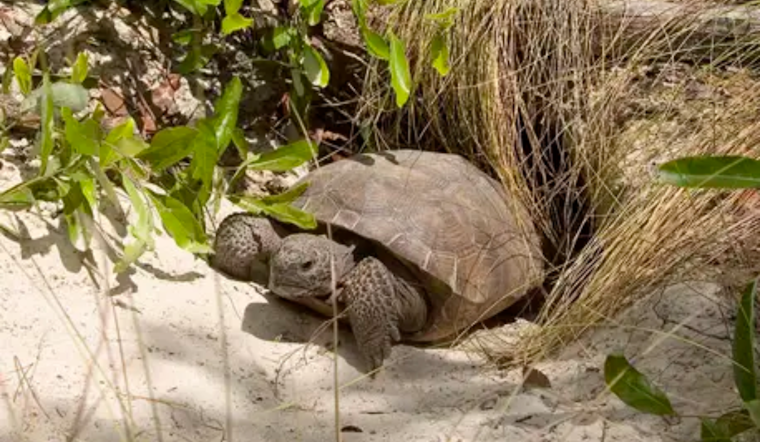
Nearly 7,000 gopher tortoises were relocated across Lake and Orange counties over the past five years, and almost all of them were sent somewhere other than the property where they were found. The mass shuffle is a conservation tool built around development, but it also raises a very Florida question: Where, exactly, did all those tortoises go?
Data provided by the Florida Fish and Wildlife Conservation Commission shows that 6,976 tortoises were confirmed relocated between July 28, 2021, and July 28, 2026, according to News 6. Lake County accounted for 4,656 relocations, while Orange County accounted for 2,320, with 6,818 animals moved to off-site recipient properties and only 158 relocated elsewhere on their original properties.
Most Of The Tortoises Left Their Original Properties
Recipient sites are not simply empty acreage where a tortoise can be dropped off and wished good luck. The Florida Fish and Wildlife Conservation Commission says they are public or private properties of at least 25 acres that have been permitted to accept tortoises displaced by development, with habitat requirements and different levels of long-term protection.
FWC guidelines call for relocated tortoises to receive health assessments, individual shell markings and an initial release into a temporary “soft release” enclosure designed to help them settle into unfamiliar habitat. The agency also says release timing should account for weather conditions, since heat-related stress and mortality are risks during the process, as outlined by FWC recipient-site guidance.
There is still no simple public answer showing which recipient site received each of the 6,818 tortoises moved off-site from the two counties. FWC told News 6 that its reporting system cannot readily connect every tortoise to a specific destination because animals from one donor property may be divided among multiple recipient sites, requiring officials to review permits individually.
Monitoring Is Supposed To Continue For Decades
That missing destination-by-destination picture matters because relocation numbers alone do not show whether tortoises survived, reproduced or became part of a stable population. FWC says long-term protected and Tier 1 short-term protected sites must submit population and vegetation surveys every five years for 25 years after receiving tortoises, while habitat management must continue for the life of the permit or conservation easement.
The concern is arriving alongside a major global warning. The IUCN Red List now identifies the gopher tortoise as critically endangered, a category reflecting an updated assessment rather than a sudden population crash in 2026; the assessment cited by News 6 estimates an approximately 80% decline over three gopher tortoise generations.
Gopher tortoises need elevated, sandy, well-drained ground to dig burrows that protect them from heat, cold and fire. Unfortunately, that same high-and-dry land is often prized for construction because it is less vulnerable to flooding, creating a direct collision between Central Florida’s growth patterns and the species’ basic housing needs.
Florida Protects The Tortoise But Not The Development Decision
Florida’s 2024 Gopher Tortoise Management Plan includes 63 conservation actions covering habitat, monitoring, research, permitting, enforcement and public education. The plan, approved in December 2024, is intended to guide the state’s efforts for a decade, according to the Florida Fish and Wildlife Conservation Commission.
FWC regulates the capture and relocation process, but the agency does not decide whether a city or county approves development. Local governments control those land-use decisions, meaning the future of connected tortoise habitat will be shaped not only by wildlife permits, but also by whether new roads, subdivisions and commercial projects preserve land where tortoises can continue finding one another.
What Residents Should Know
Gopher tortoises and their burrows are protected under Florida law, and an FWC permit is generally required before construction or other covered activity disturbs a potentially occupied burrow or the surrounding 25-foot area. Moving a tortoise, its eggs or its burrow without authorization can violate state protections, according to FWC permitting rules.
Residents who encounter a sick or injured tortoise should contact FWC rather than trying to transport it themselves, while a healthy tortoise crossing a road may be moved across that road in the direction it was already traveling. The broader lesson from nearly 7,000 relocations is less tidy: Saving individual tortoises helps, but preserving connected, high-and-dry habitat may be what keeps Central Florida’s populations from becoming a collection of isolated survivors.





