

























































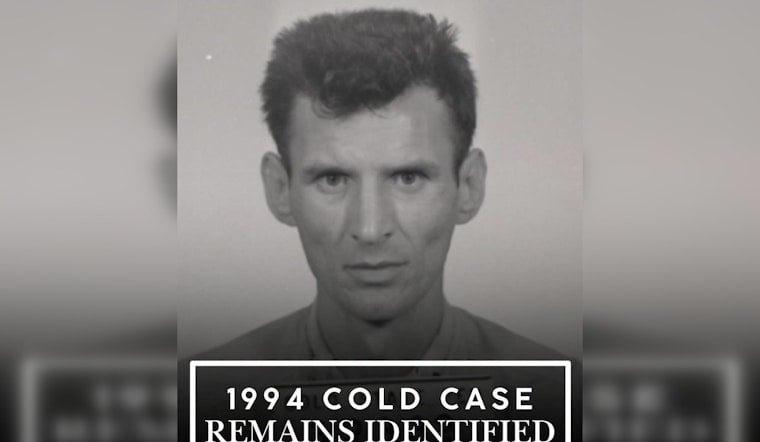
A partial human skull discovered by loggers near a campsite at Putt Lake in Nyack on July 7, 1994, has finally been given a name: George Krusely, born April 30, 1929. The identification, announced by the Placer County Sheriff's Office, closes a 32-year mystery that began when investigators collected and stored the remains along with several other items found at the scene, without ever determining how Krusely died.
According to the Placer Sheriff, detectives at the time estimated that the campsite near the lake had potentially existed for upwards of a year before the skull was found, though the cause of death was never determined. Investigators knew Krusely had last been confirmed living in California around 1963, and historical arrest records maintained in Colorado show he had previously pleaded guilty to breaking and entering in Plumas County, California, according to Ramapo College of New Jersey. Beyond that, the decades between his last known California sighting and the discovery of his remains remain unaccounted for.
For years the case sat unsolved, but that changed once Othram Inc. and the California Department of Justice conducted extensive DNA testing that developed a workable genetic profile from the evidence. Investigators then submitted that DNA information to the Ramapo College Investigative Genetic Genealogy Center in December 2024, kicking off a new phase of the investigation.
Student Genealogists Crack a Genetic Puzzle
Student volunteers at the center received the DNA profile data in January 2025 and spent nearly a year tracing genetic threads before identifying Krusely as a candidate by December 2025, per the center's research timeline. The work was complicated from the start: accessible DNA databases had low representation of some populations, and genealogy records were limited for others, making the tracing especially difficult.
Cairenn Binder, associated with the Ramapo College effort, said the case was very challenging due to the unidentified person's Croatian and Yugoslavian ancestry. U.S. Census records from 1930 show Krusely spent his early life in Youngstown, Mahoning County, Ohio, one of eight children born to Yugoslavian immigrants Frank and Barbara Krusely, according to records on FamilySearch. Ramapo College staff and students eventually identified a living descendant of Krusely and traced his genetic information back through the family line.
Investigators then turned to Ohio, where the Lordstown Police Department assisted in obtaining a DNA sample from that descendant. When the sample was compared against the profile developed from the 1994 remains, it matched, allowing investigators to confirm that the skull belonged to George Krusely.
A Remote Sierra Lake Holds Its Secret for Decades
Putt Lake, where the skull was found, is a 34.6-acre impoundment of Blue Canyon Creek situated off Interstate 80 near Emigrant Gap at an elevation of 5,356 feet, according to the California Department of Fish and Wildlife. The high-elevation, forested setting near Nyack made the case one of many that sat in the Placer County Sheriff-Coroner-Marshal's Office's backlog of unsolved files — an office whose jurisdiction stretches from the Sacramento Valley to Lake Tahoe and which has operated since 1851.
That backlog remains substantial. The sheriff's office maintains an active list of more than 80 unsolved cold cases spanning homicides, long-term missing persons cases, and unidentified remains. To tackle it, the sheriff's office and the Placer County District Attorney's Office established a dedicated joint Cold Case Investigations Team in 2023 specifically to apply emerging forensic science to these long-dormant files, according to the Placer County Cold Case Foundation.
Funding Advanced DNA Testing Remains a Barrier
Advanced DNA testing can cost up to $50,000 per case, a price tag that has historically posed a significant barrier to pursuing new leads in smaller jurisdictions. In November 2025, the Placer County Sheriff's Office launched the nonprofit Placer County Cold Case Foundation, created by community members, to help raise public funds specifically for this kind of testing.
Wayne Woo applauded everyone involved in bringing a family answers, and said advances in technology can make a remarkable difference in solving cold cases. The foundation supports both families and the county's broader cold case investigations, and the sheriff's office says it remains committed to investigating these cases and bringing answers to families still waiting.
The Ramapo College Investigative Genetic Genealogy Center, which provides casework services, research, and education programs, has worked on or helped resolve more than 89 cold cases and missing person files nationwide since opening in December 2022. Placer County has leaned on the same genetic genealogy techniques in other recent breakthroughs, including the case detailed in Hoodline's earlier report, DNA and a fake name cracks 1991 slaying, in which 64-year-old James Lawhead Jr. pleaded guilty this past June to the 1991 kidnapping, rape, and murder of Granite Bay mother Cindy Wanner after cold case detectives matched his DNA and tracked him to Arizona.
In March, investigators similarly identified the so-called Emigrant Gap Jane Doe — a woman found strangled in a Sierra Nevada snowbank off Highway 20 in 1977 — as Michigan native Melinda “Pip” Beardsley, nearly 50 years after her body was found, as reported by CBS News. Together with the Krusely identification, the cases illustrate how DNA testing and genetic genealogy are providing new hope in cold cases that once seemed permanently unsolvable.





