

























































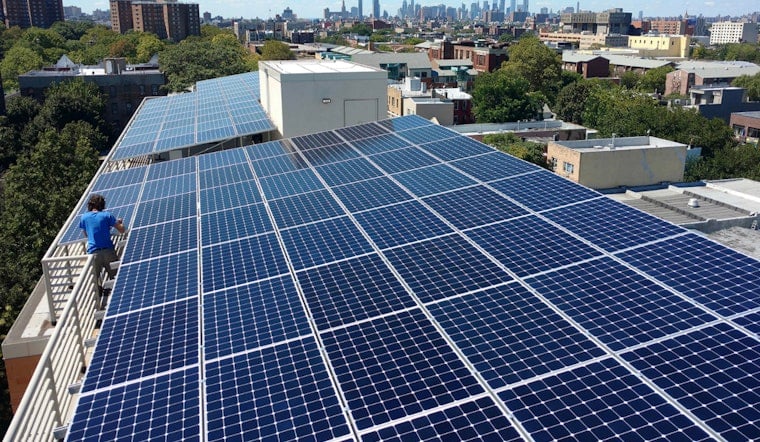
A hulking, largely vacant printing plant that once churned out copies of the New York Post is now the target of a community push to turn its rooftop into a solar power source for the South Bronx. South Bronx Unite has conducted a pre-feasibility solar assessment with Working Power for the site, which spans more than 350,000 square feet along the waterfront, and organizers say the resulting project could be community co-owned.
The plant, which News Corp began operating in 2001 before moving printing operations to College Point in 2021, sits on two lots with different ownership and lease arrangements, according to Bronx Times. The Galesi Group operates the property and holds a 99-year lease with Empire State Development Corporation, a legal arrangement rooted in a 1991 agreement between New York State and Harlem River Yard Ventures, a Galesi subsidiary, according to Empire State Development. That master lease covers the broader 96-acre Harlem River Yards site, meaning any solar project would likely require state assistance or legal negotiation before ground — or rather, rooftop — could even be broken.
Organizers have emphasized that no decisions have been made about the site's future, and South Bronx Unite says it is seeking pro bono legal assistance to sort through the property's ownership and lease arrangements. Matthew Shore, the group's director of planning and development, has framed the effort around a simple question: whose Con Edison bills are too high. The group is treating the campaign as part of a broader energy justice push it has launched in the neighborhood, per the Bronx Times report.
A Waterfront With a History of Fights Over Land Use
The former printing plant isn't just any vacant building — it sits on a stretch of waterfront that has been a flashpoint for South Bronx Unite before. The group opposed FreshDirect's expansion into the neighborhood, and organizers say the grocery delivery company received $127.8 million in tax breaks from New York State, according to South Bronx Unite's account relayed by the Bronx Times. The Galesi Group leased part of the property to FreshDirect in 2011, years before the company relocated its primary distribution facility to Harlem River Yards in 2018 after securing more than $100 million in public subsidies, a move that brought an estimated 15,000 daily truck trips to the area and catalyzed intense local opposition, according to The Guardian.
That truck traffic has compounded a public health crisis that predates FreshDirect's arrival. South Bronx neighborhoods including Mott Haven and Port Morris have childhood asthma hospitalization rates up to 21 times higher than affluent New York City neighborhoods, a disparity researchers attribute to heavy truck traffic and industrial siting, according to the Pre-Collegiate Global Health Review. The area has long carried the nickname Asthma Alley because of diesel exhaust from nearby highways and transfer stations.
Kaila Paulino, a participant in South Bronx Unite's monthly community meetings on the site's transformation, put the local fight in a wider context, saying there is a nationwide struggle for the liberation of these lands. Residents at those sessions have envisioned a mix of public green space, urban farming, EV charging stations, battery storage, walking trails and rainwater collection for the property, alongside other proposals for bus and ferry transportation connections. Other participants floated green manufacturing, office space, workforce training and art studios as possible future uses.
What a South Bronx Array Could Deliver
If built, the rooftop array could provide a 20% discount on electricity bills for about 100 households, and the project as a whole could generate roughly $3.1 million in operating income over 25 years, with excess revenue potentially reinvested into the neighborhood through a community-governed process. Organizers say the project could generate roughly twice as much energy as Sunset Park Solar, Brooklyn's cooperatively owned rooftop array atop the Brooklyn Army Terminal that delivers a 20% bill discount to roughly 200 households and businesses through a 725-kilowatt array spanning 45,000 square feet, according to the Office of the Brooklyn Borough President. That Brooklyn project, co-developed by environmental justice group UPROSE and technical partner Working Power, offers a direct operational template for what South Bronx Unite hopes to replicate, as detailed in Hoodline's coverage of the Sunset Park installation's completion.
Working Power previously helped secure Sunset Park Solar as New York City's first community-owned solar project, giving the firm direct experience translating a rooftop feasibility study into an operating cooperative. South Bronx Unite estimates its own proposed project could take as long as seven years to fully realize, a timeline organizers acknowledge reflects the complexity of untangling the site's lease structure and financing a project of this scale.
Energy Burden and the Push for Statewide Solar
The push comes as New York works toward the mandates of its 2019 Climate Leadership and Community Protection Act, which requires 70% of state electricity to come from renewable sources by 2030 and 100% from zero-emission sources by 2040, alongside a statewide goal of deploying 6,000 megawatts of distributed solar power, according to the New York State Senate. State administrative guidance implementing that law requires agencies to direct at least 35%, with a target of 40%, of overall clean energy and efficiency benefits to designated disadvantaged communities, according to the Alliance for Clean Energy New York.
The stakes for South Bronx households are steep. A June 2025 report by the Office of the New York City Comptroller found that 25% of all New York City households are energy burdened, spending more than 6% of their gross income on energy bills, with energy insecurity disproportionately affecting one-third of all Black and Latino households. A more recent report from the same office in July 2026 found that while the city has reached 641.5 megawatts of total solar capacity, only 31 megawatts have been installed across 187 municipal buildings — underscoring why officials and advocates alike see large private and industrial rooftops as essential to hitting citywide clean energy goals.
Dr. Diana Hernandez, an associate professor of sociomedical sciences at Columbia University's Mailman School of Public Health, said the Bronx is heavily impacted by energy insecurity but that solutions exist. She has said energy literacy is needed to develop efficiency and electrification and to address the moral questions that arise around utility disconnections. South Bronx Unite plans to establish a working group that will meet regularly beginning later this month, serving as a place for residents to learn about energy justice and make decisions about the organization's site-related work; the group is expected to continue meeting through at least mid-2027.
The solar proposal follows other recent moves by South Bronx Unite to reclaim underused property in the neighborhood for community benefit, including its state-backed arts hub project converting a long-vacant Mott Haven recovery center. The group has also partnered with Columbia University on neighborhood air quality monitoring following the rollout of congestion pricing. Whether Empire State Development will ultimately support repurposing state-leased industrial land for community solar remains an open question — one that South Bronx Unite's newly forming working group will likely spend the coming months trying to answer.



.jpg)