

























































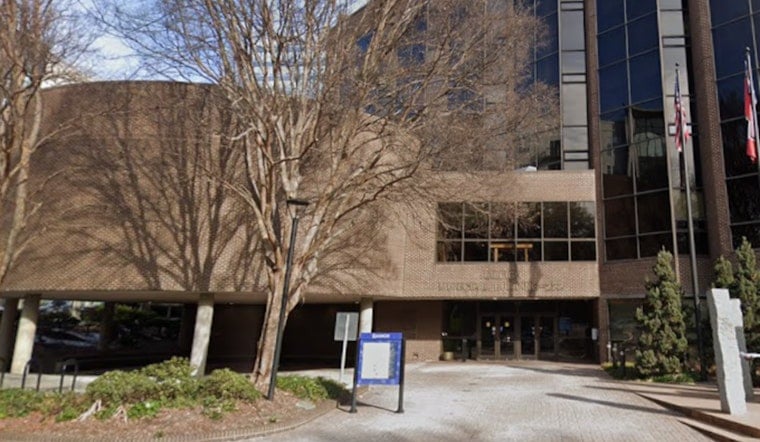
A developer wants Raleigh to annex 14 acres off Jones Sausage Road in Southeast Raleigh so it can build a 100,000-square-foot data center directly across the street from an existing neighborhood, and the city council will decide the fate of that request at its 1 p.m. session on Tuesday, August 18, at the municipal building on West Hargett Street. The property, valued at about $2.3 million on current tax rolls, is owned by B3-SFRE JSR LLC and Charlotte-based Beacon Partners, and developers estimate it will be worth $180 million once fully built out.
The project, officially named Radius DC Raleigh 1 in annexation petition documents, would sit on 13.64 acres at 3101 Jones Sausage Road, according to city annexation filings. That siting places it directly across from the Parrish Meadows residential neighborhood, giving nearby homeowners an unusually close view of the industrial buildout. The 26-page city annexation petition would let the developers tap Raleigh's municipal water system, since building in unincorporated Wake County would otherwise require buying water from another municipality, as reported by the News & Observer.
A Filing That Didn't Say ‘Data Center’
Public annexation filings listed the site's primary land use as simple “office” space rather than naming it as a data center, a choice that has drawn transparency complaints from former Raleigh City Council Member Mary Black and local community groups. Black, who served on the council from 2022 to 2024, said she plans to speak against the annexation on Tuesday and told the News & Observer she is concerned about Raleigh's current lack of data-center-specific regulations. She said she would support a moratorium on new data centers, joining a chorus of North Carolina towns that have already frozen approvals while they write targeted rules.
Mayor Pro Tem Jane Harrison, who represents District D and chairs the council's Growth and Natural Resources Committee, raised a separate set of concerns about the annexation process. Harrison flagged the transparency of the filing itself, along with vibrations, sound and heat from the facility, and the absence of any indication the project will use renewable energy. She also pointed to water demand following a recent drought and worries about electricity costs, though she said she believes the city's current process has enough guardrails and remains open to a moratorium on data centers if that changes.
Smaller Than a Hyperscale Facility, But Still Significant
City staff have described the proposal as falling on the medium part of the data-center scale, per a June 2026 presentation cited by the News & Observer, with the facility requiring 12 megawatts of critical load. That is far below a true hyperscale data center, which can demand more than 100 megawatts of power and over 100 acres of land along with significant water use. According to city submittal documentation cited by Raleigh Downtown, the developer plans a closed-loop air-cooling system, meaning the municipal water gained through annexation would go toward standard domestic needs like sinks, restrooms and fire protection rather than continuous evaporative cooling.
Beacon Partners, one of the property's co-developers, has built a substantial footprint along the Jones Sausage Road industrial corridor, having acquired or developed more than 1.4 million square feet of industrial space in East Wake County since 2023, including the nearby master-planned Beacon Commerce Park, according to Beacon Partners. The News & Observer reported it attempted to reach F. Walker Abbot, the developers' attorney, by email and phone, but did not receive an immediate response.
What Happens After Tuesday's Vote
Even if the council approves the annexation, the industrial designation would only allow the data center project to move forward; developers would still need a special-use permit from the city's Board of Adjustment, whose members are appointed by the city council. The council also retains the option to deny the annexation petition outright.
Raleigh has not joined the wave of nearby Wake County towns pausing data center approvals. Apex adopted a 12-month moratorium in April, Wendell imposed a seven-month pause in May, and Holly Springs approved a one-year moratorium in June, each aiming to update municipal zoning standards before more projects arrive, according to INDY Week. Durham has also passed a moratorium on data centers, per the News & Observer. Statewide, at least 14 municipalities and eight counties had enacted data center moratoriums or temporary pauses as of July, following a surge of more than 20 new data center project announcements driven by artificial intelligence computing demand, as reported by Carolina Public Press.
The Power Bill Fight Behind the Project
The debate over Southeast Raleigh's data center is tangled up with a much larger fight over who pays for North Carolina's growing electricity demand. Duke Energy has acknowledged that data centers are driving increasing demand for power even as the company works to raise its electricity rates, and a February state energy task force report found total net electricity demand across Duke Energy's North Carolina systems could climb between 16% and 60% over the next 15 years, compared with just a 7% increase over the past two decades, according to the Office of Governor Josh Stein.
In response to that pressure, Duke Energy signed a federal Ratepayer Protection Pledge on July 23, committing to establish a large load tariff and a separate customer class so that data centers pay for their own power infrastructure upgrades rather than shifting those costs onto residential ratepayers, per the N.C. Department of Justice. Just weeks later, Attorney General Jeff Jackson announced on August 12 that he had refused to sign a proposed Duke Energy Progress rate settlement that would raise residential electricity bills by 9.3% over two years, citing concerns that families are being asked to subsidize infrastructure built for massive data centers, according to the Carolina Journal.
That statewide reckoning over grid costs sits in the background of Tuesday's vote, even though Radius DC Raleigh 1 is described as a medium-scale project using less water and power than the largest facilities. For Southeast Raleigh residents watching the annexation petition move through city hall, the outcome will determine whether a data center joins their neighborhood at all, and whether Raleigh follows other Wake County towns in slowing down to write its own rules first.




