

























































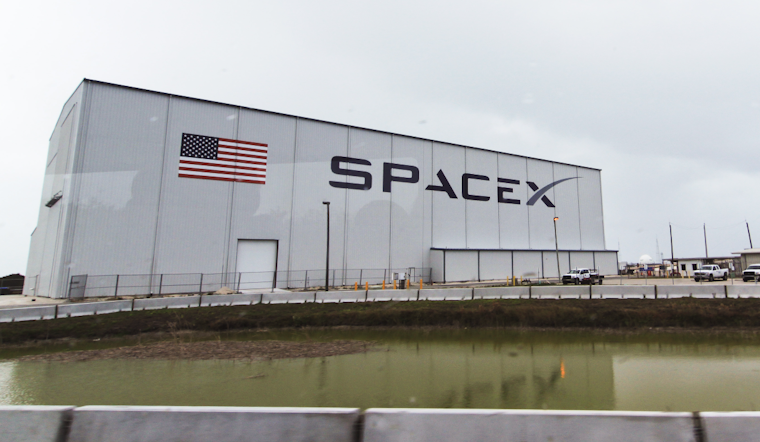
SpaceX fired a Falcon 9 rocket off the pad at Cape Canaveral Space Force Station just before 4 a.m. Wednesday, sending three more AST SpaceMobile broadband satellites — BlueBird 11, BlueBird 12, and BlueBird 13 — into low Earth orbit. The rocket lifted off from Space Launch Complex 40, and its first-stage booster touched down on the droneship "A Shortfall of Gravitas" in the Atlantic Ocean more than eight minutes after liftoff. The landing marked the booster's 30th flight and the 645th booster recovery in SpaceX's history.
The three satellites are now part of AST SpaceMobile's constellation, which is designed to deliver space-based broadband directly to unmodified smartphones, according to SpaceX, as reported by ClickOrlando. AST SpaceMobile CEO Abel Avellan said the company isn't stopping with this trio, telling the outlet, "BlueBirds 14, 15, and 16 — are close behind." The company's production line is now running through satellite 42, Avellan said, and AST SpaceMobile holds agreements with nearly 60 mobile networks worldwide, including AT&T, Verizon, and Vodafone.
A Federal Green Light for 248 Satellites
The launch builds on regulatory groundwork laid in April 2026, when the Federal Communications Commission granted AST SpaceMobile commercial authorization under its Supplemental Coverage from Space framework, according to Business Wire. That approval expanded the company's authorized fleet to as many as 248 satellites and lets it operate on 700 MHz and 800 MHz low-band cellular spectrum leased from network partners AT&T, Verizon, and FirstNet.
AT&T and Verizon Bet Big on Space-Based Coverage
AT&T formalized its role as an anchor partner in May 2024, signing a definitive commercial agreement with AST SpaceMobile that runs through 2030 to weave space-based broadband into its cellular network, according to AT&T. The deal, which grew out of a partnership dating back to 2018, is meant to keep AT&T subscribers connected in remote areas beyond terrestrial towers. Verizon made its own commitment that same month, putting up $100 million — split between $65 million in commercial prepayments and $35 million in convertible notes — to help AST SpaceMobile reach 100% geographic coverage of the continental U.S. using Verizon's 850 MHz spectrum, per Telecompetitor.
Satellites the Size of Tennis Courts
The BlueBird satellites launched this week belong to AST SpaceMobile's second-generation "Block 2" design, which carries phased-array communications antennas spanning roughly 2,400 square feet — among the largest commercial arrays in low Earth orbit, per AST SpaceMobile. That's more than three times the size of the 693-square-foot arrays on the company's earlier Block 1 satellites. The new generation also runs on a custom AST5000 ASIC processor capable of handling processing bandwidth up to 10 GHz and peak speeds of 120 to 150 Mbps per cell, the company says.
Astronomers Warn of a Brighter, Busier Sky
Not everyone is cheering the buildout. A study published in Nature in October 2023 found that AST SpaceMobile's BlueWalker 3 test satellite became one of the brightest objects in the night sky once it fully unfolded in orbit, according to Nature. Astronomers with the International Astronomical Union's Centre for the Protection of Dark and Quiet Sky raised the finding as a growing risk to ground-based sky surveys as satellite constellations expand their reflective surface area in orbit.
Commercial Service Pushed to Early 2027
Despite the steady launch cadence, AST SpaceMobile's timeline for full commercial direct-to-device service has slipped. In a July regulatory filing, the company disclosed it was pushing its targeted commercial launch to early 2027 while seeking up to $1 billion in convertible senior notes to fund operations and secure rocket launch capacity, according to SatNews. Disruptions across commercial launch providers have influenced the pace of the constellation's rollout, the outlet reported.
Crowded Orbit: Starlink and Amazon Circle the Same Market
AST SpaceMobile isn't alone in chasing direct-to-cell connectivity. SpaceX's own Starlink direct-to-cell initiative is competing for the same customers, and Amazon entered the race in early 2026 with an $11 billion agreement to acquire satellite operator Globalstar, according to Broadband Breakfast. The competition underscores how much telecom and tech giants are jockeying for control of non-terrestrial spectrum.
A Safety Net, Not a Tower Replacement
AT&T's own leadership has downplayed fears that satellite service will cannibalize terrestrial network revenue. In July, AT&T CEO John Stankey characterized direct-to-device satellite service as a complementary safety net rather than a competitive threat, noting that subscribers spend only about 2% of their time outside ground cell and fiber coverage, according to SatNews. That framing lines up with how AST SpaceMobile has pitched the technology from the start: a way to fill dead zones in wilderness and maritime areas, not to replace the terrestrial towers most people rely on every day.
Part of a Record-Setting Run at the Cape
Wednesday's launch adds to an already blistering pace at Florida's spaceports. The Space Coast closed out 2025 with a record 109 orbital launches and had already topped 30 liftoffs by May 2026, according to Hoodline's earlier coverage of Space Coast's record launch pace. SpaceX accounts for the majority of orbital launches departing Florida's Eastern Range, a trend this week's BlueBird mission continued.





.jpg)