

























































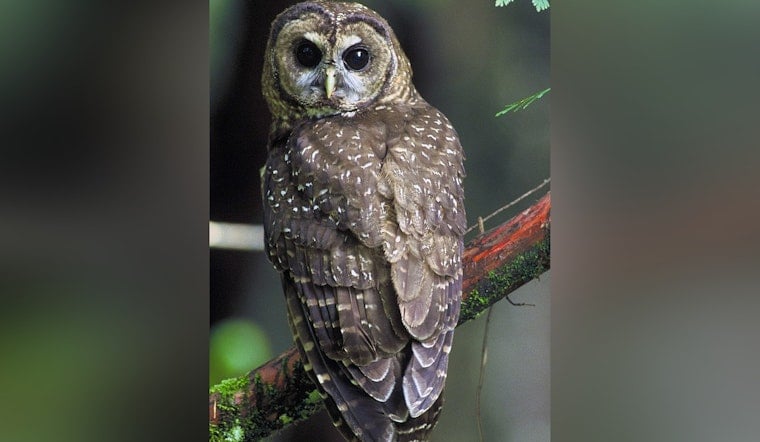
Researchers scanning more than 2.1 million hours of forest recordings made a grim discovery: no spotted owl calls at all in the Washington Cascades north of Seattle. Across much of Washington and the Oregon coast, northern spotted owl calls turned up in just 13% to 17% of sample areas, a level scientists say signals the birds are approaching or have already crossed functional extinction in large portions of their historic range.
The findings come from a sweeping new study, published in the journal Ecological Applications in August, led by Damon Lesmeister of the U.S. Forest Service and Oregon State University. As The Portland Tribune reports, scientists randomly sampled areas within 38,000 square miles of federally managed spotted owl habitat across Oregon, Washington and northwestern California, using artificial intelligence and advanced acoustic monitoring to assess long-term population trends. Passive recording devices gathered the recordings, which were then analyzed by computers at Oregon State University's Center for Quantitative Life Sciences.
Functional extinction, as the study defines it, means the birds no longer play a meaningful ecological role or can no longer reproduce enough to sustain their population. That threshold appears closest in Washington and along the Oregon coast, though the picture brightens somewhat further south. Northern spotted owl calls were detected in 44% of sample areas in the Klamath Mountains and in 91% of California's coastal sample areas, the same reporting notes.
Barred Owls Dominate the Landscape
The chief driver behind the collapse is competition, not just habitat. Barred owls were heard eight times more often than spotted owls across the study region, and their presence is staggering in some areas: 94% of sample areas along the Washington coast and western Cascades, 100% of areas on the Oregon coast, 72% in the Klamath Mountains, and 45% along the California coast. According to biological evaluations from the U.S. Fish and Wildlife Service, barred owls outcompete their smaller native cousins because they are larger, more aggressive, eat a broader range of prey, and adapt to a wider variety of forest environments than spotted owls can tolerate.
That competitive edge compounds decades of habitat loss. Spotted owl populations declined rapidly after 1990 due to the loss of old forest habitats from logging, and the birds were listed as threatened under the Endangered Species Act that same year. The Northwest Forest Plan, adopted in 1994, reduced the rate of old-growth logging on federal lands, but the Tribune's reporting makes clear that habitat protection alone has not been enough to reverse the trend, as ongoing losses now stem from both logging and wildfire alongside barred owl competition.
A multi-decade demographic analysis published in 2021 placed the crisis in historical context, finding that spotted owl populations declined 6% to 9% annually across six long-term study areas and 2% to 5% annually across five others, according to the U.S. Geological Survey. Less than 35% of 1995 population levels remained intact in seven of the study areas by the time that analysis was completed.
A Federal Culling Program Under Fire
Federal wildlife officials have responded by targeting the invader directly. The U.S. Fish and Wildlife Service finalized a 30-year Barred Owl Management Strategy in August 2024, authorizing trained specialists to lethally remove up to 450,000 barred owls across Washington, Oregon and California, a cap set at under 0.5% of the North American barred owl population annually. Controlled removal experiments cited by the USDA Forest Service Pacific Northwest Research Station found that lethally removing barred owls stabilized spotted owl population trends to just a 0.2% annual decline in managed areas, compared to a 12.1% annual decline in areas left unmanaged, results that directly informed the federal strategy.
The plan has survived a direct legislative challenge. In October 2025, the U.S. Senate voted 72 to 25 against a Congressional Review Act resolution that sought to overturn the strategy, according to the Wildlife Management Institute. Hoodline previously reported on senators defending spotted owl protections during that debate. Still, a bipartisan group of 19 lawmakers had sent a letter to Interior Secretary Doug Burgum in March 2025 seeking to halt the program, arguing it could cost taxpayers up to $1.35 billion over 30 years at roughly $3,000 per removed owl, though officials noted the strategy itself contains no specific funding allocations, per USA TODAY.
The threat is also spreading to a related species further south. In February 2023, the Fish and Wildlife Service proposed Endangered Species Act protections for the California spotted owl, designating its Coastal-Southern California population as endangered and its Sierra Nevada population as threatened. Environmental groups later sued in late 2025 to compel a final listing decision, a dispute tracked in filings from Earthjustice.
What Comes Next for Remaining Populations
Study authors pointed to several strategies that could still help, including ongoing barred owl removals, conserving landscapes well-suited for spotted owl nesting, and even bringing owls into captivity for breeding. Lesmeister said carefully considered management actions remain possible and that conservation strategies should improve outcomes for the northern spotted owl going forward, according to the Tribune's reporting.
The study's authors frame passive acoustic monitoring paired with machine learning as a tool with broader value beyond this single crisis, useful for large-scale ecological monitoring of vulnerable species generally. For now, though, the numbers describe a species whose range has already contracted dramatically, with pockets in California and southern Oregon representing what may be its best remaining strongholds.





