

























































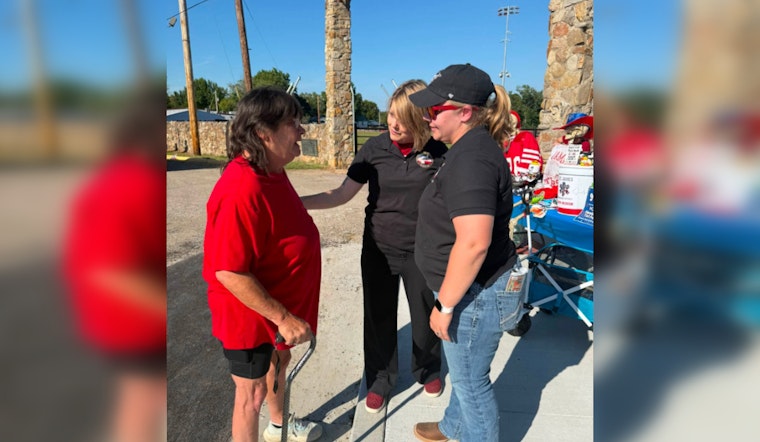
Diana walked up to the first responders table at a community tailgate outside St. James High School last Friday and asked a simple question: was any dispatcher there named Tabitha? She had never seen the woman's face, only heard her voice months earlier during a medical emergency, but she was certain that voice had helped save her life.
The moment unfolded during the Rivalry for a Reason tailgate held August 28 outside the Tigers' stadium entrance for the football team's home opener, according to the St. James Police Department. Diana had experienced a medical emergency, per the department, and it was Tabitha who answered the 911 call from one of Diana's loved ones and guided the caller through CPR while providing instructions and reassurance until help arrived. As reported by KRCG, police, firefighters and EMS soon arrived at Diana's home and took her into their care.
Diana believes Tabitha's calm guidance on the line helped save her life. Months later, she is preparing to welcome a new great-grandson, spend time with her family, and watch her grandson play football — all things she got to tell Tabitha in person once the two finally met at the tailgate.
A Reunion Dispatchers Rarely Get
For Tabitha, learning what actually happened after that 911 call ended was itself unusual. Dispatchers are often the first people callers reach during an emergency, offering direction and reassurance while police, fire and EMS crews are on the way, but they do not always learn how the story ends once the line goes quiet. The tailgate gave Tabitha a chance to see the outcome of a call she might otherwise never have followed up on.
The event that brought them together did double duty as a fundraiser. First responder agencies competed in a rubber-duck donation drive that raised $226.75 for the St. James Kiwanis Tot Pack Program, which sends backpacks of weekend snacks home with MOCA Head Start students in the St. James R-1 School District, according to the St. James Police Department. Phelps County 911 has since recognized Tabitha and its other dispatchers for their work, per the department's account.
How the Call Reached Tabitha
Tabitha works at Phelps County Central Communications, the dispatch hub that fields emergency calls for St. James and the surrounding area. The center was created in 1994 through a consolidated E-911 merger between the City of Rolla and the Phelps County Emergency Services Board, according to the City of Rolla, and it began as a six-month pilot before becoming permanent. Housed inside the Rolla Police Department, the center now runs 24/7 with 18 Emergency Communications Officers covering 15 public safety agencies across Phelps County, the city notes. Non-emergency calls to St. James police and text-to-911 messages across the county are routed through the same center, per the City of St. James, so callers throughout the region rely on one unified system regardless of which town they call from.
The center's leadership has drawn its own recognition. Communications Chief Stacey Smith, who began her dispatch career in 1996 and now oversees the agency, was named Director of the Year at the 2026 Missouri Public Safety Communications Conference, according to conference records.
Why Dispatcher-Led CPR Matters
What happened on Diana's call reflects a broader pattern in emergency medicine. More than 350,000 out-of-hospital cardiac arrests occur annually in the United States, and 911 telecommunicators serve as the first link in the chain of survival for nearly all of them, according to the American Heart Association. Immediate CPR from a bystander can double or triple a cardiac arrest victim's chance of survival compared with waiting for paramedics, the association has found. That research is part of why the group formally endorsed hands-only CPR for untrained bystanders in 2008 — eliminating the fear of rescue breathing that often makes callers hesitate, and simplifying the instructions dispatchers give over the phone. Telecommunicator CPR protocols call for dispatchers to quickly check a caller's consciousness and breathing, start chest-compression coaching, and dispatch emergency units at the same time, minimizing any delay before help is on scene and compressions begin.
For Tabitha, that training played out in real time on a call from someone desperate to help Diana. For Diana, it meant a second chance to watch her grandson play football and to meet the great-grandchild she is preparing to welcome. And for one evening at a high school tailgate, a dispatcher who rarely learns how her calls end got to see exactly what her voice on the line had made possible.





