

























































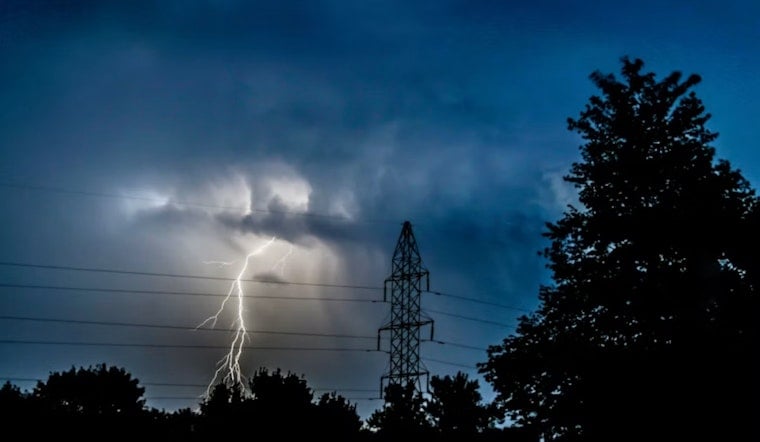
Strong storms tore through Northeast Ohio on Saturday, knocking out power to more than 12,000 customers by mid-afternoon and leaving drivers navigating dark traffic signals from Cuyahoga to Stark County. With more rain and wind in the forecast through the evening, utility crews are bracing for the outage count to climb even higher before the night is over.
According to the FOX 8 Cleveland WJW report, the FirstEnergy outage map showed more than 12,000 customers without service around 3:30 p.m. as the storms moved through the region. Stark County bore the brunt with nearly 4,000 outages, while Cuyahoga County reported 2,342 outages, Lake County recorded 2,645, and Portage County counted 2,581. Several thousand customers across Northeast Ohio in total were left waiting for the lights to come back on.
The storms arrived alongside a broader severe weather threat. The National Weather Service in Cleveland issued a flood watch for 2 p.m. to 10 p.m. across 10 Northeast Ohio counties, including Cuyahoga, Lake, Summit, Portage, Stark and Mahoning, warning that localized rainfall totals of 3 to 4 inches could trigger flash flooding. Separately, as reported by WKYC, the weather service tracked severe thunderstorm cells through Cuyahoga, Geauga and Lake counties that produced wind gusts up to 60 mph — strong enough to snap tree branches and damage utility lines.
More Rain On the Way, Roads Already Snarled
Additional rain and storms were expected to continue through the evening, per the FOX 8 report, raising the possibility of further downpours and strong winds compounding the damage already done to the grid. With traffic signals knocked out in storm-hit neighborhoods, the Cleveland Division of Police reminded drivers via Facebook that any intersection with a dead signal must be treated as a four-way stop, a safety measure meant to prevent crashes while crews work to restore power.
Anyone who spots a downed line is urged to stay at least 30 feet away, since energized lines can charge wet ground for a similar distance, according to FirstEnergy safety guidance. Customers can report outages by texting OUT to 544487 or calling 1-888-LIGHTSS.
A Grid Already Under Regulatory Scrutiny
Saturday's outages land amid mounting friction between FirstEnergy and Ohio regulators over how fast the utility restores power after storms. In June, the Public Utilities Commission of Ohio denied FirstEnergy's bid to loosen its reliability standards, which would have stretched the allowable average reconnection window for The Cleveland Electric Illuminating Company from 135 minutes to 150.49 minutes, according to the Public Utilities Commission of Ohio.
The pressure has intensified at the local level, too. Earlier this month, PUCO issued a probable noncompliance finding against FirstEnergy after the City of Lakewood complained about frequent municipal blackouts, recommending a forfeiture of more than $3 million after investigators found crews had relied on lawn sprinklers to cool overheating substation equipment, per the City of Lakewood. That scrutiny follows a January settlement in which FirstEnergy agreed to return $275 million in customer restitution and refunds and committed to a $14 billion investment plan for its Ohio transmission and distribution infrastructure through 2029.
Part of a Pattern This Summer
Saturday's blackouts extend a string of storm-driven outages that have hit the region repeatedly this month. Earlier storms knocked out power to more than 33,000 customers on August 10 and more than 7,000 in Lorain County on August 7, as Hoodline previously reported. Northeast Ohio's grid has a long history of vulnerability to summer storms — the August 2024 outbreak that spawned five EF-1 tornadoes produced the highest number of power outages in the region since July 1993, according to the National Weather Service.
The region's sensitivity to tree limbs and overhead lines during severe weather dates back further still. It was a FirstEnergy transmission line in Walton Hills that overheated and sagged into unpruned trees in August 2003, triggering a cascading failure that left 50 million people without power across North America — the largest blackout in the continent's history.





