

























































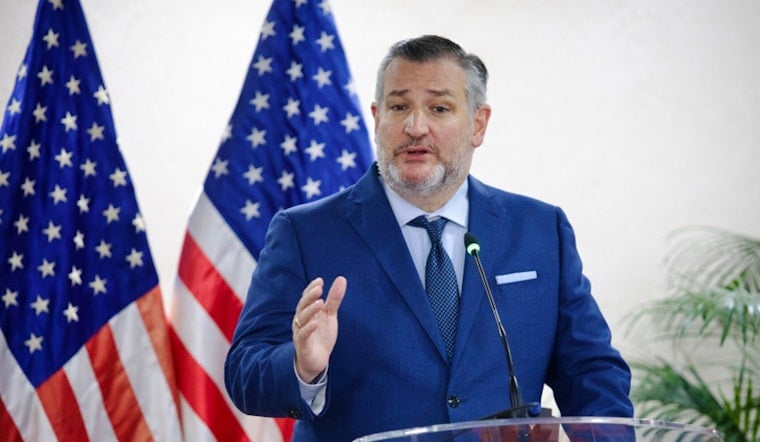
Texas Senator Ted Cruz says the Republican Party is heading toward a reckoning over its own identity once President Donald Trump leaves the White House in January 2029, predicting that GOP lawmakers will spend the coming years hashing out whether the party stays wedded to Trump's populist economic approach or returns to small-government, free-market roots. Cruz also left open the door to a 2028 presidential run of his own, while questioning the widely held assumption that Vice President JD Vance is automatically positioned to inherit Trump's movement.
Speaking in an interview with MS NOW, Cruz said that once Trump's second term ends, Republicans will need to work through fundamental questions about who leads the party next and what it believes, according to the Denver Gazette. Cruz said Republicans must debate whether the party should be small-government and free-market conservative or big-government and nanny-state, and whether it should embrace isolationism or continued American leadership abroad. He added that there will be time to sort all of that out, framing the debate as something that will unfold gradually over the next several years rather than resolve immediately.
Trump's Populist Turn Versus Cruz's Free-Market Roots
Cruz, who has chaired the Senate Committee on Commerce, Science, and Transportation since the Senate Republican Conference ratified him as chairman in January 2025, said the Republican Party should be conservative economically. That statement carries weight given his own history: Cruz took Trump on directly in the 2016 primary, winning 11 state contests and 551 delegates before suspending his campaign, a run that established him as the chief traditional-conservative alternative to Trumpism inside the party.
Cruz said Trump's agenda has favored greater government intervention in the economy and healthcare, pointing to elements like federal ownership stakes in corporations and government subsidies for families as departures from the party's older economic orthodoxy. He also voiced concern about Trump's tariffs specifically, even as he acknowledged that Trump's populist agenda has changed the Republican Party's overall trajectory since Trump first took over the party in 2016.
Praise for Trump Alongside Pointed Criticism
Despite those disagreements, Cruz was careful to praise Trump's willingness to confront Washington's status quo, describing him as fearless and possessing a backbone, and calling him a unique historical figure who has shown courage in the capital. At the same time, Cruz said Trump should show more message discipline and focus, a notable critique from a senator who says he sometimes speaks with Trump daily. Cruz added that Trump does not always listen to his advice, even though the president frequently does.
The two men's relationship has featured its share of public needling. During a White House ceremony launching Trump Accounts last month, Trump joked that nominating Cruz to the Supreme Court would draw 100 Senate votes because lawmakers from both parties would want to, in Trump's words, get him the hell out of the Senate — a remark Hoodline previously covered. Cruz himself authored the legislative framework behind Trump Accounts, the tax-advantaged, government-seeded $1,000 child investment savings accounts folded into the One Big Beautiful Bill Act that Trump signed in July 2025 and that launched last month, a program California Gov. Gavin Newsom has separately praised as a genius idea.
Doubts About Vance as the Automatic Heir
Cruz specifically questioned the view that Vance will simply inherit Trump's mantle as the party's 2028 standard-bearer, an assumption that has taken hold as early polling shows Vance leading hypothetical Republican primary surveys with roughly 41% support. Secretary of State Marco Rubio has been making gains among Hispanic voters and in prediction markets during the same stretch, according to MundoNOW. Both Vance and Rubio are considered potential 2028 Republican presidential nominees, and Cruz's comments suggest he does not see either man's path as settled.
Cruz himself has left open the possibility of another presidential run in 2028, a prospect bolstered by his electoral standing back home. He won a third Senate term in November 2024 by defeating Democratic Representative Colin Allred by 8.49 percentage points, expanding his statewide margin by nearly six points compared to his 2018 race, when he barely survived a challenge from Beto O'Rourke by 2.6 percentage points in what was then the narrowest U.S. Senate margin in Texas since 1978.
A Party Still Sorting Out Its Own Fault Lines
The debate Cruz describes is already playing out in pieces across the party's conservative media and legislative flanks. Commentator Tucker Carlson, along with Representative Marjorie Taylor Greene and Representative Thomas Massie, have been weighing a third-party break from Trump over foreign policy, including disputes with Cruz himself over Israel and Iran policy, as Hoodline reported in a story on conservative third-party plans. Separately, Senator Kevin Cramer of North Dakota placed a formal hold this month on all future Trump administration nominees to pressure federal officials into reversing a Biden-era wetlands policy affecting Midwest farmers, according to the Washington Examiner, an example of the kind of intraparty friction that can surface even among Senate Republicans nominally aligned with the administration.
Cruz's own legislative record under Trump's second term shows both cooperation and independent initiative. He introduced federal legislation in July 2025 requiring mandatory anti-collision technology on military aircraft, responding to a January 2025 midair collision near Reagan National Airport that killed 67 people. He also argued publicly in March 2025 that foreign students on visas participating in anti-Israel campus protests are not protected under the First Amendment, backing the administration's push to revoke visas and deport student protesters. Those positions, Cruz's allies argue, underscore that his disagreements with Trump are selective rather than wholesale — focused on economic philosophy rather than the administration's broader legal and foreign policy fights.





.jpg)