

























































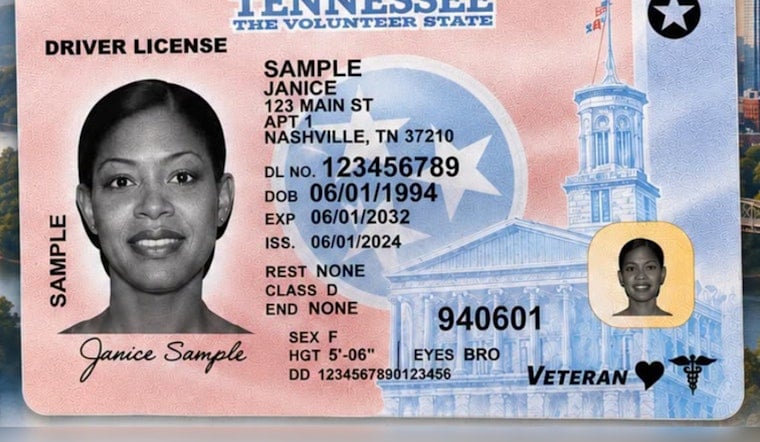
Leyna Holt says the scanning problem hits her every single time she flies. Since getting her Tennessee REAL ID early last year, the Nashville-area resident has watched TSA agents stop her at the checkpoint and run her card through the reader two or three times before it finally clears. She does not think she is an isolated case.
Tennessee's Department of Safety and Homeland Security has acknowledged the issue publicly, saying in a statement that it is aware of “a small number of Tennesseans” whose driver's licenses are failing to scan at TSA airport checkpoints. As reported by WSMV, the state has not confirmed the exact cause of the problem, though it is reviewing the affected IDs. Holt, who lives near Nashville International Airport, told the station she is skeptical the trouble is as limited as officials suggest, saying it may be more widespread than the state has acknowledged.
Holt described the routine to WSMV: TSA personnel stop her every time and scan her ID two or three times before letting her through. During a trip through Houston, she said, a TSA agent told her the issue involved Tennessee IDs and “many” Kentucky IDs as well, and that the photos were simply too light for the reader to recognize.
A Contrast Problem Baked Into the Printing Process
The technical explanation traces back to how the cards are made. Tennessee driver's licenses and REAL IDs are not printed at local Driver Services Centers or in Nashville; hard copies are produced at an out-of-state secure printing facility and mailed to applicants, a process that can take up to 20 business days, according to Roane County Government. Some of those newly issued cards feature photos with lighter contrast or overexposed backgrounds that pass a basic visual check but fall short of what automated readers need to map facial landmarks, the same report notes.
Those readers are TSA's second-generation Credential Authentication Technology units, known as CAT-2, which perform a 1:1 facial match between a live camera image taken at the checkpoint and the photo printed on the traveler's card, according to the Transportation Security Administration. TSA accelerated deployment of CAT-2 units following the nationwide REAL ID enforcement deadline of May 7, 2025, when all domestic air travelers 18 and older were first required to present a REAL ID-compliant credential or an acceptable alternative, as Hoodline reported at the time.
The problem is not confined to Tennessee. TSA agents at out-of-state airports have reported similar scanning obstacles with driver's licenses from Kentucky and Mississippi, where light photo contrast or print finish defects have triggered checkpoint supervisor reviews, per the same WSMV account. That regional pattern suggests the trouble may stem from shared printing contract specifications rather than a single state's error.
Free Replacements, But a Waiting Game
For now, Tennessee is offering a fix, though not an instant one. Affected travelers can obtain a free replacement card at their local Driver Services Center, waiving the fee that normally applies to duplicate licenses, according to the Tennessee Department of Safety and Homeland Security. Under standard state rules, a duplicate license otherwise costs $8 for a first replacement and $12 for subsequent ones, making this a real exception to normal policy.
Holt has already gotten her replacement, one with a clearer, darker photo. But because new cards are printed out-of-state and mailed rather than issued on the spot, she will not know for certain whether the fix worked until her next flight in October, when she plans to test whether the new card scans on the first attempt.
That mailing delay leaves a real gap for travelers with trips coming up sooner. Anyone whose ID keeps failing at the checkpoint does not have to wait on a mailed card to fly. A valid passport can be used to clear airport security, and TSA also accepts passport cards, permanent resident cards, and Department of Defense IDs as alternatives.
Travelers Can Opt Out of Facial Scanning Entirely
There is also a lesser-known option available to anyone uneasy about the automated cameras in the first place. Participation in TSA's facial recognition scanning is voluntary, and travelers whose IDs fail to scan, or who simply choose to opt out, can request a standard manual identity verification from a Transportation Security Officer instead, per the agency's own guidance.
Travelers without an acceptable REAL ID or valid passport also have a costlier fallback: since February 1, TSA has offered “TSA Confirm.ID,” an optional identity verification system priced at $45 for a 10-day travel period. It is a steep price compared to the free replacement Tennessee is offering, underscoring why fixing the underlying photo issue matters more than working around it. Until the state pins down the fix, travelers like Holt are left double-checking their cards, and their photos, before every trip through security.




