

























































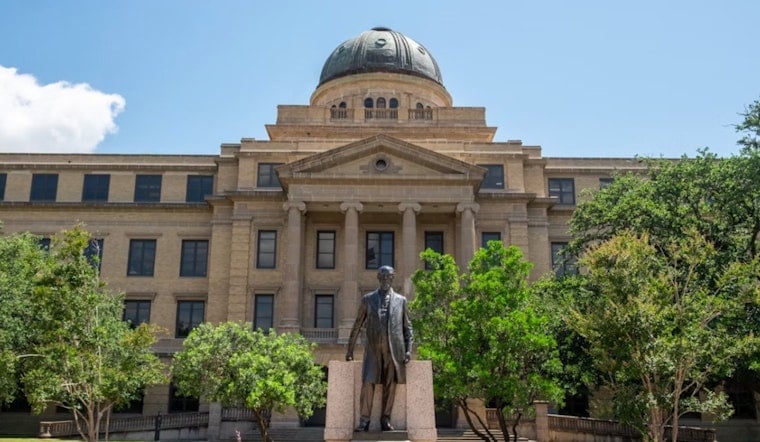
Several faculty members at Texas A&M University-Victoria have resigned in the wake of a sudden new policy requiring nearly all employees to work on campus five days a week, 40 hours per week, during the school year. The abrupt shift, tied to a new state law restricting telework at public universities, has already led to multiple canceled classes and left staff scrambling to rearrange their lives around a policy that took effect with little runway.
According to a Chron report, Texas A&M-Victoria staff received an email notification about the new remote-work requirements in June, and by mid-July they were being asked to sign forms confirming their understanding of and commitment to the policy. Teresa Klein, president of the Texas chapter of the American Association of University Professors, told the outlet that several faculty members resigned over the on-campus policy change, and that the abrupt shift left faculty scrambling. Klein said multiple classes at the university have already been canceled as a result of those resignations, and that new mothers, parents of young children, and staff with elderly parents at home have voiced concern about the strain the policy places on caregiving.
A Statewide Law With Narrow Exceptions
The policy stems from Texas Senate Bill 2615, passed in 2025, which restricts remote work and telework by public-university employees and generally forbids public schools and universities from permitting employees to telework. Per the Texas Legislature's own bill text, the law added Section 51.992 to the Texas Education Code, establishing a default prohibition on telework starting in the 2025–2026 academic year, with exemptions carved out for part-time teachers, employees on temporary research assignments, and employees whose only classes qualify for remote instruction. Notably, the statute defines telework as performing institutional business during working hours away from an employee's workplace, but it specifies no required number of on-campus hours for employees who don't fall under an exemption.
That distinction is central to the dispute. The American Association of University Professors has called Texas A&M-Victoria's implementation an overcompliance and misapplication of the law, according to the university's staff, while Texas A&M-Victoria officials have stated that the policy change complies with Senate Bill 2615. Legislative committee materials reviewed by the Texas Tribune show state lawmakers relied on a 2019 study from The Review of Higher Education, cited by the Texas Senate Committee on Higher Education in justifying the bill, which argued that face-to-face faculty engagement produces better student retention and academic outcomes.
A Legal Shift Two Decades in the Making
The law didn't just create a new rule — it erased an old one. Per a Texas Senate Research Center analysis, SB 2615 explicitly overrode Texas Government Code Section 658.010, a 1999 statute that had given individual agency heads broad discretion for 26 years to authorize remote work arrangements for state employees. That helps explain why Texas A&M-Victoria leaders say they no longer have the discretion to grant the flexibility many faculty had come to expect.
The Texas Tribune's reporting adds crucial geographic context: when Texas A&M-Victoria president Christian Hardigree took office in 2025, 31% of the university's faculty were the only residents of their profession in their zip code, and 73% of the remaining faculty lived in the Houston metropolitan area, more than two hours away. Chron's reporting similarly found that houston and its surrounding areas are home to 72 percent of Texas A&M-Victoria faculty, with some employees living as far away as San Antonio. Many of those employees now face steep gas and travel costs navigating a commute that didn't factor into their original hiring or housing decisions.
Other Texas Campuses Took a Different Approach
Not every Texas institution read the law the same way. According to an Austin Community College District announcement, other public higher education institutions in the state updated their telework policies for August 2026 under the same statute by maintaining continuous in-person campus coverage while still permitting up to two telework days per week for eligible non-teaching positions — a notably more flexible interpretation than the five-day mandate now in place in Victoria.
Under Texas A&M-Victoria's version of the policy, staff must submit written permission requests just to work remotely at all. Faculty advocacy groups say the university is up in arms over the change, per professor advocacy group officials cited in Chron's reporting, even as administrators frame the shift as necessary for supporting an incoming freshman class that Hardigree said grew 23 percent over the previous year's.
Enrollment Pressures Add to the Stakes
The timing carries added weight given the university's recent numbers. Texas A&M University System data published in December 2025 showed Texas A&M-Victoria's total enrollment fell 9.2% between fall 2024 and fall 2025, dropping from 3,586 to 3,256 students — the steepest percentage decline of any institution in the system. University officials maintain that students deserve faculty who are present, accessible, and fully engaged, even as the policy arrives amid broader enrollment strain and a fresh push to accommodate more incoming freshmen.
The university, located in Victoria, Texas, officially joined the Texas A&M University System on September 1, 2025, after 52 years under the University of Houston System — a governance transition Hoodline covered last year. It's under that new system structure, just under a year old, that the current attendance mandate is now being enforced. Chron's inquiry into the matter did not find evidence contradicting faculty accounts of resignations tied to the policy, though the exact number of departures has not been independently confirmed.
The Texas Higher Education Coordinating Board holds rulemaking authority under the law to standardize telework compliance rules across the state's public colleges and universities, though it remains unclear whether the board will issue further guidance clarifying how the exemptions should apply. For now, faculty and administrators at Texas A&M-Victoria remain at odds over how far the new law actually requires the university to go.





