

























































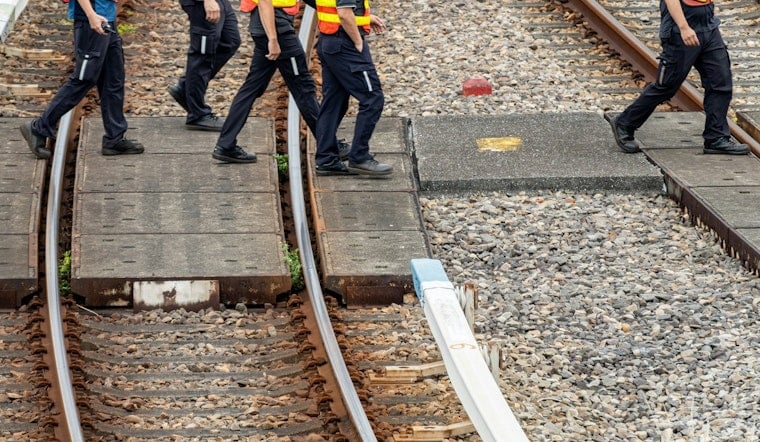
A Texas safety policy meant to protect workers around rail lines is creating a new hurdle for contractors: passing a required exam in English only. For companies that rely heavily on Spanish-speaking workers, the rule could shrink the pool of people eligible for jobs near tracks even when those workers have years of construction experience.
Texas rail transit agencies must provide roadway worker protection training to employees and contractors working around rail lines, but a June 2026 Texas Department of Transportation memo requires the related tests to be administered exclusively in English, according to KXAN Austin. The policy allows workers to use study and reference materials in their native languages, but the multiple-choice credentialing exam itself is no longer offered in Spanish.
The change is hitting Houston-based Gold Lion Services, which had secured a contract to repaint canopies at rail stations. Company manager Sergio de la Llata told KXAN that he sent five workers through the required course, but four were turned away because they could not meet the English-language testing requirement.
The rule is about more than paperwork
Roadway worker protection rules are designed to prevent employees from being struck by trains or on-track equipment while performing maintenance, construction or inspection work. The Federal Railroad Administration says railroads and contractors must provide on-track safety training and ensure workers understand the procedures governing the assignments they perform, as outlined by the Federal Railroad Administration.
That safety rationale is not in dispute. The concern from contractors is whether an English-only written exam actually proves a worker can communicate safely on a job site, particularly when workers may understand spoken instructions but be less comfortable reading or speaking technical English.
De la Llata said many construction workers primarily speak Spanish but understand English, and some may be able to read English without feeling comfortable speaking it. He also argued that the new policy “does not ensure greater worker protection,” according to KXAN’s report.
Houston training schedules show the language distinction
There is an important distinction between the language of the course and the language of the exam. Houston METRO’s public trackway schedule has listed both English- and Spanish-language roadway worker protection training sessions, including Spanish sessions in June and July, according to the agency’s published training schedule.
In practical terms, a worker may still receive instruction in Spanish but be required to demonstrate qualification on an English-only test. That arrangement could preserve access to safety instruction while still leaving contractors with fewer workers who can complete the final credentialing step.
OSHA guidance emphasizes understandable training
The federal Occupational Safety and Health Administration has long said employers must provide safety instruction in a way workers can understand. In a formal interpretation, OSHA explained that construction rules do not specifically require safety communication to be based in English, as long as workers receive information they are capable of understanding.
That guidance does not automatically invalidate TxDOT’s testing policy, which governs a specific credentialing process for rail-line work. But it helps explain why contractors see a difference between requiring clear communication on a work site and requiring every worker to pass a written exam in one language.
Contractors warn of a thinner workforce
For companies like Gold Lion Services, the immediate issue is staffing. If workers who previously completed Spanish-language testing can no longer qualify, contractors may have to recruit from a smaller pool, spend more time preparing employees for English exams or turn down rail-related work altogether.
TxDOT has said the English-only requirement was adopted because of safety concerns involving communication during track maintenance and work-zone setup. The policy now puts that claim to a real-world test: whether a stricter exam language standard produces safer crews, or simply leaves contractors scrambling to find enough qualified workers.





