

























































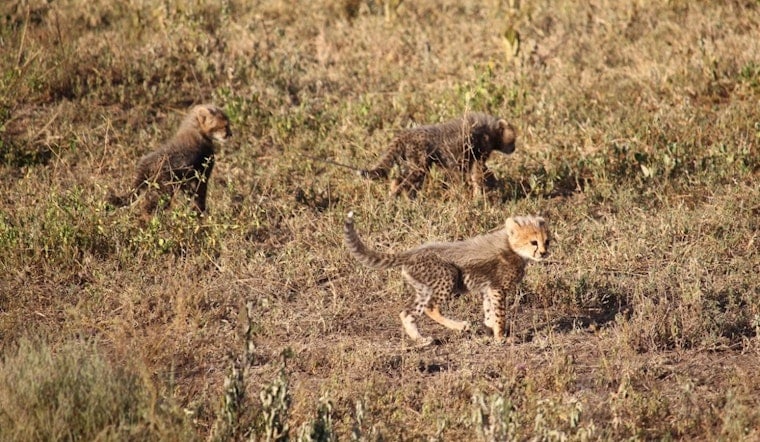
Three cheetah cubs are healthy and developing well at The Wilds in Cumberland, Ohio, after being born to parents Kuki and Glenn in June, according to a Columbus Zoo release. The litter, made up of two males and one female, marks the 12th cheetah litter born at the sprawling Muskingum County conservation park, and the cubs have already received their initial vaccinations and begun exploring outside their birth den.
The births were first reported by NBC4 WCMH-TV, which noted the cubs have reached important developmental milestones under the care of Kuki, a 4-year-old female who arrived at The Wilds from the Smithsonian Conservation Biology Institute in August 2024. The cubs' father, Glenn, is 9 years old and came to the park from Missouri's Dickerson Park Zoo in May 2023. Dr. Joe Greathouse, vice president of The Wilds, said the animal care team provided outstanding care and dedication, and noted that Kuki successfully raised her first litter, with the cubs reaching important early milestones.
A Reclaimed Coal Landscape Turned Conservation Hub
The Wilds itself has an unusual origin story. The park sits on nearly 10,000 acres in Muskingum County that were donated in 1984 by Central Ohio Coal Company, a subsidiary of American Electric Power, after the land had been heavily surface-mined for coal from the 1940s through the 1980s — ground once worked by the massive dragline excavator known as Big Muskie, according to the Columbus Zoo and Aquarium. The conservation park formally incorporated that same year and opened to the public for safari tours in 1994, two years after releasing its first endangered species, Przewalski's wild horses, into its open pastures.
Of the park's roughly 10,000 total acres, about 3,000 are dedicated to animal pastures and guest tours, while the remaining 7,000 acres function as an ecological restoration laboratory working to revive native Ohio forests and root out invasive species like Amur honeysuckle on former strip-mined ground, the zoo notes. The Wilds is managed by the Columbus Zoo and Aquarium and operates a collaborative cheetah breeding program that has been running since the late 2000s, with the first successful litter born there in 2010, according to Independent Travel Cats.
Part of a Nationwide Coalition Fighting a Breeding Crisis
The Wilds participates in the Association of Zoos and Aquariums' Cheetah Breeding Center Coalition, a network of 10 dedicated breeding facilities formed in 2013 by Conservation Centers for Species Survival and the AZA. The coalition builds large off-exhibit facilities that give cheetahs mate choice among multiple partners, an approach that has helped grow North America's managed cheetah population by 20 percent, according to Fossil Rim Wildlife Center. The coalition prioritizes cheetah breeding to support a healthy, sustainable population, a mission underscored by the difficulty of breeding the species in human care.
Cheetahs face mounting pressure in the wild from habitat loss, declining prey populations, and coexistence challenges with people. Fewer than 7,100 adult and adolescent cheetahs remain in the wild, per the International Union for Conservation of Nature. While the IUCN classifies the species as Vulnerable globally, cheetahs are listed as Endangered under the U.S. Endangered Species Act and receive CITES Appendix I protection against commercial international trade, according to Born Free USA. Wild cheetahs now occupy only about 9 percent of their historic African and Asian range, and the illegal live pet trade carries an estimated 70 percent mortality rate during transit.
Reproductive Science Roots and a Cautious Path to Public Viewing
The Columbus Zoo network has been at the forefront of felid reproductive science for years. In February 2020, scientists at the Columbus Zoo and Aquarium and the Smithsonian Conservation Biology Institute achieved a global first when a surrogate cheetah delivered two cubs conceived through in vitro fertilization and embryo transfer, a technique that allows genetic material from non-breeding cheetahs to be preserved, according to CBS News.
Visitors hoping to catch a glimpse of the new cubs will have to wait on Kuki's terms. Behind-the-scenes specialty tours that offer access to the Carnivore Center where the cheetahs reside depend entirely on Kuki's comfort level, and the cubs may only be available to view during select tours once the animal care team determines the timing is right. The Wilds also runs 4WD Wildside Tours guided by animal management staff, giving visitors off-road pasture access, though that behind-the-scenes carnivore access has always hinged on mother-cub comfort, per Ohio Cooperative Living.





