

























































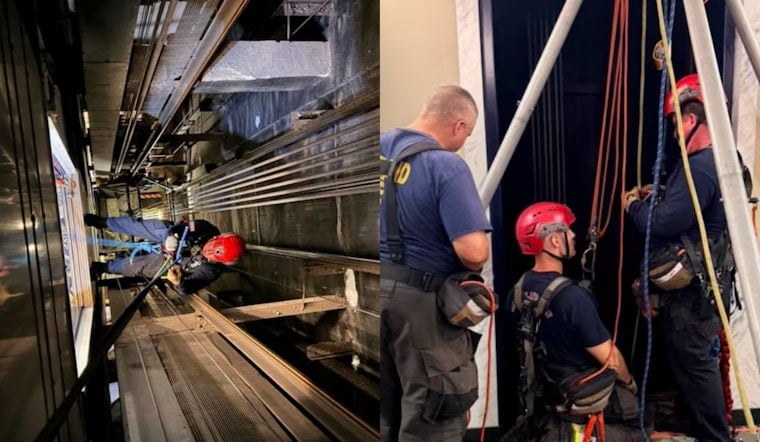
A person trapped inside an elevator car stuck in a blind section of the shaft at Terminal Tower was freed Thursday after Cleveland firefighters rigged ropes and hoisted the rider roughly five stories to safety. The trapped person walked away with no injuries.
Cleveland fire crews responded to the call at the historic downtown high-rise, according to Cleveland 19 News, which reported that the elevator car had stalled somewhere along a portion of the shaft without landing doors. That kind of stretch is known in fire service terminology as a blind shaft or blind hoistway — a continuous run of three or more floors with no doors, which makes a standard door-opening rescue impossible and forces crews to rely on rope-based pickoff procedures instead, according to Fire Engineering. Cleveland Fire has noted that elevator emergencies present unique challenges depending on the building and where exactly the car ends up stopping, per the report.
Rope Team Pulls Off a Five-Story Pickoff
Because conventional access was not an option, crews turned to Technical Rescue 1, the department's specialized rope-rescue unit, which conducted the pickoff. Tower 1 crew members assisted the specialized squad on scene. A Cleveland fire rescuer secured the trapped person within the rescue system before the pair were raised approximately five stories through the elevator shaft, according to the outlet's account of the operation.
Technical Rescue 1 operates out of Fire Station 17 in the League Park neighborhood and serves as the Cleveland Division of Fire's primary unit for high-angle rope rescue, confined-space extrication, trench rescues, and structural collapse response, according to background compiled on Wikipedia. The department runs 26 stations citywide, but its most technical rescue resources are centralized at that single station. It is not the squad's first high-profile rope job downtown — in July 2025, the same technical rescue team safely pulled a window washer to safety after he became stranded between the 11th and 12th floors of nearby Key Tower following an equipment failure, as previously reported by WKYC. Cleveland's technical rescue crews have handled other rope and water operations around the city recently, including pulling a teen from a flooded creek earlier this month.
Before firefighters entered the open shaft, standard fire service protocol called for lockout/tagout procedures on the electrical power systems for both the stalled car and adjacent hoistways, eliminating the risk of unexpected movement while rescuers worked on the cab or suspended lines, per Fire Engineering's explanation of the process. Cleveland firefighters routinely rely on this kind of specialized rope-rescue equipment and training whenever conventional elevator access is not possible.
A Landmark With a Growing Residential Population
Terminal Tower has loomed over Public Square since it was dedicated in 1930, rising 708 feet across 52 stories to become the world's second-tallest building at the time of its completion and the tallest in Ohio until Key Tower overtook it in 1991. What was once purely a commercial office landmark developed by the Van Sweringen brothers above the city's passenger rail terminal now doubles as housing. In March 2020, developer K&D Group completed a $40 million adaptive-reuse conversion that transformed floors four through 15 into 297 luxury apartments known as the Terminal Tower Residences, according to details from Cleveland Construction.
That kind of conversion has become a hallmark of downtown Cleveland's growth. The area's residential population climbed 12% between 2019 and 2026 to reach roughly 21,000 residents, a surge driven largely by historic office-to-apartment projects like the one at Terminal Tower, per data from Downtown Cleveland Inc. It is a reminder that emergencies inside these century-old towers now affect not just office workers and tourists, but hundreds of people who call the buildings home.
Who Inspects the Elevators?
Elevator safety statewide typically falls under the Ohio Department of Commerce Division of Industrial Compliance, but Cleveland holds a statutory municipal exemption that lets it run its own local elevator inspection authority under Ohio Administrative Code Rule 4101:5-1-03. That means certificates of operation and routine safety inspections for buildings like Terminal Tower fall to the city rather than state inspectors. Separately, Cleveland Codified Ordinance 3143.02 requires owners of buildings taller than five stories and 75 feet to submit a comprehensive exterior wall and structural inspection report every five years once the structure turns 30 years old, a rule that applies to aging downtown towers across the skyline.
It remains unclear what specifically caused Thursday's car to stall inside the blind section of the shaft, and when Terminal Tower's municipal elevator inspection certificate was last renewed. Emergency responses at the tower are nothing new — in August 1976, an armed veteran held nine hostages on the building's 36th floor for nine hours before surrendering to police, an episode that ended without physical injury, according to the Case Western Reserve University Cleveland Memory Project. Thursday's rescue ended just as safely, with the trapped rider walking away unharmed after the rope team's five-story hoist through the shaft.





