

























































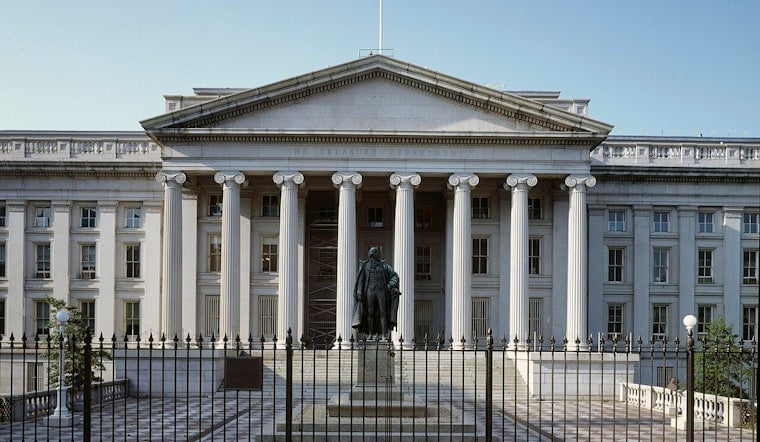
The U.S. Department of the Treasury announced Wednesday it will double the size of its liquidity support buyback operations for longer-dated government debt, moving to calm a bond market that had just pushed 30-year yields to their highest level in 19 years. The change increases each buyback operation from $2 billion to at least $4 billion, covering securities in the 10-to-20-year and 20-to-30-year sectors, with the expanded operations set to run from September 9 through November 4, 2026.
The announcement came a day after the 30-year Treasury yield touched 5.34% on August 18, its highest mark since June 2007, according to Investing.com. That surge capped a rough stretch for U.S. government debt: a $25 billion auction of 30-year bonds on August 13 cleared at 5.216%, the highest auction yield for that maturity since 2001, as reported by The Spokesman-Review. A 10-year note auction earlier the same week had drawn the highest financing cost for that maturity since 2007.
Reuters, which compiled market reaction to the move, reported that 30-year U.S. bond yields fell almost 10 basis points to around 5.187% following the news, trading roughly 7 basis points lower on the day, according to Reuters. Jeremy Stretch, head of G10 FX strategy at CIBC, told the outlet the Treasury secretary had to be mindful of market risks and had made adjustments. The measure, Stretch said, showed the Treasury recognized bond-market conditions and was prepared to adjust policy to limit market pressures.
Analysts See a Signal, Not Just a Number
Rene Albrecht, senior analyst at DZ Bank, linked the recent rise in yields to the Treasury's buyback action, telling Reuters the primary aim of the operation was to lower long-end yields. Albrecht said the Treasury had used its policy toolkit to address the recent rise in yields, and that market participants feared the pain of long-end yields at 5% or higher because it raises both government and private-sector interest costs. He also noted there were three months until the midterm elections, per the same Reuters account.
Stretch, for his part, identified concerns about inflation, the G4 debt profile and the impact of artificial intelligence as factors weighing on the bond market, adding that the long end of the market had been selling off and could become problematic for other asset classes. He also said the dollar had cheapened as the yield story unfolded. Former Pimco CEO Mohamed El-Erian, in remarks reported by MarketWatch, noted that although the buyback amounts remain small relative to total federal debt, markets rallied because investors expect Treasury Secretary Scott Bessent to actively use policy tools to suppress rising yields.
What Buybacks Actually Do
The mechanics matter here: the Treasury's official statement specified that the buyback expansion will not alter overall net debt issuance or regular auction sizes. Instead, the operations are funded through cash management or short-term bill issuance, meaning the total volume of national debt remains unchanged even as the government works to relieve pressure at the long end of the yield curve by purchasing older, illiquid off-the-run securities, according to RSM US.
This is not a new tool. The Treasury reintroduced its regular buyback program in May 2024, the first non-test buyback initiative since 2000-2002, with the explicit goals of bolstering secondary market liquidity and improving cash management, per research published through Carleton Digital Commons. Between that May 2024 relaunch and September 2025, the Treasury repurchased more than $113 billion in securities for cash management and over $115 billion for liquidity support, dwarfing the mere 17 total buyback operations conducted across the entire 22-year span from 2002 to 2023.
Academic research examining the original 2000-2002 buyback program found that reducing the secondary market supply of bonds contributed roughly 90 basis points to price returns on repurchased bonds and near substitutes, accounting for nearly one-fifth of overall bond price changes during that period, the Carleton research shows. That historical evidence underpins the market's bet that even modest buyback volumes can meaningfully cap yield spikes.
Markets React, Mortgage Rates in the Balance
The market response was immediate. The iShares 20+ Year Treasury Bond ETF, known as TLT, rose 1.3% in pre-market trading after having fallen to its lowest level since June 2004, while U.S. equity futures advanced as long-term borrowing costs dropped, according to Benzinga.
The stakes extend well beyond Wall Street trading desks. High Treasury benchmark yields pass through directly to household borrowing costs, and the average U.S. 30-year fixed mortgage rate hit a 2026 high of 6.69% in early August as benchmark long bond yields climbed, as Hoodline previously reported. Whether Wednesday's intervention translates into meaningfully lower mortgage costs for homebuyers remains to be seen.
The Bigger Fiscal Picture
The yield surge did not emerge in a vacuum. An International Monetary Fund staff report published in February projected U.S. general government deficits to stay between 7% and 8% of GDP, with public debt reaching 140% of GDP by 2031 — structural pressures that have repeatedly drawn warnings from global monetary officials, as Hoodline detailed in its coverage of the IMF's spending warning. JPMorgan Chase CEO Jamie Dimon had separately warned in the spring about surging U.S. debt nearing $39 trillion and heavy Treasury refunding schedules creating bond market risks, a warning Hoodline covered at the time.
Key questions remain open for the months ahead. It is unclear whether short-term money markets can smoothly absorb the additional bill supply needed to fund these expanded buybacks, and whether this targeted yield suppression can hold if long-term fiscal deficits remain stuck at 7% to 8% of GDP. The Reuters dispatch on the announcement was compiled in London by Samuel Indyk and Dhara Ranasinghe and edited by Elisa Martinuzzi.





